Cal Poly Pomona Senior Project: ADUs in the City of La Habra

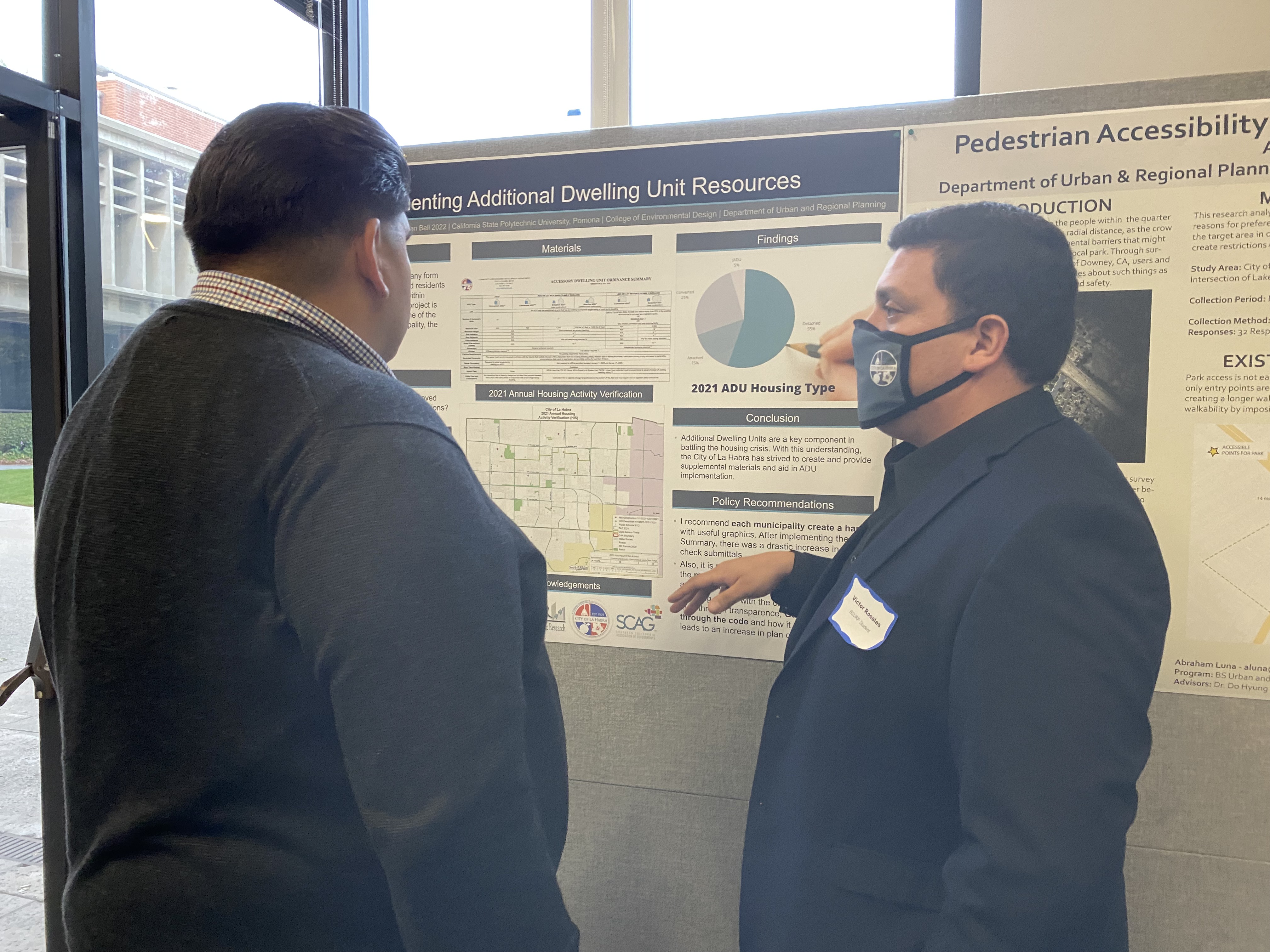
Senior Project poster by Victor Rosales. Image credit: Victor

I’m celebrating the graduates in my Senior Projects class at Cal Poly Pomona Department of Urban & Regional Planning! Today we big up this researcher:

Will ADU Resources Expedite Implementation?

By: Victor Rosales

Abstract: In the City of La Habra, California, there was not enough Accessory Dwelling Units (ADUs) being built to address the housing crisis. One of the main obstacles was a lack of ADU resources and materials available to the public. While the city’s municipal code is accessible for public review, a large portion of the community does not understand how to interpret zoning codes or how codes apply to individual projects.

With this understanding of the problem, I worked with city staff on creating supplemental ADU materials, with the intended goal of increasing the amount of ADUs built within city limits. In 2021, the city’s Senior Building Official created an ADU Summary handout with basic outlines of development standards and simple graphic aides. This newly introduced resource, along with the assistance and communication from staff to the community, resulted in an upsurge in ADU plan check submittals and new construction. City staff tracked the progression of these newly built ADUs though paid plan checks, Certificate of Occupancy, surveys, and California Department of Housing credit logs. The data showed an increased number of ADUs constructed in the last 6 months of 2021, which correlated with the timing of the implementation of the ADU Summary. By providing supplemental materials for ADUs, the City of La Habra was able to increase the amount of ADUs built in their community in 2021. Additionally, staff revised and enhanced these readily available resources to support ADU development. As a result, the amount of plan check submissions has nearly tripled in the first six months of 2022.

Upon studying the City of La Habra’s approach to ADUs, I offer several policy recommendations for resources and information that support expediting ADU implementation in cities.

Victor Rosales at CPP Senior Projects Poster Session 2022. Photo: Jonathan Pacheco Bell

Cal Poly Pomona Senior Project: Wildfire Mitigation and Resilience in SoCal

Senior Project poster by Stacy Lee and Eric Ji. Image credit: Stacy and Eric

I’m celebrating the graduates in my Senior Projects class at Cal Poly Pomona Department of Urban & Regional Planning! Today we big up this team:

Wildfire Mitigation & Resilience Strategies: Best Planning Practices across Local Jurisdictions in Southern California

By: Stacy Lee & Eric Ji

Abstract: Increasing forecasts of prolonged and more severe fire seasons can be attributed to several factors: urban density growth; fire suppression and fuel buildup; and climate change. Many of these issues are amplified in Southern California, especially in the wildland-urban interface (WUI). Land-use policies must begin to proactively strategize around the immutable outbreaks of future wildfires as expanding boundaries of development and very high fire severity zones cross onto each other.

This qualitative research empirically analyzes the survey response consisting of a list of 19 planning strategies for wildfire mitigation on a Likert scale on compatibility, feasibility, and necessity of each local jurisdiction across four counties. The Counties of Los Angeles, Orange, Riverside, and San Bernardino with areas of very high fire severity zones identified by CAL FIRE were contacted with the survey request. The 18 responding jurisdiction responses scored each strategy to display the compatibility, feasibility, and necessity on a scale from 0 to 4, and cross analyzed by any implemented strategies in the corresponding jurisdictions or alternative policies in lieu of the strategies presented in the survey.

These findings are used to develop a scale of adoptable strategies based on the context of each jurisdiction as well as possible alternatives and narratives to adopting feasible strategies.

Stacy and Eric at CPP Senior Projects Poster Session 2022. Photo: Jonathan Pacheco Bell

Cal Poly Pomona Senior Project: Youth Homelessness in East Riverside County

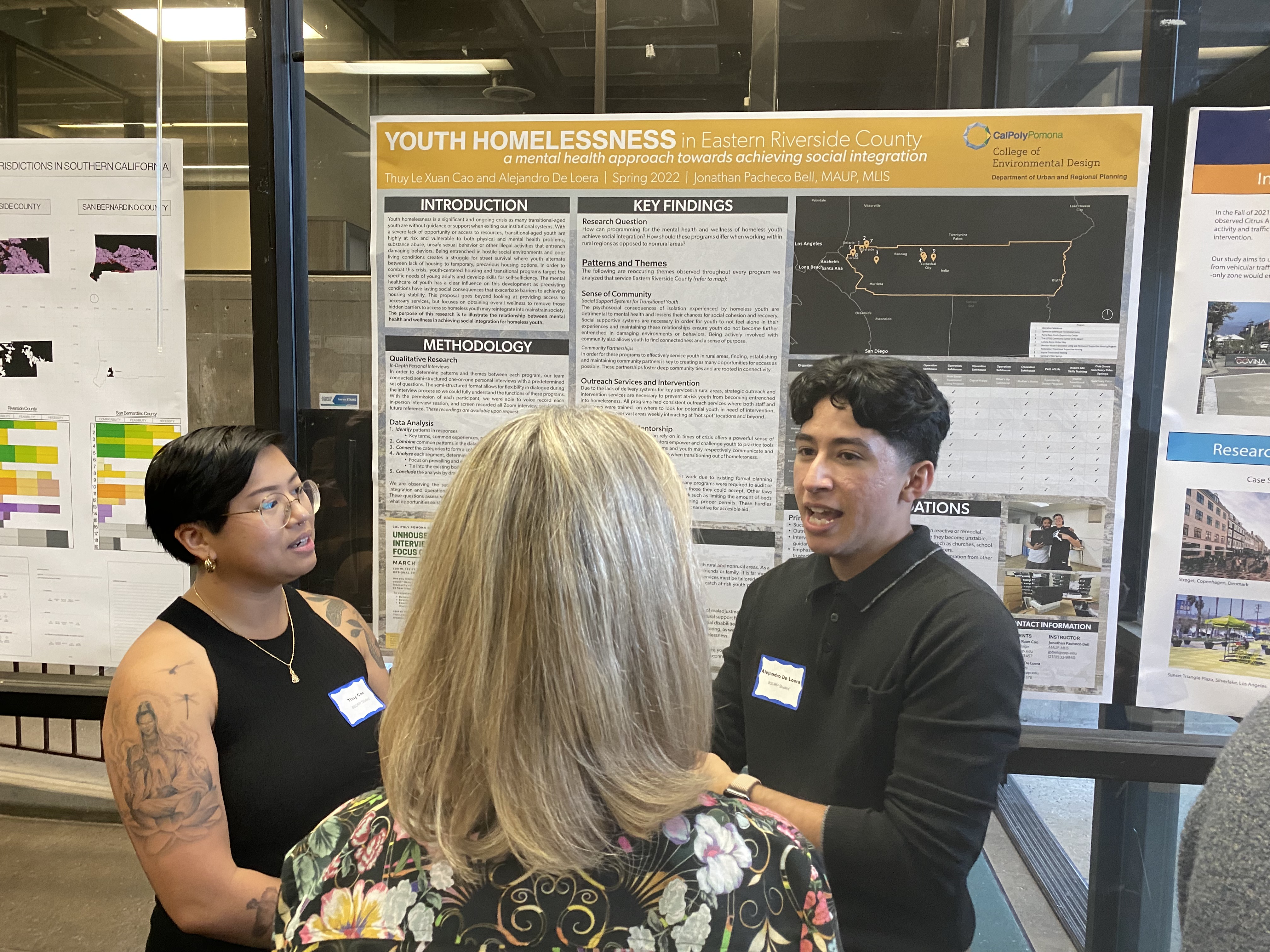
Senior Project poster by Thuy Le Xuan Cao and Alejandro De Loera. Image credit: Thuy and Alejandro

I’m celebrating the graduates in my Senior Projects class at Cal Poly Pomona Department of Urban & Regional Planning! Today we big up this team:

Youth Homelessness in Eastern Riverside County: A Mental Health Approach Towards Achieving Social Integration

By: Thuy Le Xuan Cao & Alejandro De Loera

Abstract: Youth homelessness is an ongoing crisis. Transitional-aged youth need support when exiting institutional systems. Without access to stable living environments, youth are exposed to trauma. Without coping strategies for stress, they’re vulnerable to chronic or cyclical homelessness. Hostile environments and poor living conditions create struggles for street survival. To combat this crisis, youth-centered housing and transitional programs target their unique needs. Youth mental healthcare influences this development as preexisting conditions including housing insecurity, mental health issues, substance use and family dysfunction have psychosocial consequences exacerbating barriers to housing stability. This project examines access to services for wellness and removal of hidden access barriers so unhoused youth can integrate into society.

Youth homelessness is prevalent in rural and nonrural areas and correlates to mental health issues magnified by rural conditions. Supportive services must be tailored to rural homeless youth needs. Beyond skill building, homeless youth require tailored interventions including non-housing case management, mentorship, counseling and mental health treatment. The creation of safe communal spaces promotes social cohesion where youth may interact and gain social capital from peer mentorship. Notably, planning itself creates a barrier to collective action due to formalities required for programs to exist legally.

We’ve created recommendations for 3 stages of intervention: Primary interventions include successful outreach focusing on preventative services for at-risk youth. Secondary programming offers local and short-term supportive programs with flexible hours for youth in crisis. Tertiary support prioritizes community partnerships to offer continuous, long-term services where homelessness occurs.
*Abbreviated from original

Thuy and Alejandro at CPP Senior Projects Poster Session 2022. Photo: Jonathan Pacheco Bell

Embedded Planning on a Graduation Cap

“We Cannot Plan From Our Desks” — Jonathan Pacheco Bell, on Kenny Uong’s graduation cap. Photo credit: Kenny Uong

Kenny Uong, the future CEO of Los Angeles Metro, quoted me on his graduation cap at CSUN 🎓😭✊🏽 WE CANNOT PLAN FROM OUR DESKS 📢

Congratulations, Kenny 👏🏽

#EmbeddedPlanning

Reflections of the LA Uprising 30 Years Later

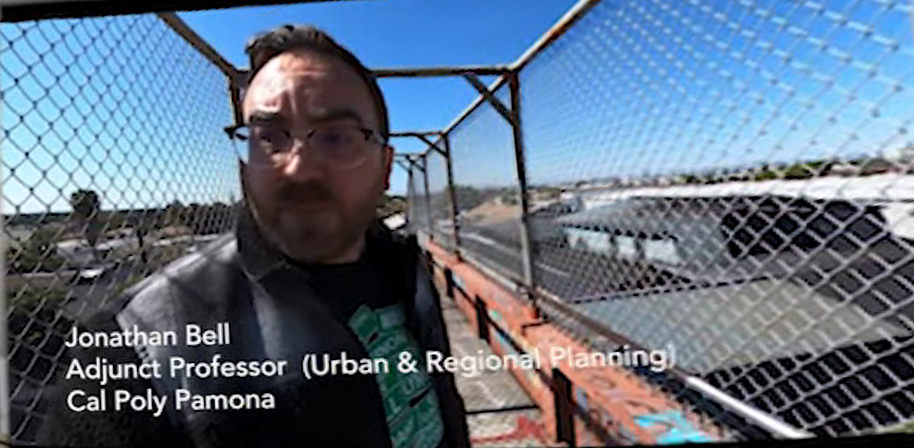
Still image from “Reflections of the LA Uprising” 30 Years Later

The 1992 Los Angeles Uprising began thirty years ago today — April 29, 1992.

I was interviewed for “Reflections of the LA Uprising” 30 years later. This is a collaboration by JOVRNALISM, USC Annenberg, KCET, and LA Times.

I shared how the unrest led me on a path toward urban planning in/for South Central LA. And I testified this path would inspire me to create Embedded Planning as an LA County planner on the ground in Florence-Firestone.

Rightfully, this interview was done at the landmark Roosevelt Park pedestrian bridge over the Blue Line.

Many community voices are part of this project. Check out the immersive video “Echoes of the Uprising” where we share our memories and oral histories.

Three decades later, we still have work to do.

Echoes of the Uprising

Building Embedded Planning Praxis at Cal Poly Pomona

Infographic by APSA Cal Poly Pomona

I’m doing the talk, “Building Embedded Planning Praxis” on Thursday, April 21, 2022 at 7pm Pacific at Cal Poly Pomona Department of Urban & Regional Planning. This event is organized by the American Planning Student Association (APSA) at CPP. Our hybrid seminar is in person AND on Zoom. Come through.

We Cannot Plan From Our Desks.

Embedded Planning at Whittier College Sustainability Club

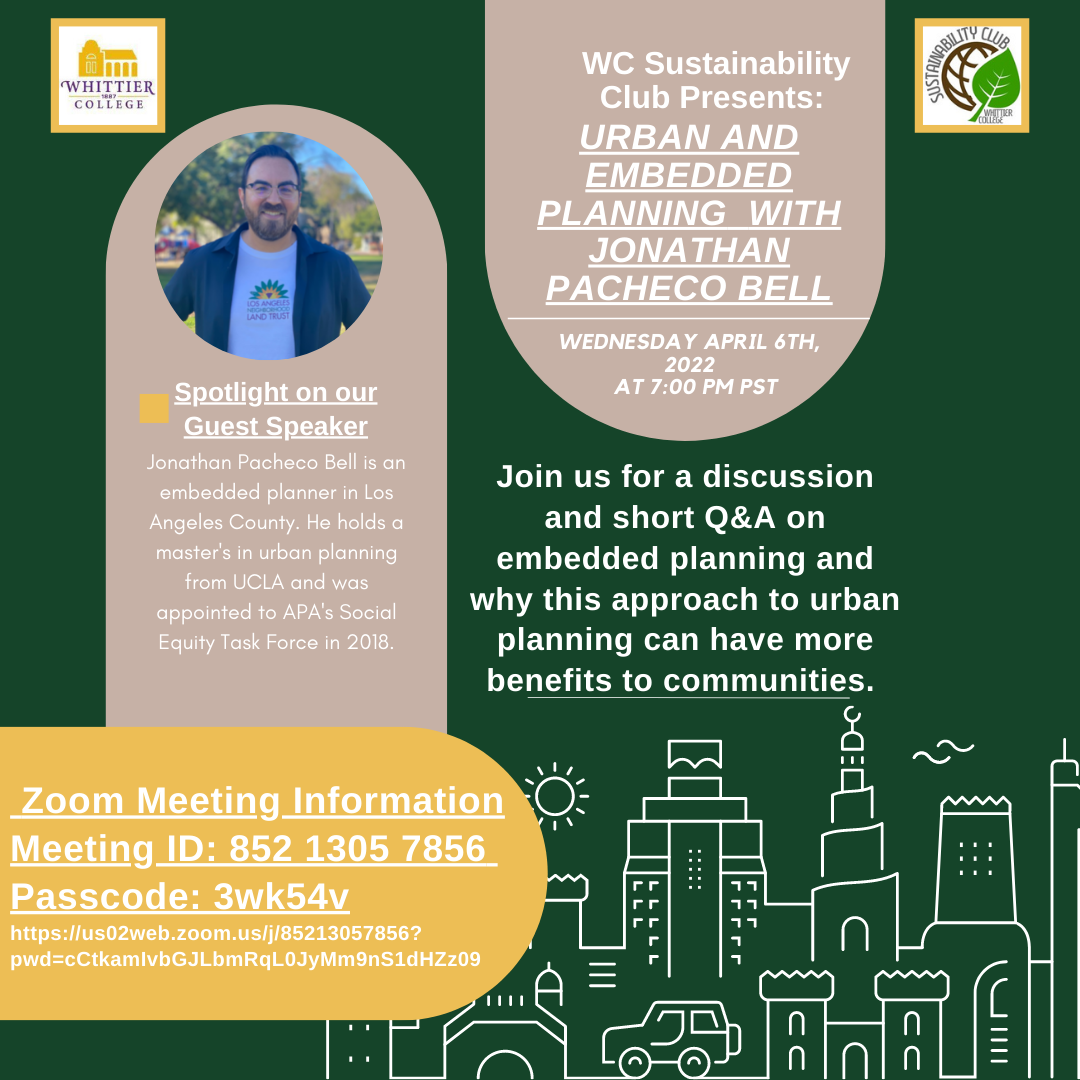
Infographic by the WC Sustainability Club

Shout out to the Whittier College Sustainability Club for hosting my talk tonight on Embedded Planning. Special thank you! to Ashley Dueñas for her leadership bringing this talk to students. Street-level praxis resonated. It is the future of planning. We cannot plan from our desks.

Mike The PoeT Sonksen at Cal Poly Pomona Urban & Regional Planning

Guest speaker Mike the PoeT Sonksen at Cal Poly Pomona Urban & Regional Planning. Photo by Jonathan Pacheco Bell

On March 5, 2022, Mike the PoeT Sonksen was the guest speaker in my Advocacy Planning course at Cal Poly Pomona. He taught us about geographic literacy and the power of place. Mike opened with poems, transitioned into a vivid slide deck lecture, then led our class through two writing exercises connecting personal memory and action to planning praxis. He stayed to co-facilitate our week’s discussion of Latin@ Urbanism.

Mike bleeds LA. If you’re looking for your next guest speaker, tour guide, essayist or poet, Mike is the one.

Embedded Planning in Job Interviews

Infographic by Jonathan Pacheco Bell

The latest instance of our Embedded Planning movement coming up favorably in a job interview.

We are everywhere.

We cannot plan from our desks.

Background image: The book I recommend to every critical planner and embedded planner — especially the Fortress LA chapter — is City of Quartz: Excavating the Future in Los Angeles, by Mike Davis.

Photo by Jonathan Pacheco Bell

Embedded Planning at Whittier College

My guest speaker role at the 2021 Environmental Justice Enforcement Symposium connected me with Dr. Rebecca Overmeyer-Velazquez at Whittier College.

Earlier this month, I joined the professor’s class sharing #EmbeddedPlanning with students in the “Jobs for Justice” series.

We didn’t stop there.

Next month, I’m at the campus Sustainability Club talking career pathways into city planning and Embedded Planning praxis.

We cannot plan from our desks 📢

Senior Project at Cal Poly Pomona

Infographic by Jonathan Pacheco Bell

This semester at Cal Poly Pomona Urban & Regional Planning I’m teaching URP 4620 Senior Project, Part Two. Building on research proposals developed in URP 4600A, this course is independent and student-driven. I’ll be guiding the student’s research process leading to a capstone paper, project, or design.

Interviewed in the New York Times about LA Informal Housing

I’m interviewed in the New York Times about the human dimensions of informal housing enforcement in South Central Los Angeles. I’m grateful to the family in @FlorenceFirestone who trusted me to share their story.

Conor Dougherty’s December 18, 2021 article is here: https://www.nytimes.com/2021/12/18/business/economy/california-housing.html

Embedded Planning at SUNY Buffalo

This week I joined the SUNY Buffalo classroom of Wes Grooms, Ph.D. for a lunchtime chat on #EmbeddedPlanning praxis. It was one talk in a 2-part conversation about equity, with Carlton Eley, MSURP delivering the companion talk on equitable development.

Shout out to Dr. Grooms and students for the discussion. Dialog helps this praxis grow. I appreciated Dr. Grooms’ observation that while planning theory typically develops in the academy, Embedded Planning is a product of the community.

Cal Poly Pomona Seeks Dean of College of Environmental Design

Cal Poly Pomona seeks a Dean of the College of Environmental Design

The new Dean must be an innovative, strategic, and collegial academic leader who embraces the mission of Cal Poly Pomona, is committed to student success, and will be a champion for CPPENV. Ideally, the new Dean of ENV will take office in the spring but is expected to do so no later than June 2022. Review of applications will begin December 6, 2021.

Academic Search is assisting Cal Poly Pomona in this search. Please see the profile for the position here:

To ensure full consideration, inquiries, nominations, and applications (PDF preferred) should be submitted electronically, in confidence, to: CPPENVDEAN@academicsearch.org

Nominations are encouraged. If you have a nomination for the position, please send the name, position, and institution along with an email address if you have it, to: CPPENVDEAN@academicsearch.org

Nominators and prospective candidates may also arrange a confidential conversation about this opportunity with the senior consultant leading this search, Cynthia M. Patterson, at: Cynthia.Patterson@academicsearch.org