I served as one of the film’s interviewees and was thoroughly impressed with the team’s analysis, critique, and recommendations. I wanted the world to see this documentary, so I asked if I could archive it on my YouTube page. This video is posted with the permission of the student team and faculty advisor.
Thank you, EMS team! You are future urban planners.
Documentary team: Joanna Kedir, Gelila Assefa, Lucia Wolfe, Edwin Salinas Reyes, Victor Young, Emily Wang, Marcus Kruse, Dr. Walter Scheib
This documentary is posted for educational use only.
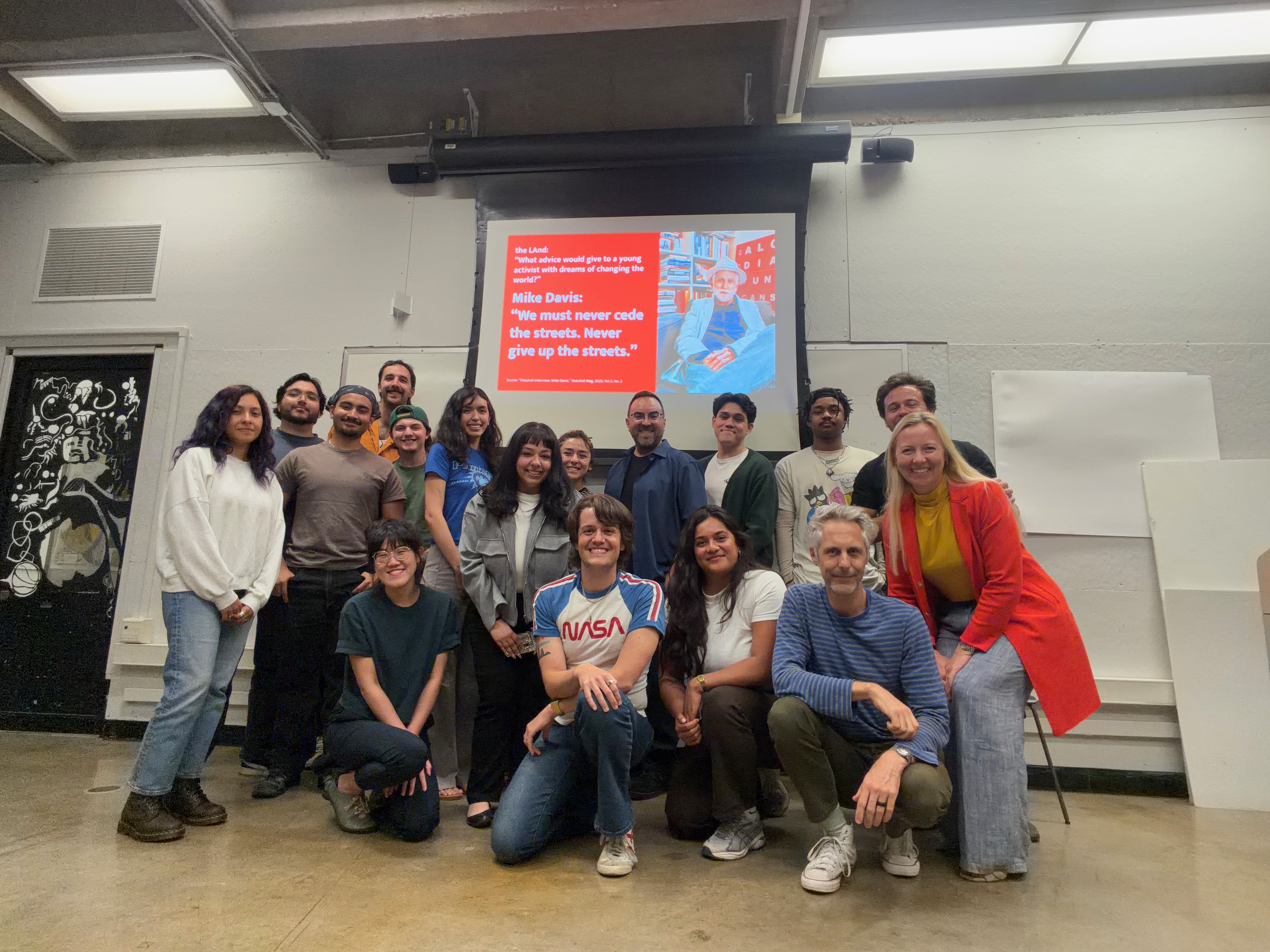
In my recent guest talk, “Critical Public Space Planning: Challenges & Possibilities,” we explored this question:
Is critical public space planning practice possible?
Drawing from my life experience — coming up as a hip hop kid & graffiti writer in the 90s, starting in architecture (buildings) in high school before finding urban planning (community spaces) in college, creating the street-level praxis of Embedded Planning in Florence-Firestone (now worldwide!), working as a street-level community planner-organizer, designing equitable parks and open spaces in LA, leading community walks for 10+ years, continuing a lifelong critique of Hostile Architecture from my graffiti days to today — I argued YES.
Shout out to Professor Catherine Guentert and CPPURP urban design students for the space and debate.
The Biltmore Los Angeles in Downtown LA, October 9-12, 2025
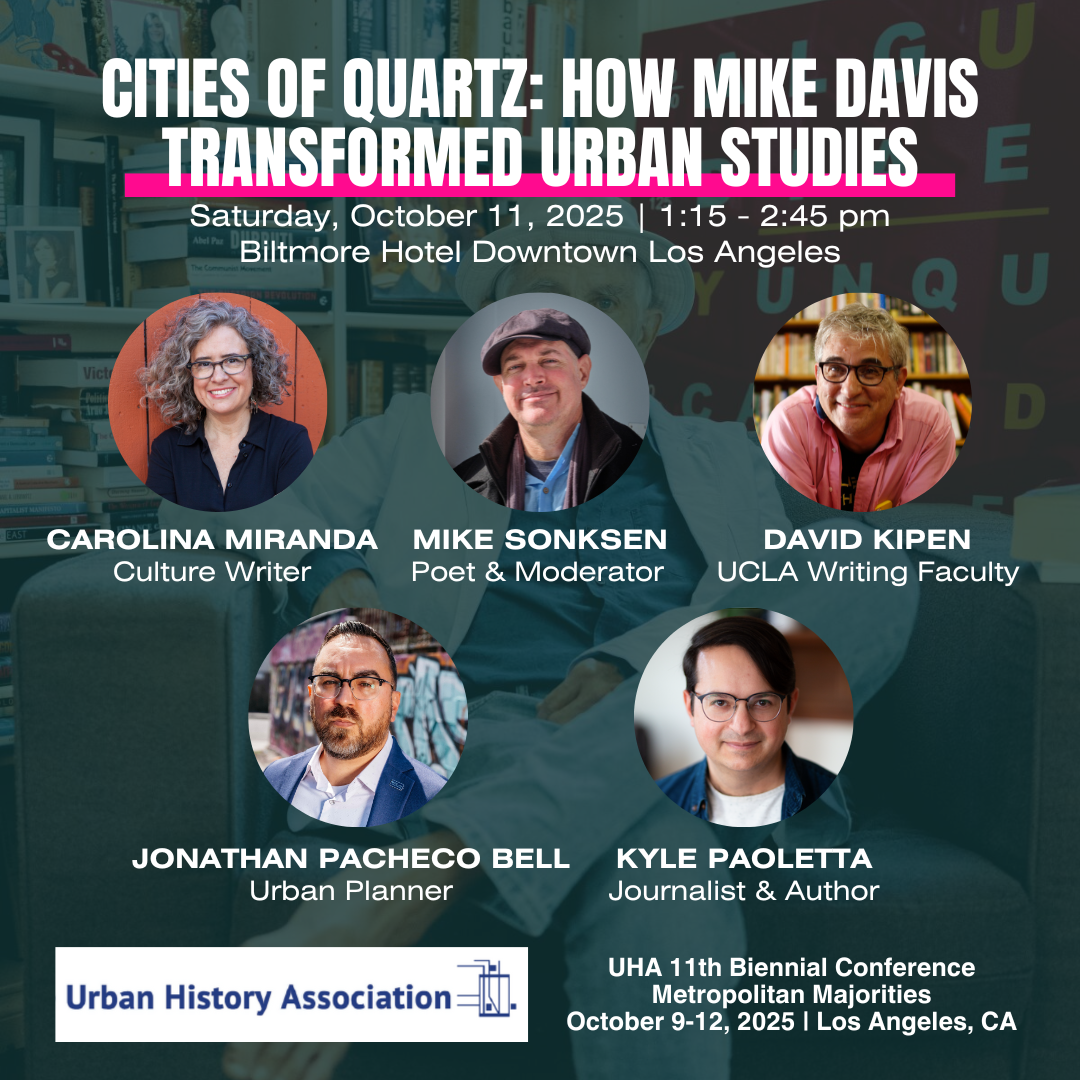
Cities of Quartz: How Mike Davis Transformed Urban Studies (Roundtable)
Saturday, October 11, 2025 | 1:15-2:45pm
Abstract:
In this roundtable discussion, a group of writers, academics, and urban planners will discuss the life and work of Mike Davis. With books like City of Quartz, Ecology of Fear, and Planet of Slums, Davis played an irreplaceable role in pushing urban scholars to foreground questions of equity, justice, and sustainability in their work. Each of Davis’ books and articles was grounded in a clear-eyed assessment of the power dynamics that create unequal societies, and throughout his life he remained a forceful advocate for the moral necessity that poor and working-class communities — whatever their ethnic or racial makeup — have the same chance at opportunity as the ruling class.
To illuminate Davis’ legacy, our discussion will begin with the impact he had on how the city of Los Angeles understands itself, before we open our inquiry into applying his method to cities everywhere and incorporating his ethos into future urban plans.
The roundtable will be moderated by Mike Sonksen, a poet and former Woodbury University professor who was mentored by Mike Davis and remained friends with him for over two decades.
The Biltmore Los Angeles in Downtown LA, October 9-12, 2025
Cities of Quartz: How Mike Davis Transformed Urban Studies (Roundtable)
Saturday, October 11, 2025 | 1:15-2:45pm
Abstract:
In this roundtable discussion, a group of writers, academics, and urban planners will discuss the life and work of Mike Davis. With books like City of Quartz, Ecology of Fear, and Planet of Slums, Davis played an irreplaceable role in pushing urban scholars to foreground questions of equity, justice, and sustainability in their work. Each of Davis’ books and articles was grounded in a clear-eyed assessment of the power dynamics that create unequal societies, and throughout his life he remained a forceful advocate for the moral necessity that poor and working-class communities — whatever their ethnic or racial makeup — have the same chance at opportunity as the ruling class.
To illuminate Davis’ legacy, our discussion will begin with the impact he had on how the city of Los Angeles understands itself, before we open our inquiry into applying his method to cities everywhere and incorporating his ethos into future urban plans.
The roundtable will be moderated by Mike Sonksen, a poet and former Woodbury University professor who was mentored by Mike Davis and remained friends with him for over two decades.
The Biltmore Los Angeles in Downtown LA, October 9-12, 2025
Cities of Quartz: How Mike Davis Transformed Urban Studies (Roundtable)
Saturday, October 11, 2025 | 1:15-2:45pm
Abstract:
In this roundtable discussion, a group of writers, academics, and urban planners will discuss the life and work of Mike Davis. With books like City of Quartz, Ecology of Fear, and Planet of Slums, Davis played an irreplaceable role in pushing urban scholars to foreground questions of equity, justice, and sustainability in their work. Each of Davis’ books and articles was grounded in a clear-eyed assessment of the power dynamics that create unequal societies, and throughout his life he remained a forceful advocate for the moral necessity that poor and working-class communities — whatever their ethnic or racial makeup — have the same chance at opportunity as the ruling class.
To illuminate Davis’ legacy, our discussion will begin with the impact he had on how the city of Los Angeles understands itself, before we open our inquiry into applying his method to cities everywhere and incorporating his ethos into future urban plans.
The roundtable will be moderated by Mike Sonksen, a poet and former Woodbury University professor who was mentored by Mike Davis and remained friends with him for over two decades.
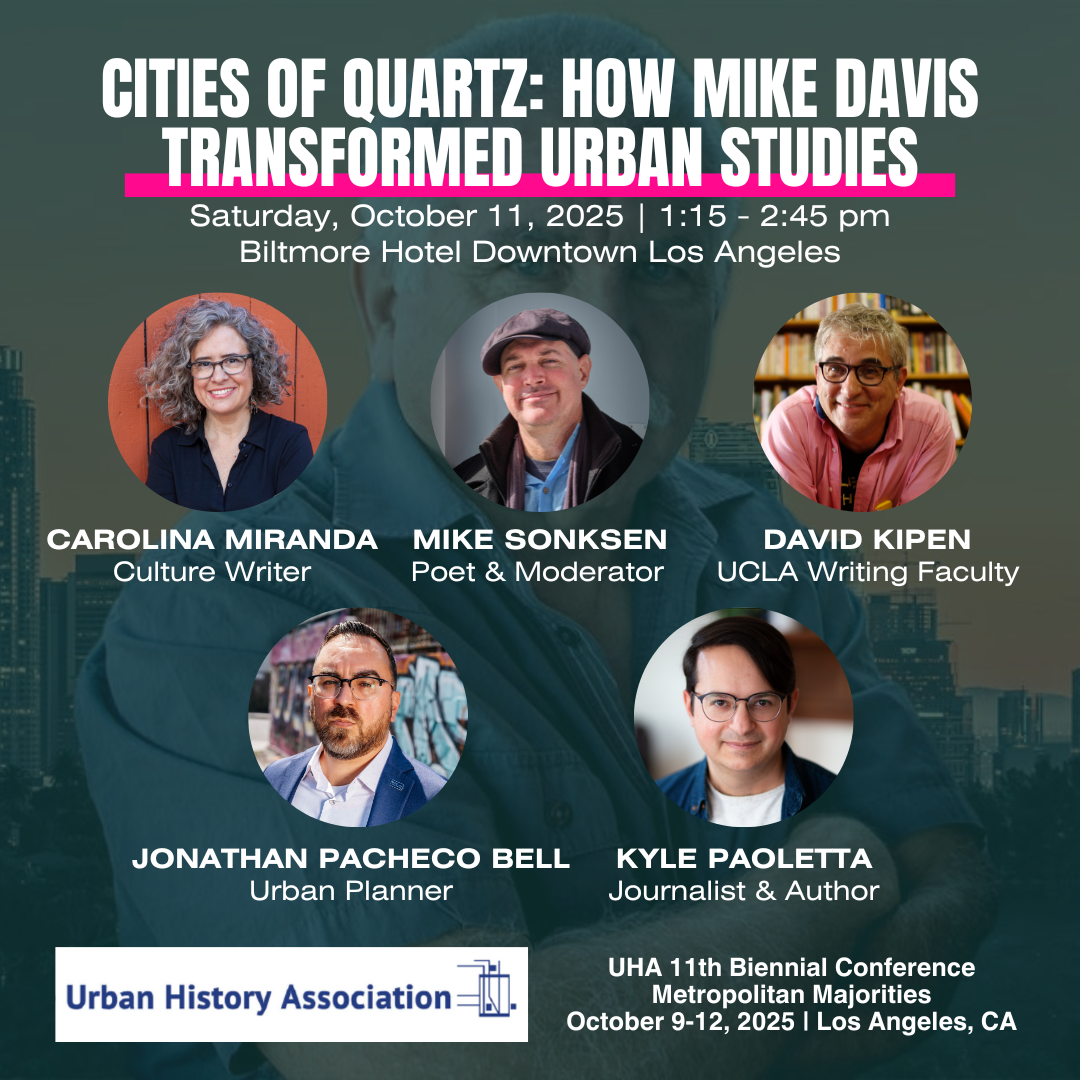
I’m on a panel recognizing the legacy of Mike Davis with writer legends Carolina A. Miranda, Kyle Paoletta, David Kipen, and Mike The PoeT Sonksen at the Urban History Association Conference 2025 in Los Angeles. More to come soon.
Join us on Saturday, October 11th, 1:15-2:45pm at the Biltmore Hotel in Downtown LA.
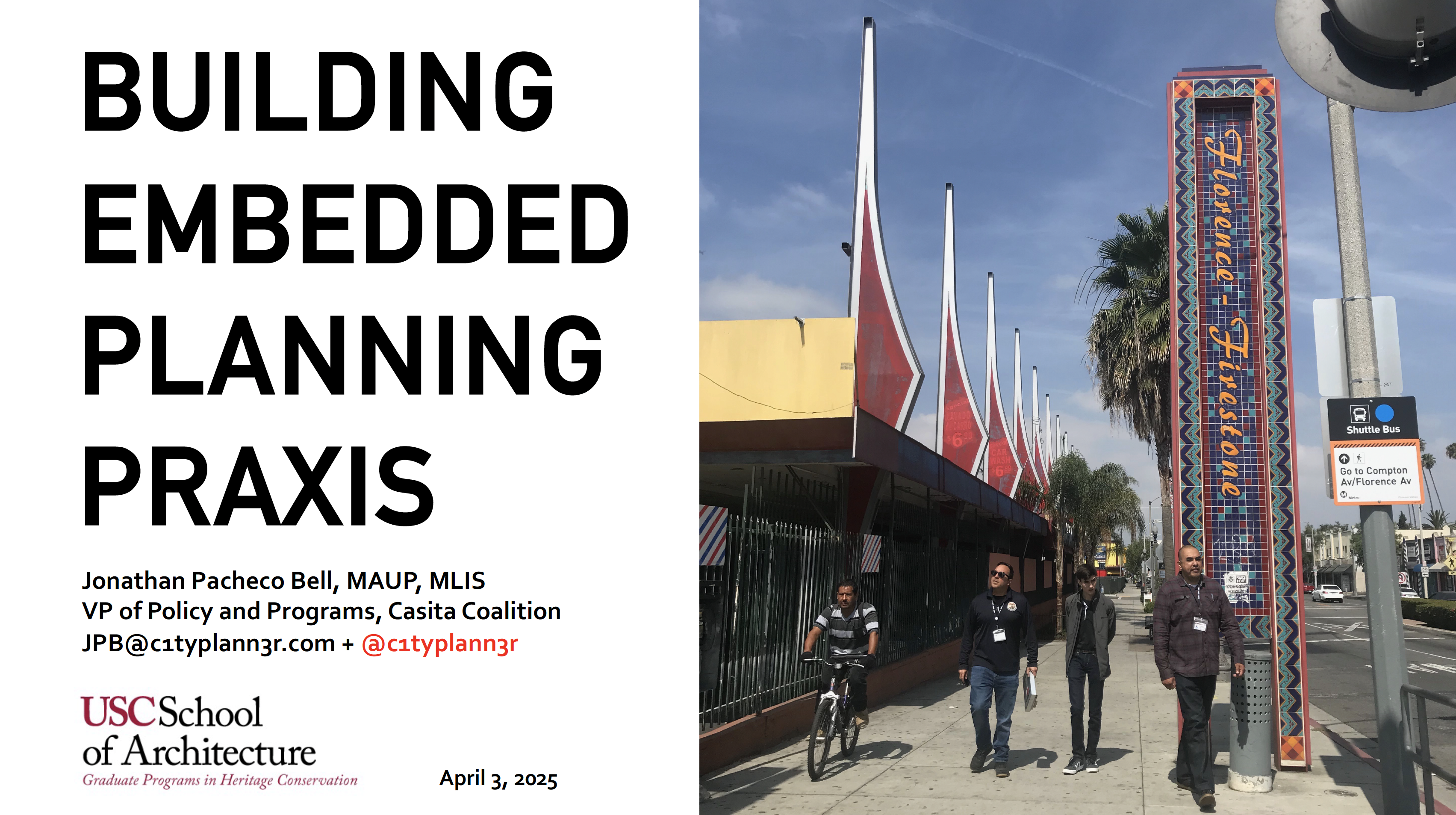
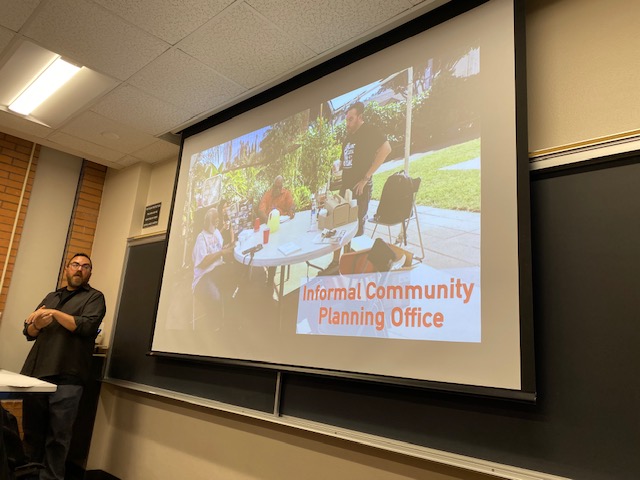
Scenes from USC Architecture from my 4/3 guest talk, “Building Embedded Planning Praxis.” The invited lecture was delivered in the USC Master of Heritage Conservation graduate course, Heritage Conservation Policy and Planning.
Who’s the cat in the photo?! In 2003 in the MAUP program at UCLA Luskin Department of Urban Planning, I took an architecture theory course where I learned Professor Gregory Ulmer’s CATTt method for writing a manifesto. I would go on to use the CATTt to write my 1-page manifesto on Embedded Planning titled, “We Cannot Plan From Our Desks,” published in the October 2018 issue of APA’s Planning Magazine.
And now we’re a worldwide movement in planning theories and practices.
Photos by Meredith Drake Reitan, Professor & Associate Dean. Thanks for the invite to speak with your MHC students!
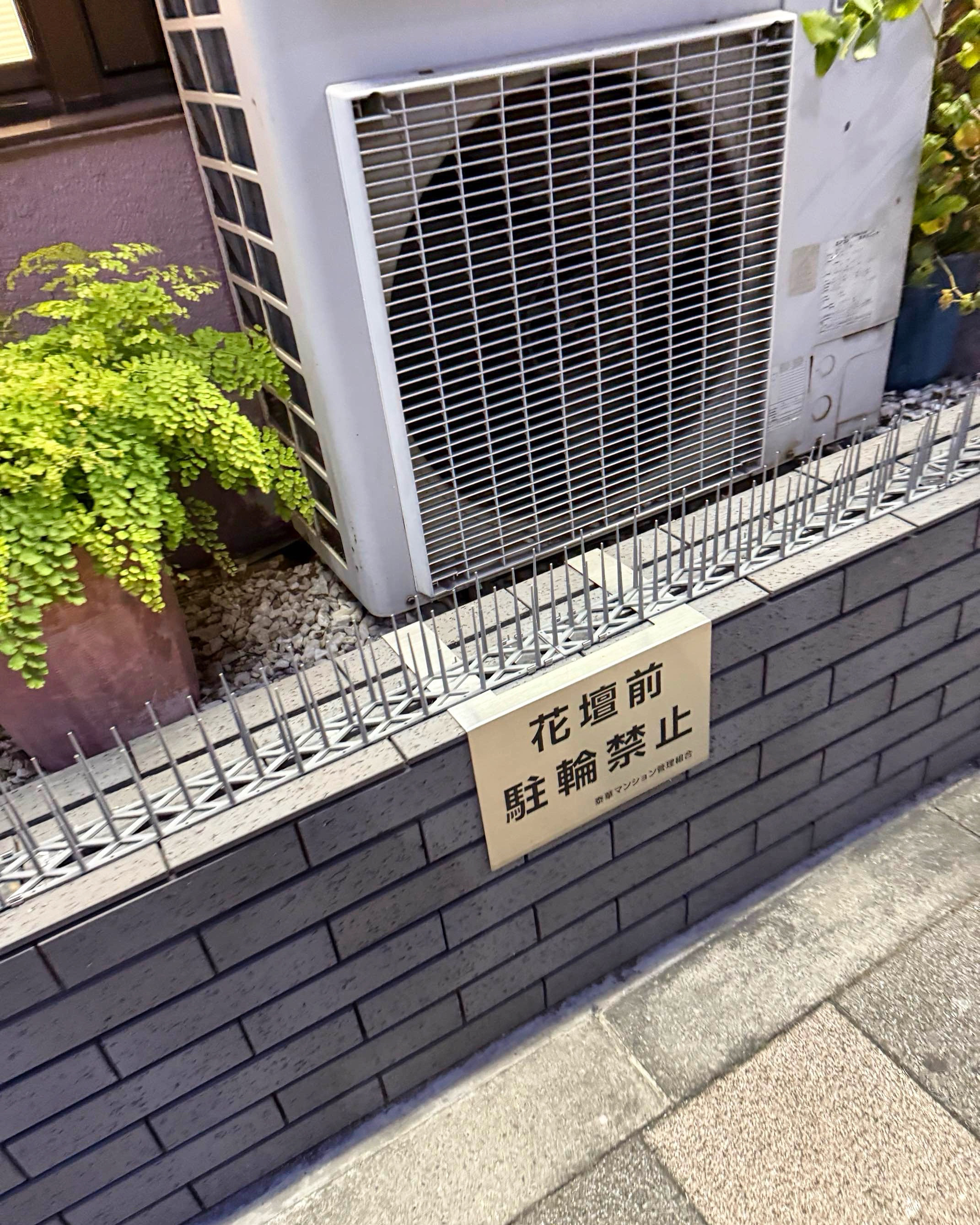
Cal Poly Pomona MURP student Abby Urquiza found some conspicuous Hostile Architecture in Tokyo. Last semester, we examined Hostile Architecture in the Planning & Control module in our course, URP 5120: Planning Ideas & Action. From our readings:
The city is engaged in a merciless struggle to make public facilities and spaces as ‘unlivable’ as possible for the homeless and the poor.
I joined the City of Quartz walking tour on May 11th with the UC Irvine Urban Studies Student Association. Shout out to Professor Walter Nicholls and students for allowing me to guest narrate our field trip.
We keep Mike Davis alive by reading his works, engaging his critiques, and putting feet on the street to understand the city.
Selected photos from the walk:
Discussing Hostile Architecture outside Angels FlightLayers of history on BroadwayDisney Hall almost did not happenProfessor Nicholls explaining the development of Grand AvenueRendezvous point at Los Angeles State Historic Park
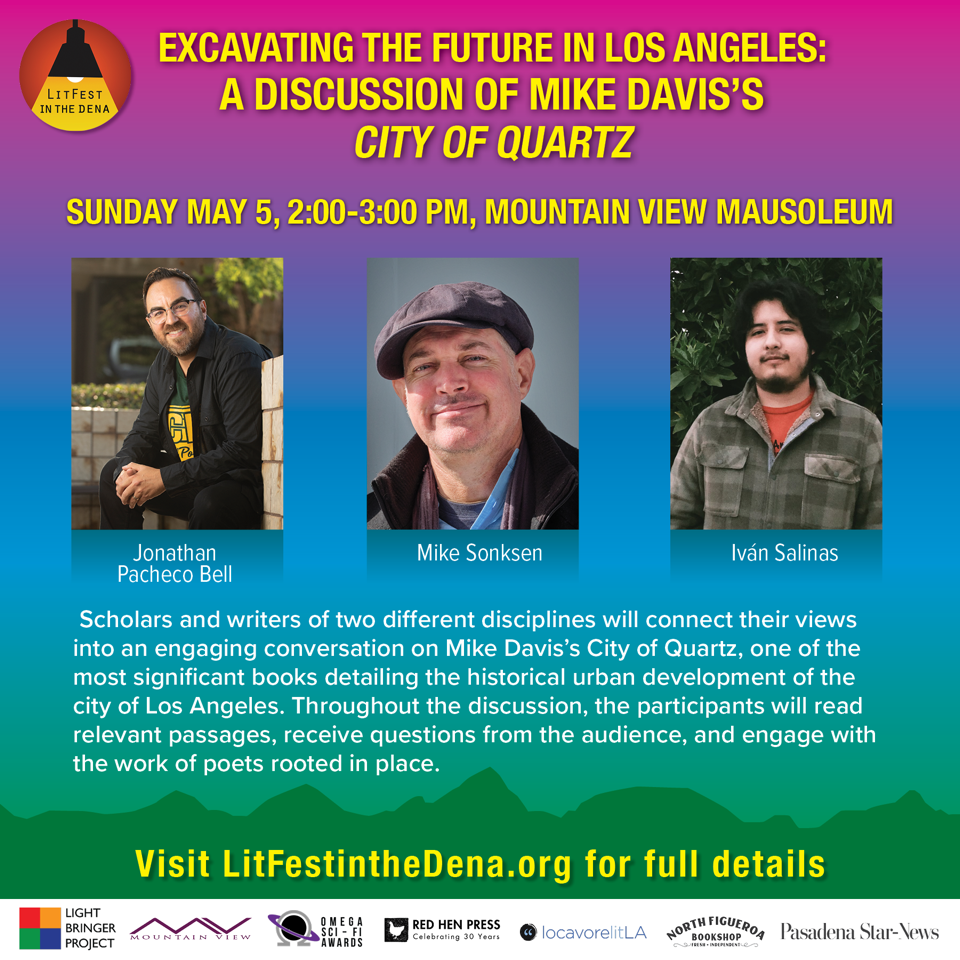
Excavating the Future in Los Angeles: A Discussion of Mike Davis’s City of Quartz Sunday, May 5, 2024, 2:00-3:00pm LitFest in the Dena, Mountain View Mausoleum, Altadena, CA With fellow panelists, Ivan Salinas & Mike The PoeT Sonksen
Bio: Jonathan Pacheco Bell is a Senior Embedded Planner at 4LEAF, Inc. and Adjunct Professor of Urban Planning at Cal Poly Pomona. Born in Boyle Heights and raised in East LA and Montebello, Jonathan came up as a graffiti writer in the 90s creating art and culture on the ground. For nearly 20 years, Jonathan has worked in South Central LA building community partnerships through street-level urban planning. He turned his methods into a new form of practice called Embedded Planning – where the planner works in and from community spaces. He has guest lectured across the U.S. on bottom-up urban planning and is always searching for the next space to engage community members. In addition to teaching and practice, Jonathan serves as Vice President of the Florence-Firestone Community Organization, a 501c3 nonprofit in South Central. He is co-author of the neighborhood history book, A Paseo Through Time in Florence-Firestone. His writing has been published in Planning Magazine, Cultural Daily, UrbDeZine, and Public Libraries Quarterly. Jonathan holds a Master’s in Urban Planning from UCLA Luskin School of Public Affairs and proudly represents City of Pasadena as a resident in the city’s vibrant and diverse District 5.
I’m joining Iván Salinas and Mike The PoeT Sonksen at LitFest in the Dena on the panel, “Excavating the Future in Los Angeles: A Discussion of Mike Davis’s City of Quartz,” 5/5 in Altadena.
Arguably the late Mike Davis’s best known work, City of Quartz is one of the most significant books detailing the history of urban development in LA. Our panel will discuss passages, answer audience question, engage poetry rooted in place, and reflect on the enduring impact of Mike Davis and City of Quartz.
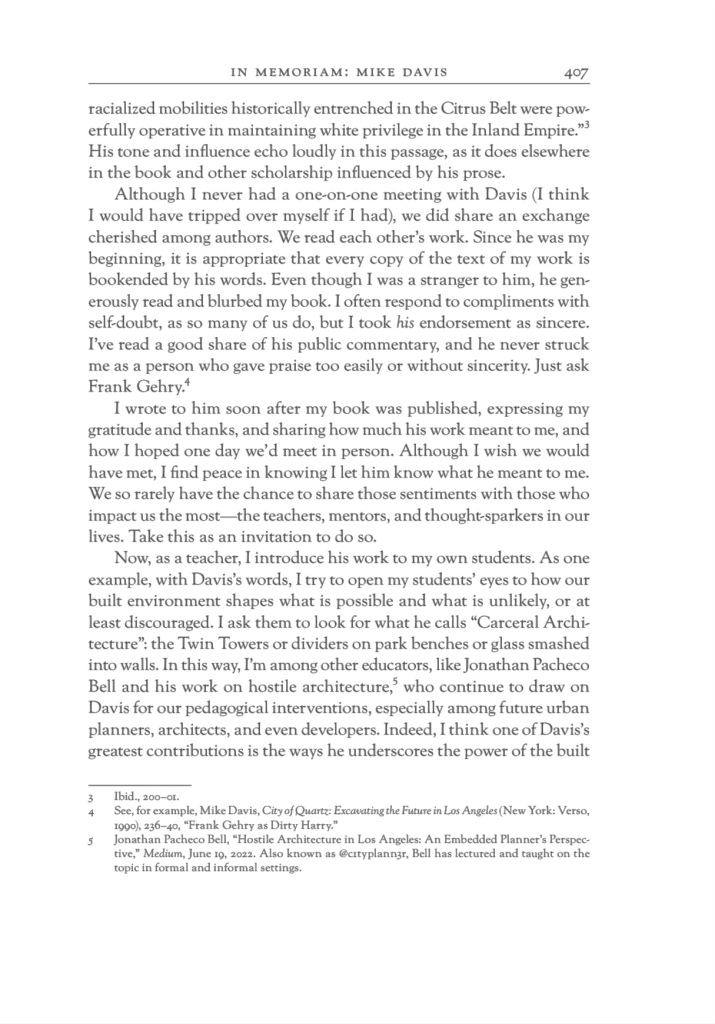
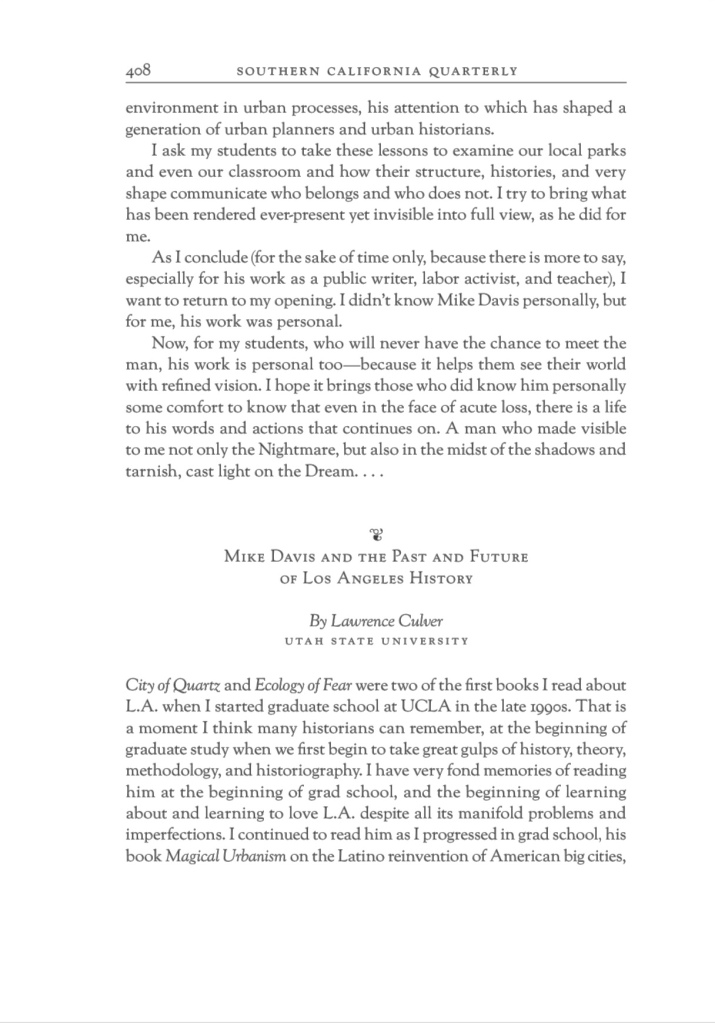
“Now, as a teacher, I introduce his work to my own students. As one example, with Davis’s words, I try to open my students’ eyes to how our built environment shapes what is possible and what is unlikely, or at least discouraged. I ask them to look for what he calls “Carceral Architecture”: the Twin Towers or dividers on park benches or glass smashed into walls. In this way, I’m among other educators, like Jonathan Pacheco Bell and his work on hostile architecture, who continue to draw on Davis for our pedagogical interventions, especially among future urban planners, architects, and even developers. Indeed, I think one of Davis’s greatest contributions is the ways he underscores the power of the built environment in urban processes, his attention to which has shaped a generation of urban planners and urban historians.”
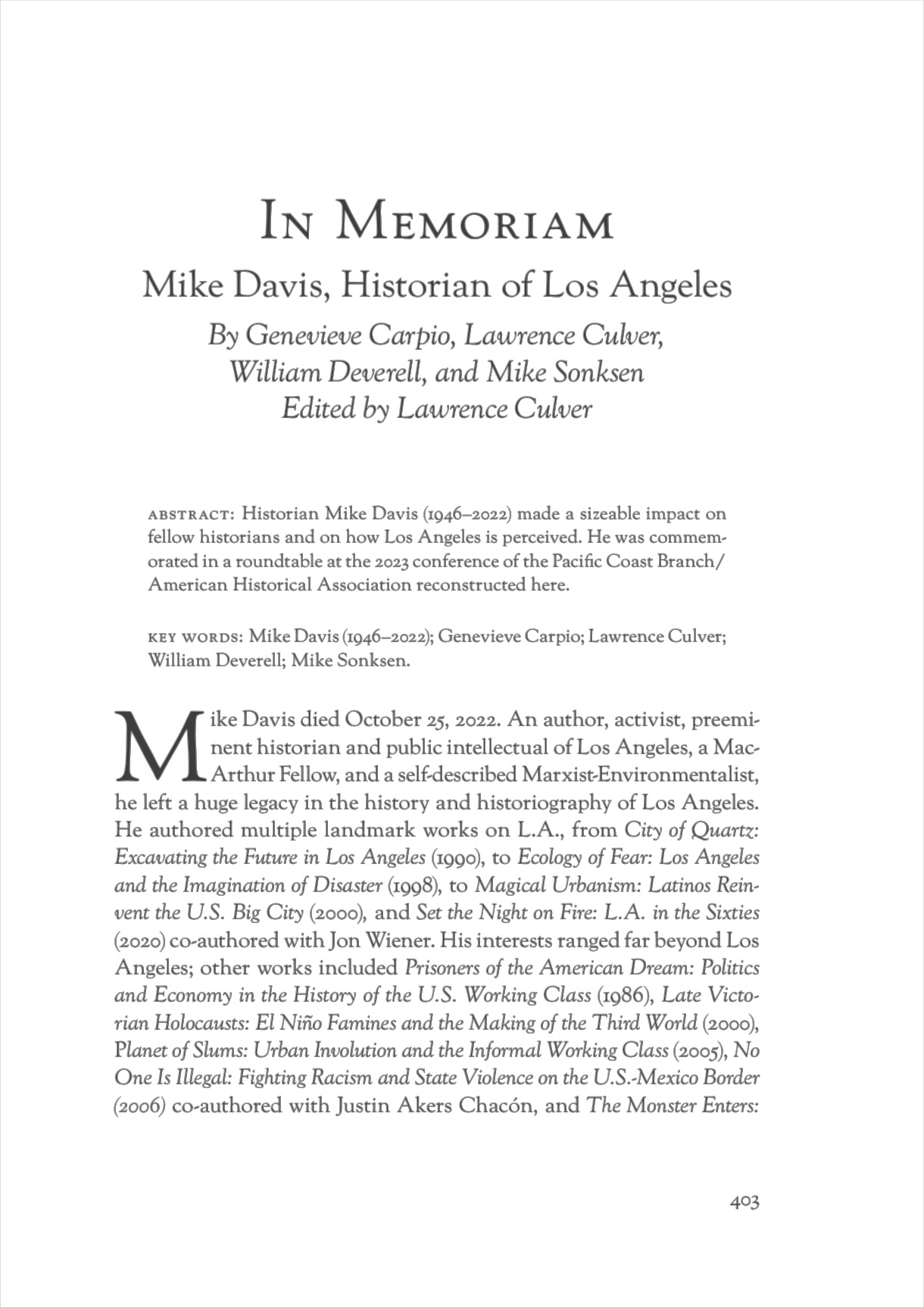
Dr. Genevieve Carpio. “Mike Davis’s Enduring Impact: A Reflection on Sunshine and Noir in the Junkyard of Dreams.” 105, no. 4, Southern California Quarterly (Winter 2023): 404-408.
I joined a chorus of voices sharing the impact of the late urban historian Mike Davis. I mean every word ❤ I’m an LA urban planner because of Mike. Embedded Planning praxis exists because of his teachings.











You must be logged in to post a comment.