Walk Audits During ICE Raids in South Central LA

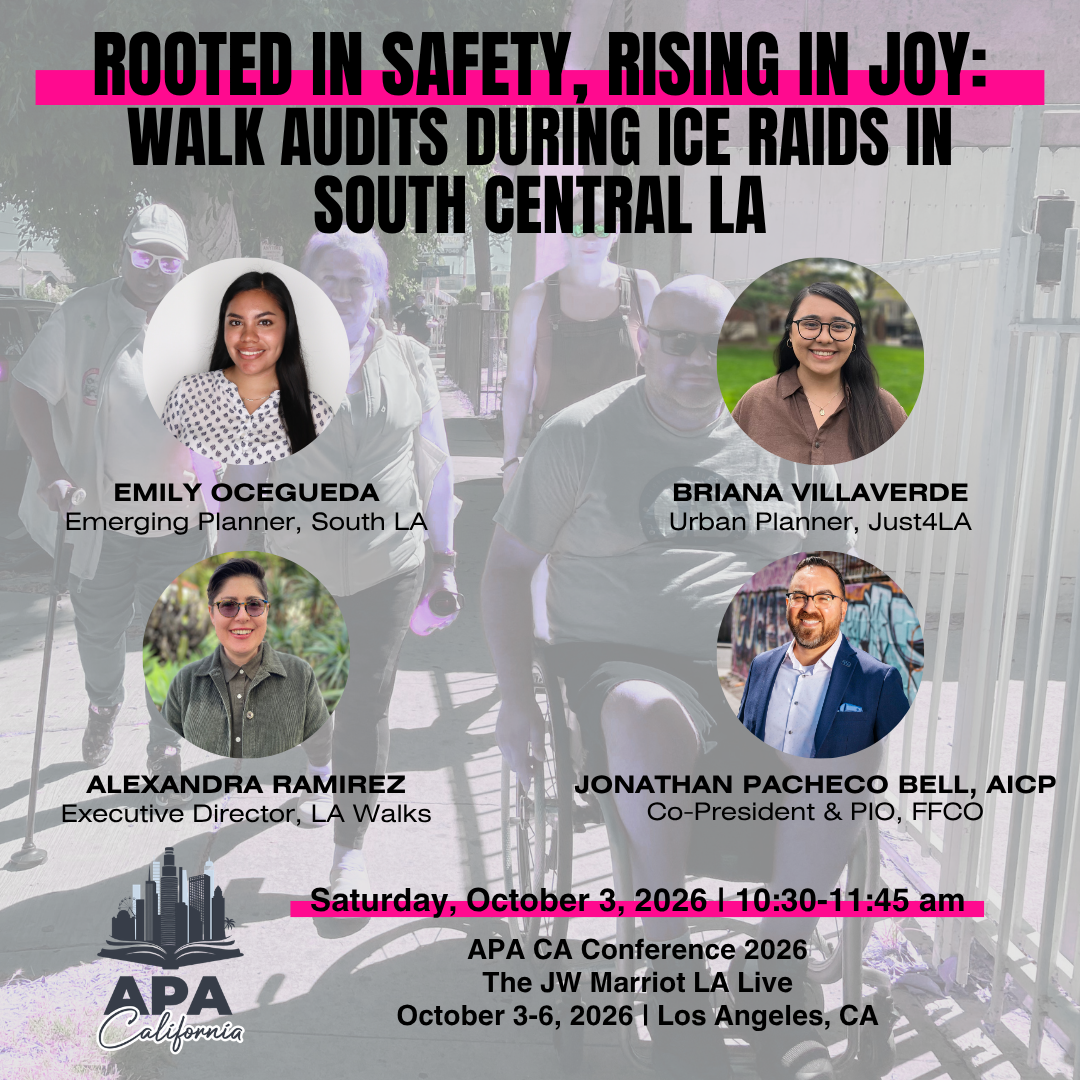
Rooted in Safety, Rising in Joy: Walk Audits During ICE Raids in South Central LA

Saturday, October 3, 2026, 10:30-11:45 a.m. | APA CA Conference 2026, Los Angeles, CA

Speakers:


– Emily Ocegueda: Emerging Planner, Florence-Firestone resident, Walk + Roll Audit participant, UCI Urban Studies graduate

– Briana Villaverde: Urban Planner, Just4LA

– Alexandra Ramirez: Executive Director, Los Angeles Walks

– Jonathan Pacheco Bell, AICP: Co-President & PIO, Florence-Firestone Community Organization
 (moderator)

Session Summary (short):

How do we plan for safe streets during ICE raids? This session explores a Walk + Roll audit in Florence-Firestone in South Central LA centering joy, creativity, and safety over fear. Learn to use storytelling, reflection, and zine-making to turn walk audits into healing tools for mobility justice.

Session Summary (full):

How do we plan for safe streets when simply being in public space carries risk? In South Central LA’s Florence-Firestone community, active ICE enforcement disrupted a planned walk audit, forcing organizers and residents to reconsider not just how to assess streets, but what questions the assessment should begin with. Rather than centering the audit on traditional infrastructure deficiencies alone, Los Angeles Walks, Florence-Firestone Community Organization, the Vision Zero Artist in Residence, and community members grounded the process in a 7-Generation visioning exercise that asked: For whom are streets meant to be safe, and for what purposes?

This session shares how we restructured the Florence-Firestone Walk + Roll event to prioritize safety, community storytelling, and reflection before observation. Participants engaged in a facilitated walk that uplifted lived experiences, memory, and care – followed by a creative zine-making session that helped translate stories into shared values, priorities, and visions for safer streets. Infrastructure conditions were still observed but interpreted through a relational and cultural lens instead of a checklist.

Panelists will reflect on how this approach shifted facilitation, documentation, and outcomes, and what it revealed about safety, belonging, and accountability in communities facing surveillance and displacement. The session highlights both the possibilities and limits of vision-centered engagement in mobility planning.

Learning Objectives:

– Explore a dual “Walk and Van Ride” audit model to accommodate safety and mobility needs and ensure that seniors, undocumented residents, and other vulnerable community members can participate comfortably in analyzing and documenting neighborhood conditions.

– Learn techniques to lead walk + roll audits that empower community members to engage, reflect, and share their lived experiences with mobility issues in a safe and supportive communal environment.

– Learn how facilitated walk + roll audits can center community stories, memory, and lived experience as valid forms of planning knowledge alongside physical and technical observations.

– Identify ways to reinterpret traditional walk + roll audit findings through a community-defined lens of care, joy, and belonging.

– Recognize how vision-centered engagement can inform Vision Zero efforts by clarifying whose safety is prioritized and how community knowledge can shape problem framing within capital infrastructure and inter-agency processes.

Equity Session Statement:

This session examines how planning can adapt when immigration enforcement makes public spaces unsafe. Drawing from a Walk + Roll event in Florence-Firestone, it centers lived experience across race, immigration status, disability, language, and age. Grounded in 7-Generation visioning, storytelling, and creative documentation, we show how traditional planning tools can exclude disadvantaged communities, and how care-centered approaches can better inform safer streets and Vision Zero efforts.
¡Mike Davis, Presente!

¡ Mike Davis, Presente !

Urban History Association Conference 2025

Metropolitan Majorities: UHA 11th Biennial Conference

The Biltmore Los Angeles in Downtown LA, October 9-12, 2025


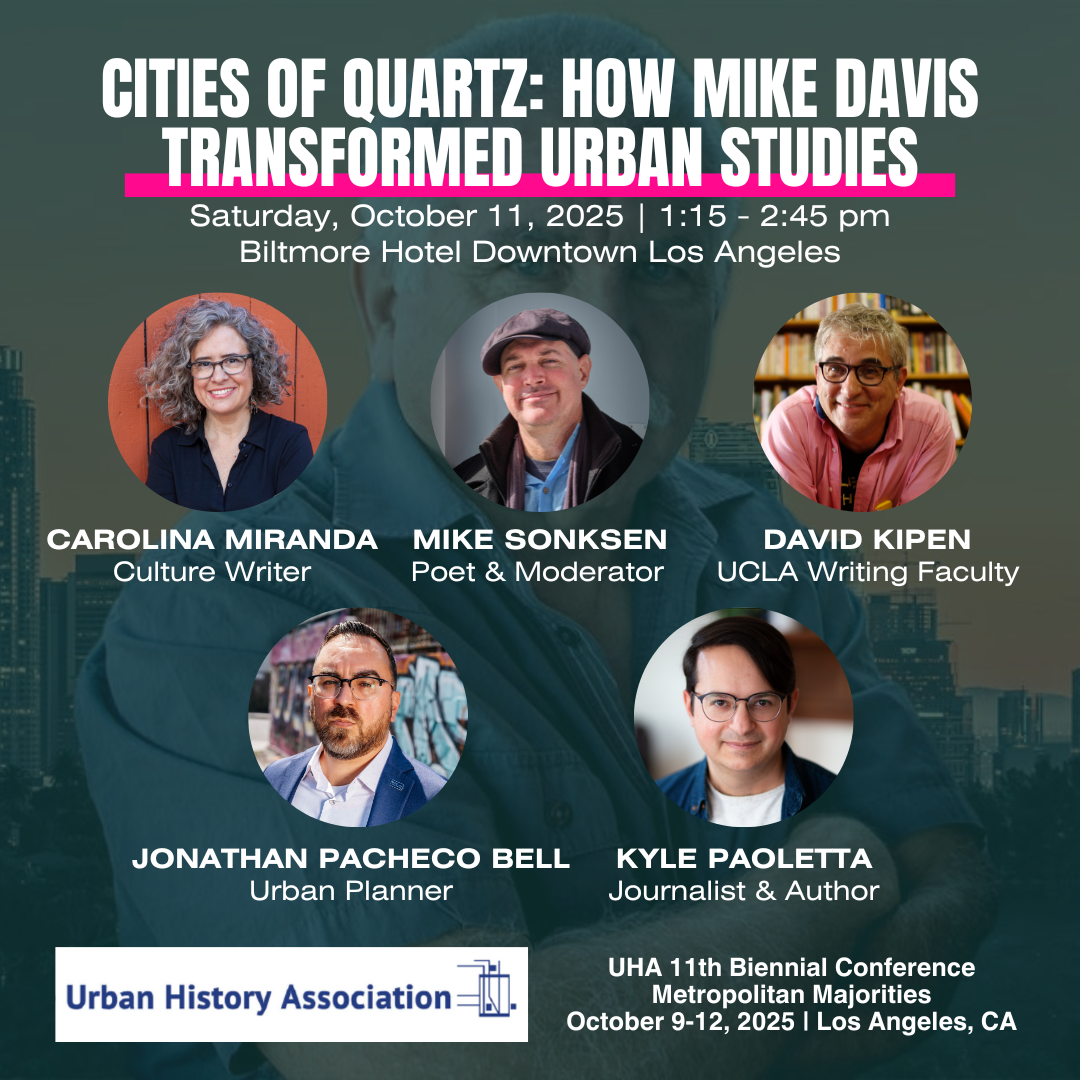
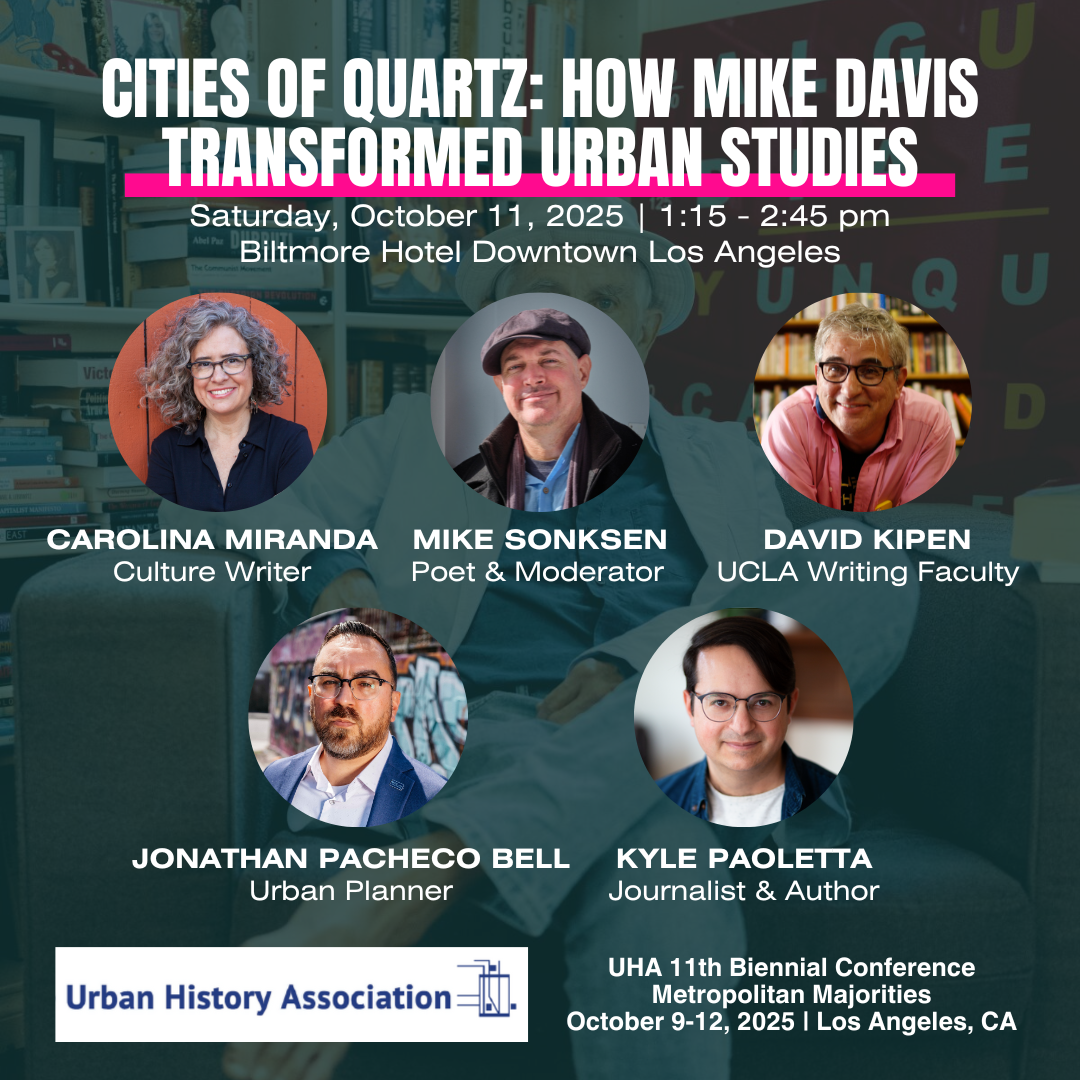
Cities of Quartz: How Mike Davis Transformed Urban Studies (Roundtable)

Saturday, October 11, 2025 | 1:15-2:45pm

Abstract:

In this roundtable discussion, a group of writers, academics, and urban planners will discuss the life and work of Mike Davis. With books like City of Quartz, Ecology of Fear, and Planet of Slums, Davis played an irreplaceable role in pushing urban scholars to foreground questions of equity, justice, and sustainability in their work. Each of Davis’ books and articles was grounded in a clear-eyed assessment of the power dynamics that create unequal societies, and throughout his life he remained a forceful advocate for the moral necessity that poor and working-class communities — whatever their ethnic or racial makeup — have the same chance at opportunity as the ruling class.

To illuminate Davis’ legacy, our discussion will begin with the impact he had on how the city of Los Angeles understands itself, before we open our inquiry into applying his method to cities everywhere and incorporating his ethos into future urban plans.

The roundtable will be moderated by Mike Sonksen, a poet and former Woodbury University professor who was mentored by Mike Davis and remained friends with him for over two decades.

Speakers:

— Carolina A. Miranda, Culture Writer

— Mike The PoeT Sonksen, Poet & Moderator

— David Kipen, UCLA Writing Faculty 

— Jonathan Pacheco Bell, Urban Planner 

— Kyle Paoletta, Journalist & Author

Embedded Planning Keynote at APA WA Conference 2025

We Are Honoring Mike Davis at the Urban History Association Conference 2025 in Los Angeles

We’re honoring Mike Davis at the Urban History Association Conference 2025.

Urban History Association Conference 2025

Metropolitan Majorities: UHA 11th Biennial Conference

The Biltmore Los Angeles in Downtown LA, October 9-12, 2025


Cities of Quartz: How Mike Davis Transformed Urban Studies (Roundtable)

Saturday, October 11, 2025 | 1:15-2:45pm

Abstract:

In this roundtable discussion, a group of writers, academics, and urban planners will discuss the life and work of Mike Davis. With books like City of Quartz, Ecology of Fear, and Planet of Slums, Davis played an irreplaceable role in pushing urban scholars to foreground questions of equity, justice, and sustainability in their work. Each of Davis’ books and articles was grounded in a clear-eyed assessment of the power dynamics that create unequal societies, and throughout his life he remained a forceful advocate for the moral necessity that poor and working-class communities — whatever their ethnic or racial makeup — have the same chance at opportunity as the ruling class.

To illuminate Davis’ legacy, our discussion will begin with the impact he had on how the city of Los Angeles understands itself, before we open our inquiry into applying his method to cities everywhere and incorporating his ethos into future urban plans.

The roundtable will be moderated by Mike Sonksen, a poet and former Woodbury University professor who was mentored by Mike Davis and remained friends with him for over two decades.

Speakers:

— Carolina A. Miranda, Culture Writer

— Mike The PoeT Sonksen, Poet & Moderator

— David Kipen, UCLA Writing Faculty 

— Jonathan Pacheco Bell, Urban Planner 

— Kyle Paoletta, Journalist & Author

Cities of Quartz: How Mike Davis Transformed Urban Studies

We’re honoring Mike Davis at UHA in LA.

Urban History Association Conference 2025

Metropolitan Majorities: UHA 11th Biennial Conference

The Biltmore Los Angeles in Downtown LA, October 9-12, 2025


Cities of Quartz: How Mike Davis Transformed Urban Studies (Roundtable)

Saturday, October 11, 2025 | 1:15-2:45pm

Abstract:

In this roundtable discussion, a group of writers, academics, and urban planners will discuss the life and work of Mike Davis. With books like City of Quartz, Ecology of Fear, and Planet of Slums, Davis played an irreplaceable role in pushing urban scholars to foreground questions of equity, justice, and sustainability in their work. Each of Davis’ books and articles was grounded in a clear-eyed assessment of the power dynamics that create unequal societies, and throughout his life he remained a forceful advocate for the moral necessity that poor and working-class communities — whatever their ethnic or racial makeup — have the same chance at opportunity as the ruling class.

To illuminate Davis’ legacy, our discussion will begin with the impact he had on how the city of Los Angeles understands itself, before we open our inquiry into applying his method to cities everywhere and incorporating his ethos into future urban plans.

The roundtable will be moderated by Mike Sonksen, a poet and former Woodbury University professor who was mentored by Mike Davis and remained friends with him for over two decades.

Speakers:

— Carolina A. Miranda, Culture Writer

— Mike The PoeT Sonksen, Poet & Moderator

— David Kipen, UCLA Writing Faculty 

— Jonathan Pacheco Bell, Urban Planner 

— Kyle Paoletta, Journalist & Author

Permit Pitfalls Panel at the Build the Middle National Housing Convening 2025

I learned so much from moderating this breakout session at the Build the Middle National Housing Convening 2025. And from feedback received thus far, session attendees gained many insights, tools, and practical action steps.

Big thanks to our panelists: Diana Gonzalez from Los Angeles County Department of Regional Planning, Tennis Wick from Permit Sonoma, Derek Ouyang from Stanford RegLab, and Awais Azhar from HousingWorks Austin.

Planning and Code Enforcement Collaboration

Land Use Hot Topics and Code Enforcement

– Navigating political pressures and maintaining professionalism in sensitive enforcement situations. 

Through interactive discussions and real-world case studies, participants will leave equipped with practical tools and best practices to manage politically sensitive land use issues in their own jurisdictions. This session aligns with the conference theme by emphasizing the importance of adaptability, collaboration, and innovation in the face of evolving challenges in code enforcement.