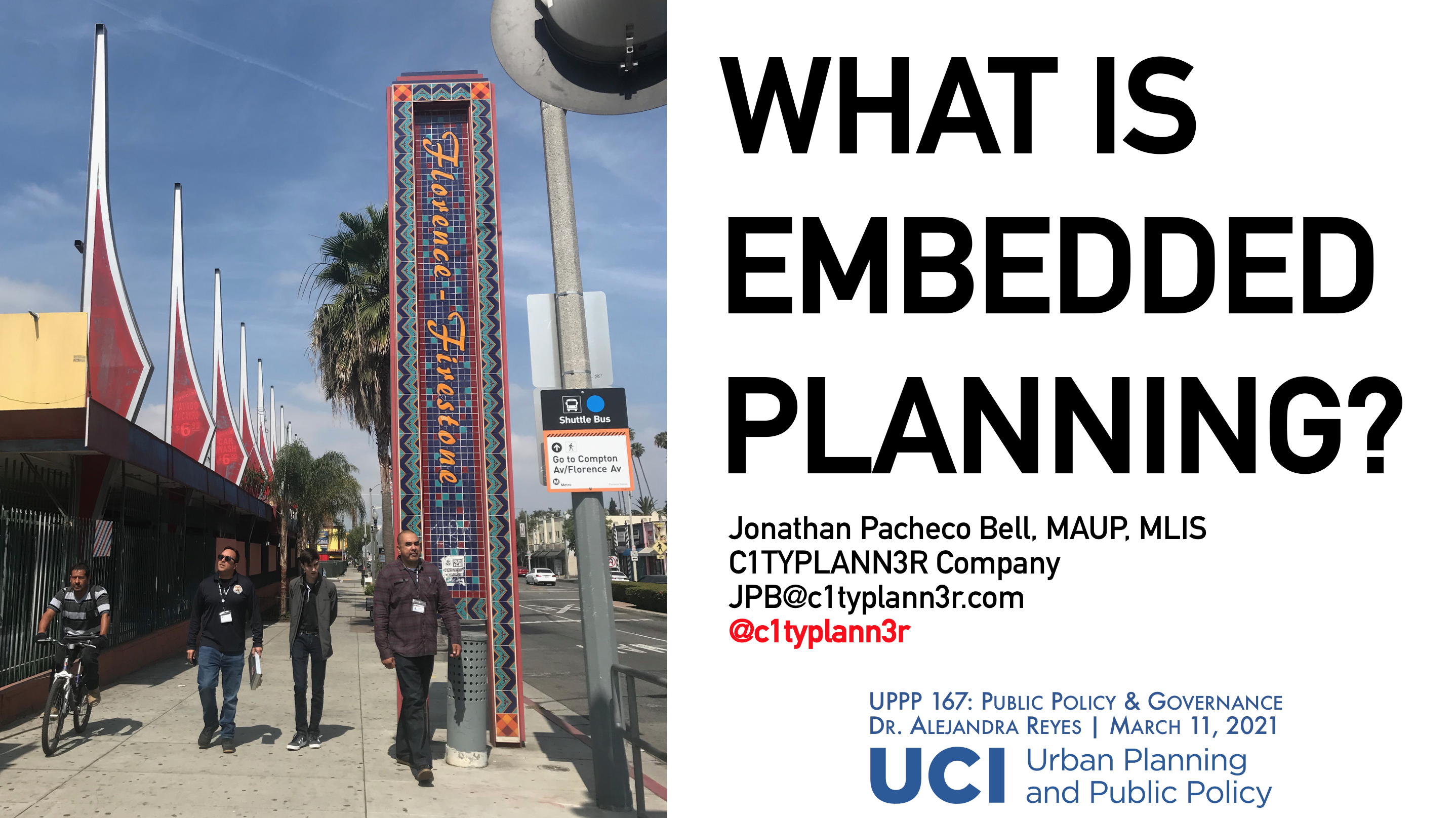
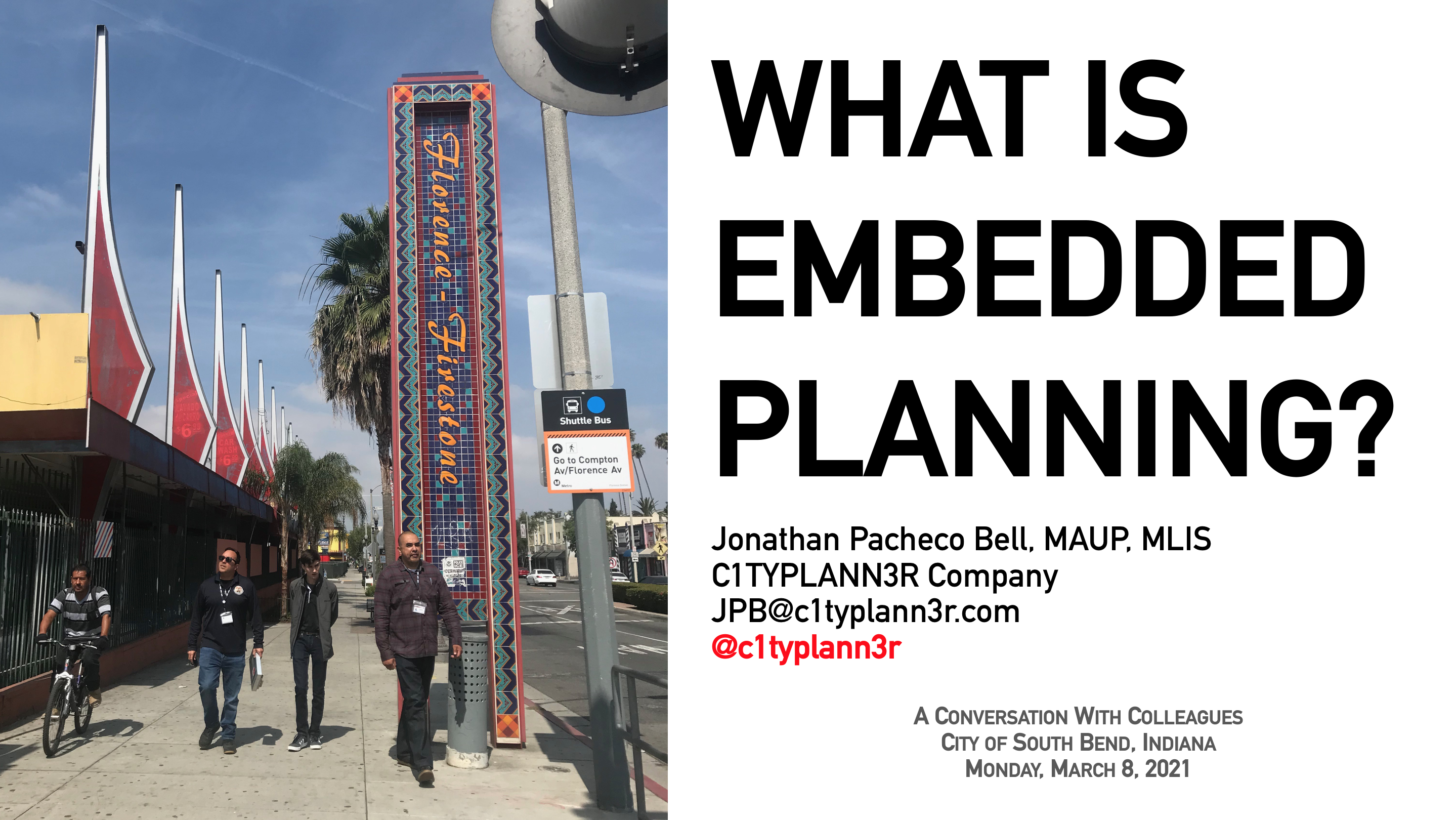
Just wrapped a presentation on Embedded Planning praxis with planners and city staff at the City of South Bendin support of the Linden Avenue Greenhouse Project ✔️ Shout out to my South Bend colleagues for the conversation and help growing #EmbeddedPlanning. And huge thank you to Dominique D. Edwards for organizing today’s talk 🙌🏽 💙 🏁
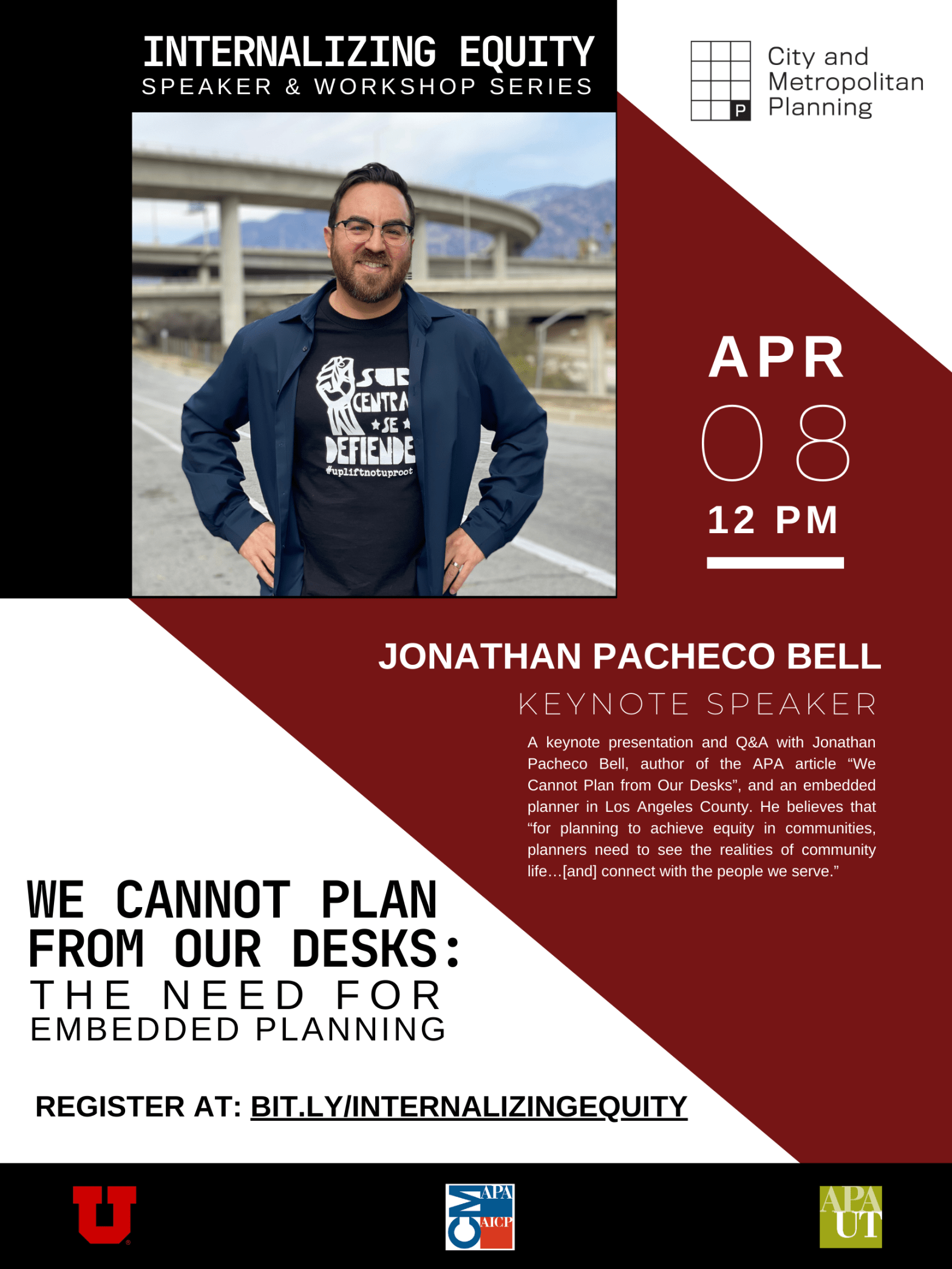
Stoked to announce that I’m delivering the keynote address for the Internalizing Equity series at the University of Utah Department of City & Metropolitan Planning:
️Thanks to Bianca Paulino, Claudia Loayza, and Professor Stacy Harwood!
Bio: Jonathan Pacheco Bell is a practicing urban planner with over 20 years of experience in the public, private, and nonprofit sectors spanning the fields of urban planning, architecture, and library/information science. He is the creator of #EmbeddedPlanning, a praxis that situates the work of planners on the ground to advance equity, build authentic relationships, and increase public participation for historically marginalized communities through street-level engagement. Its maxim is: We Cannot Plan From Our Desks! After 14 years as an Embedded Planner in South Central LA for local government and community-based organizations, he recently launched C1TYPLANN3R Company, a workshop to produce new thought and action in his intersecting fields. Jonathan holds an MA in Urban Planning from UCLA Luskin School of Public Affairs, an MLIS from SJSU iSchool, and undergraduate degrees in political science and architecture.
On February 25th, I launched my new virtual speaking series on #EmbeddedPlanning. It was only right to inaugurate this public talk at UCLA Urban Planning, where I was a student of Edward Soja and Jackie Leavitt in 2003-2005. Much of the DNA of Embedded Planning traces back to their courses.
This talk covered the origins of the idea, defined the praxis, showed what Embedded Planning looks like on the ground, offered some benefits and critiques, and concluded with takeaways for theory and practice. A lively discussion followed, and from there I was able to advance my thinking about the praxis. I also took that opportunity to announce my pivot to freelance practice with the newly launched C1TYPLANN3R Company.
Huge shout outs to our event’s co-sponsors: PRAXIS, Planners of Color for Social Equity, and the UCLA Institute on Inequality and Democracy. Thanks so much for bringing everyone together here. And thank you to everyone who joined from across different time zones, geographies, and hemispheres! The talk was recorded and archived for later viewing. Please contact me if you’d like to see it.
Are you interested in hosting an Embedded Planning talk in your community? Please hit me up.
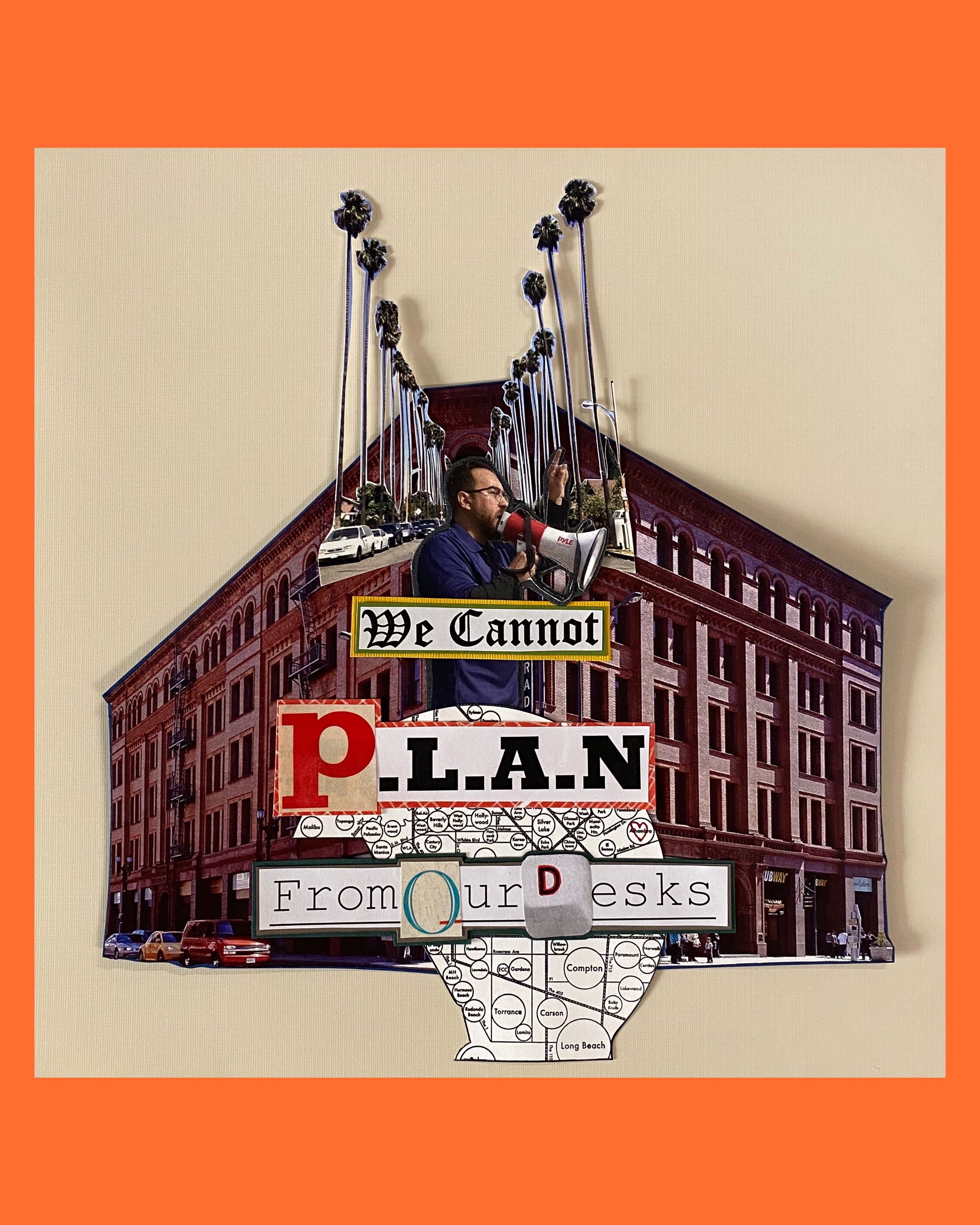
We Cannot Plan From Our Desks. [Collage by artist Jax Arriola @mijacutsdeep]
I trace Embedded Planning back to my high school days as a 90s graffiti writer in LA, and tell the story of Embedded Planning’s origins and evolution, all while situating it within an 11th grade classroom of future planners in East LA, in “Embedded Planning Returns to ELARA.”
Yesterday I was interviewed by an author writing a novel set in the time of the 1992 LA Uprising. I shared memories of interpreting the unrest through my eyes at the time, a high school graffiti tagger in Montebello navigating the larger LA hip hop scene. I’ll share the book when it’s published.
I started a Ko-fi page. Ko-fi (☕️ but it rhymes with “No Fee”) is a micro-donations platform for creators. Ko-fi enables folks to support my writing passion projects. And, Ko-fi sends 100% of the donations to the creator, me!
I launched this because in 2021, I’m ramping up writing about Embedded Planning, my praxis that situates the work of city planners on the streets, not behind a desk. I’m also writing about Public Space, Los Angeles, and more.
Wanna be a part of these efforts?! Your donations will help fund my process, including research, printing, web and database access, copyediting fees, and of course, the iterative and emotional part of writing. Anything helps!
Please consider supporting my writing and praxis that advances equity in urban planning. Thank you so much.
Here’s a good critique of the emerging medium of writing + publishing through Substack. Also reads as a Big Up to old school blogging, with rich links to blogs past and present.
I was a contributing writer for UrbDeZine from 2014 to 2019. UrbDeZine is/was an online magazine covering urban planning, historic preservation, and architecture in seven US cities. Why the slash/verbs? Because the fate of the magazine is unknown. From its aggregator page at Planetizen, we see the last original article published in October 2019. UrbDeZine has been offline since late that year undergoing a “redesign and reorganization” as described on its currently-staticholding page. I write this entry in the waning days of November 2020 noting the relaunch period listed is Summer 2020. I hold out hope it’ll go-live again, but I’ve come to grips with the possibility that UrbDeZine may not come back.
This is dispiriting for a few reasons. First, because UrbDeZine was a passion project of its editor, who always supported the contributing writers, including unpublished and unknown authors, myself included. Second, because the writers added so many original essays, critical reflections, and news stories that advanced conversations on the built environment. Third, and most personally, because I started to find my voice on its pages. My earliest public commentaries on urban planning appeared in UrbDeZine.
My personal attachment wants to see these back online, and there’s interest from some readers, too. The articles pop up in searches but the links don’t work. Now and then, a reader will contact me asking where they’re at. There was enough interest to create a workaround.
Below are my writings from UrbDeZine, in PDF. This list entails works wherein I manually saved the article before it went offline. Most of my articles are accounted for. Some, but not all, of the PDFs retain working hyperlinks in the text. Also, a disclaimer: some of my views have evolved since the original publication of these commentaries (most notably, I’m no longer so stringent about informal housing).
By providing access to these works, I hope to contribute to the public discourse that helped me develop and mature my thinking about today’s vexing urban planning problems.
“We Are a Movement”: Students Advance Embedded Planning at the 2019 National Planning Conference, UrbDeZine. May 14, 2019.
An Open Letter to the Pasadena Planning Commission Urging a Comprehensive Overhaul of the Second Dwelling Unit Ordinance, UrbDeZine. December 12, 2016.
Paragraph from a paper on #EmbeddedPlanning by CPPENV MURP student Gaby Ruiz. Source: @EmbeddedPlanning on Instagram.
I’ve been doing more talks about Embedded Planning in high school and college classes, as well as meeting students for one-on-one conversations about my praxis, all through Zoom during this Coronavirus pandemic. I realized that I was sending lots of follow up emails providing links to my writings. After copy-pasting the same content several times, it became apparent that there was a more efficient way. This is it.
This post serves as the first compilation of my public works (writings, interviews, and more) on Embedded Planning. As my work on this street-level planning praxis evolves, I’ll share updated compilations as new posts on this infrequently updated blog.
Questions about Embedded Planning? Hit me up here.
WRITINGS
We Cannot Plan From Our Desks, Planning. October 2018.
You must be logged in to post a comment.