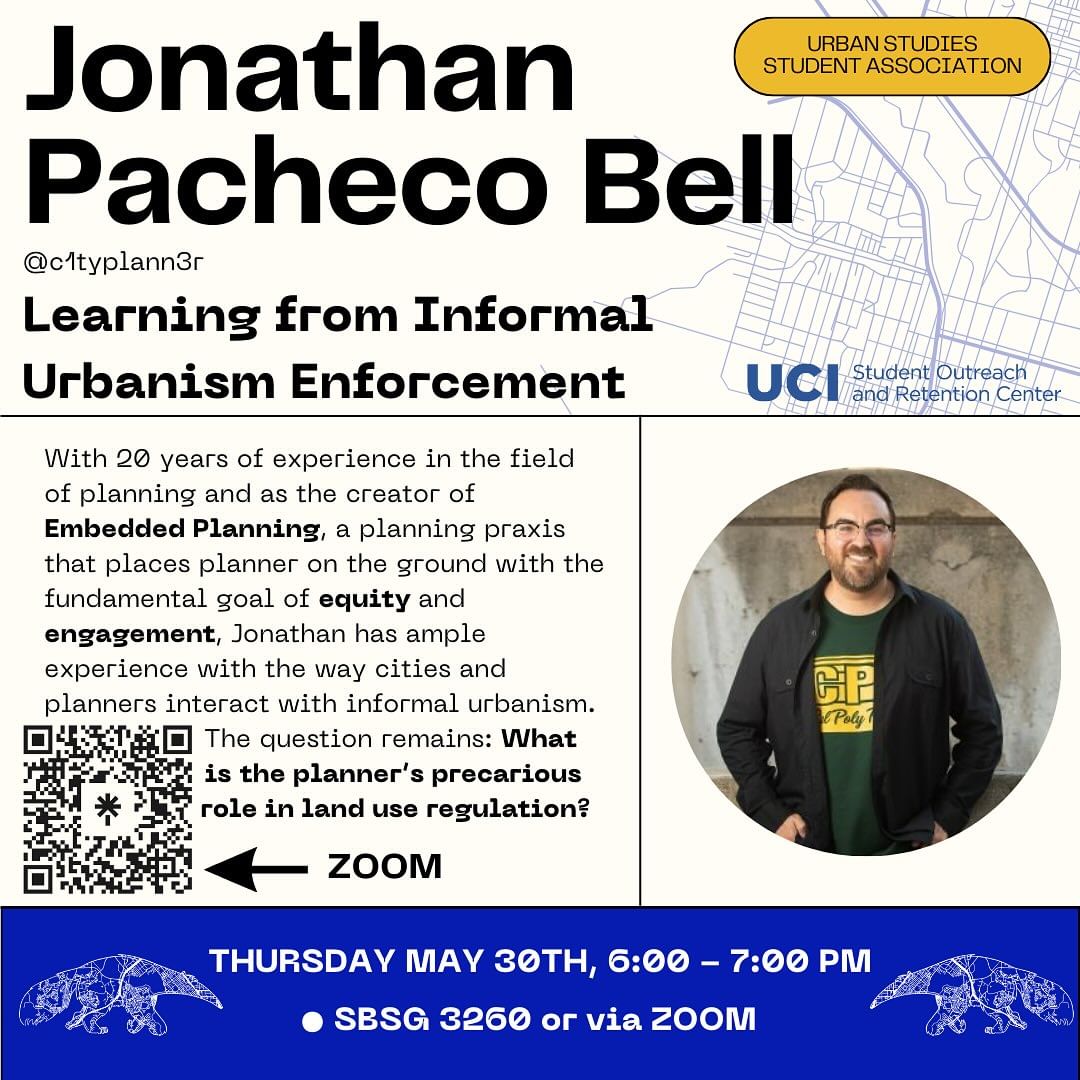
I’m joining UCI’s Urban Studies Student Association May 30th at 6pm for the talk, “Learning From Informal Urbanism Enforcement.” As this is the last general meeting of the quarter, we’re going out strong with a critical discussion of my decade+ doing Zoning Enforcement in South Central LA. This talk on Zoom is free and open to all.
Summary: With 20 years of experience in the field of planning and as the creator of Embedded Planning, a praxis that places the planner on the ground with the fundamental goal of equity and engagement, Jonathan has ample experience with the way cities and planners interact with informal urbanism. The question remains: What is the planner’s precarious role in land use regulation?
I’m doing the talk, “Building Embedded Planning Praxis” and breaking down the origins, applications, and trajectory of Embedded Planning with @CPUrbanists at Cal Poly San Luis Obispo. The public talk is on Tuesday, May 21st at 11:10am on Zoom. Excited for my first time speaking at Cal Poly SLO; as a Cal Poly Pomona faculty member, I consider SLO my sister campus 💚
I joined the City of Quartz walking tour on May 11th with the UC Irvine Urban Studies Student Association. Shout out to Professor Walter Nicholls and students for allowing me to guest narrate our field trip.
We keep Mike Davis alive by reading his works, engaging his critiques, and putting feet on the street to understand the city.
Selected photos from the walk:
Discussing Hostile Architecture outside Angels FlightLayers of history on BroadwayDisney Hall almost did not happenProfessor Nicholls explaining the development of Grand AvenueRendezvous point at Los Angeles State Historic Park
Honored to present “What is Urban Planning?” for Career Day at South LA College Prep High School. We examined the history and role of urban planning, the birth of Embedded Planning next door in Florence-Firestone, and planning as a career that empowers you to build strong communities in partnership with community members. And we’re discussing a return for an Embedded Planning workshop!
Summary: Jonathan will present, “What is Urban Planning?” The presentation illustrates how Jonathan transformed from a graffiti writer to architecture student to urban planner and the special role South Central LA plays in his origin story. Using interactive exercises and storytelling, Jonathan will share how he created Embedded Planning – planning from the street-level – in South Central’s Florence-Firestone district and affirm why students should pursue urban planning careers to improve their communities.
Bio: Jonathan Pacheco Bell is a Senior Embedded Planner at 4LEAF, Inc. and Adjunct Professor of Urban Planning at Cal Poly Pomona. Born in Boyle Heights and raised in East LA and Montebello, Jonathan came up as a graffiti writer in the 90s creating art and culture on the ground. For nearly 20 years, Jonathan has worked in South Central LA building community partnerships through street-level urban planning. He turned his methods into a new form of practice called Embedded Planning – where the planner works in and from the street. He has guest lectured across the U.S. on urban planning and is always searching for the next space to engage students. In addition to teaching and practice, Jonathan serves as Vice President of the Florence-Firestone Community Organization, a 501c3 nonprofit in South Central LA. He is co-author of the neighborhood history book, A Paseo Through Time in Florence-Firestone. Jonathan holds a Master’s in Urban Planning from UCLA.
Honored to return home to East LA College Department of Architecture as a speaker for the Spring 2024 Lecture Series. I’m doing the talk “Building Embedded Planning Praxis” on May 7 at 12pm: free + open to all.
Bio: Jonathan Pacheco Bell is a Senior Embedded Planner at 4LEAF, Inc. and a Lecturer at Cal Poly Pomona Department of Urban and Regional Planning. Born in Boyle Heights and raised in East LA and Montebello, Jonathan came up as a graffiti writer in the 90s creating art and culture on the ground.
For nearly 20 years, Jonathan has worked in South Central LA building community partnerships through street-level urban planning. He turned his methods into a new form of practice called Embedded Planning, where the planner works from the street-level to increase equity and participation for historically marginalized communities harmed by inequitable planning.
Jonathan has guest lectured across the U.S. on Embedded Planning. His speaking engagements include Columbia GSAPP, UCLA, University of Utah, Ohio State, Pratt Institute, Stanford Engineering, University of North Carolina-Chapel Hill, and Woodbury University; state and national Planning conferences in California, Iowa, and Louisiana; and public forums such as MOCA, City Parks Alliance, and the SF Urban Film Fest.
In addition to teaching and practice, Jonathan serves as Vice President of the Florence-Firestone Community Organization, a 501c3 nonprofit in South Central. He is co-author of the neighborhood history book, A Paseo Through Time in Florence-Firestone.
Jonathan is a first-generation student and proud product of the California public school system from kindergarten to graduate school. He holds a Master’s in Urban Planning from UCLA Luskin, an MLIS from SJSU iSchool, a Bachelor’s in Political Science from Cal State LA, and an Associate’s in Architecture from East LA College.
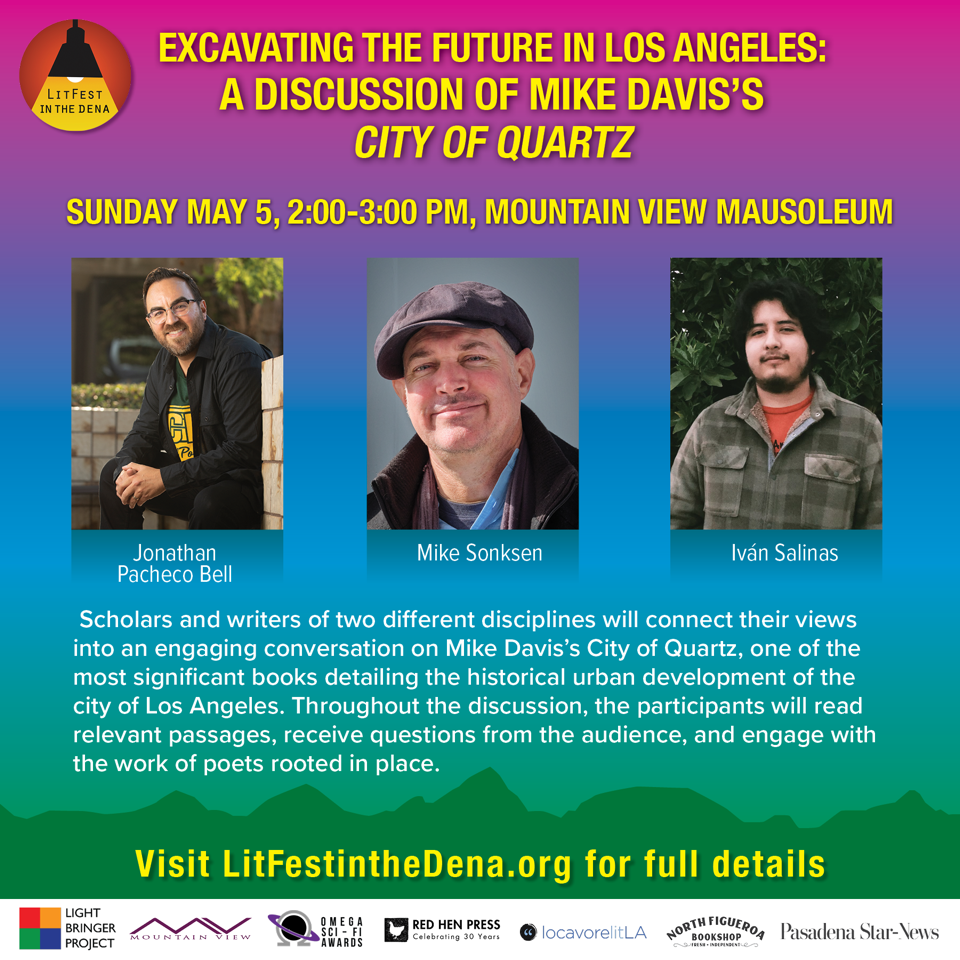
Excavating the Future in Los Angeles: A Discussion of Mike Davis’s City of Quartz Sunday, May 5, 2024, 2:00-3:00pm LitFest in the Dena, Mountain View Mausoleum, Altadena, CA With fellow panelists, Ivan Salinas & Mike The PoeT Sonksen
Bio: Jonathan Pacheco Bell is a Senior Embedded Planner at 4LEAF, Inc. and Adjunct Professor of Urban Planning at Cal Poly Pomona. Born in Boyle Heights and raised in East LA and Montebello, Jonathan came up as a graffiti writer in the 90s creating art and culture on the ground. For nearly 20 years, Jonathan has worked in South Central LA building community partnerships through street-level urban planning. He turned his methods into a new form of practice called Embedded Planning – where the planner works in and from community spaces. He has guest lectured across the U.S. on bottom-up urban planning and is always searching for the next space to engage community members. In addition to teaching and practice, Jonathan serves as Vice President of the Florence-Firestone Community Organization, a 501c3 nonprofit in South Central. He is co-author of the neighborhood history book, A Paseo Through Time in Florence-Firestone. His writing has been published in Planning Magazine, Cultural Daily, UrbDeZine, and Public Libraries Quarterly. Jonathan holds a Master’s in Urban Planning from UCLA Luskin School of Public Affairs and proudly represents City of Pasadena as a resident in the city’s vibrant and diverse District 5.
I’m joining Iván Salinas and Mike The PoeT Sonksen at LitFest in the Dena on the panel, “Excavating the Future in Los Angeles: A Discussion of Mike Davis’s City of Quartz,” 5/5 in Altadena.
Arguably the late Mike Davis’s best known work, City of Quartz is one of the most significant books detailing the history of urban development in LA. Our panel will discuss passages, answer audience question, engage poetry rooted in place, and reflect on the enduring impact of Mike Davis and City of Quartz.
BRODIE: What are the conversations like about this among your colleagues and other people who do what you do? . . .
PACHECO BELL: A lot of times city planners get blamed for this, but in fact, it’s oftentimes not city planners that are deciding to add hostile architecture. Rather, it’s the absence of mechanisms within city planning to deal with it. One of my longstanding critiques.
So, yes, there are instances where public agencies or the state might support the addition of hostile architecture, but there are also many instances where the private sector is doing this.
You have sometimes groups that form together to create hostile architecture to add in public space, to drive away those who they deem undesirable, and then sometimes you have sort of lone wolf individuals.
So this is a multidimensional issue. This is a multidimensional public space equity issue with a lot of people involved in it. My critique is that the urban planning field has done very little to address it.
The sharpest critiques that are coming out right now about hostile architecture are coming from the citizen journalists, young people on TikTok. And that is giving me hope that we’re going to have a turning point where we can start really talking about this as an international public space equity issue driven by young people on social media.
Join me this Friday, March 29th at 11:00am PST for an update on the important topic of unpermitted or informal ADUs and efforts to make the process of legalization easier and less costly, hosted by Casita Coalition, a statewide nonprofit. Our panel will cover:
– The current process for legalizing an unpermitted unit under state law – How a safety-first legalization process can help preserve existing homes – Designing an ADU amnesty program that addresses common barriers for homeowners – AB 2533 (Carrillo)—a bill Casita Coalition is supporting to improve current ADU amnesty provisions
This webinar is generously sponsored by the City of Piedmont.
With my fellow FFCO Board Members Ramsey Nicholson and Art Jones. Photo by Aditi Peyush
My fellow Board Members have reelected me to serve as Vice President of the Florence-Firestone Community Organization (501c3) in South Central LA. I greatly appreciate the Board’s vote of confidence and I’m honored to continue uplifting our neighborhood in this role.
FFCO has many wonderful things planned for community members in 2024. Our resource fairs, community food giveaways, and holiday events will continue, and we’re expanding community education programs with generous funding from our partners.
Building on last year’s Vision Zero advocacy, we’re upping our community engagement and planning service. I’m stoked to work on FFCO’s community planning initiatives, including our new public engagement partnership with Metro for the Rail to River Segment B project, community walks and bike rides, client projects with universities like CPPURP and UCLA Luskin, urban planning workshops, Embedded Planning advocacy, community assistance navigating LA County planning efforts underway, and more.
The Florence-Firestone community welcomed me with open arms when I was a “baby zoning enforcement planner” nearly 17 years ago. I figured out my life’s purpose here — as a planner and a person. I’m humbled to be an adopted FF resident serving my friends and neighbors. Thank you for the boundless support and inspiration!
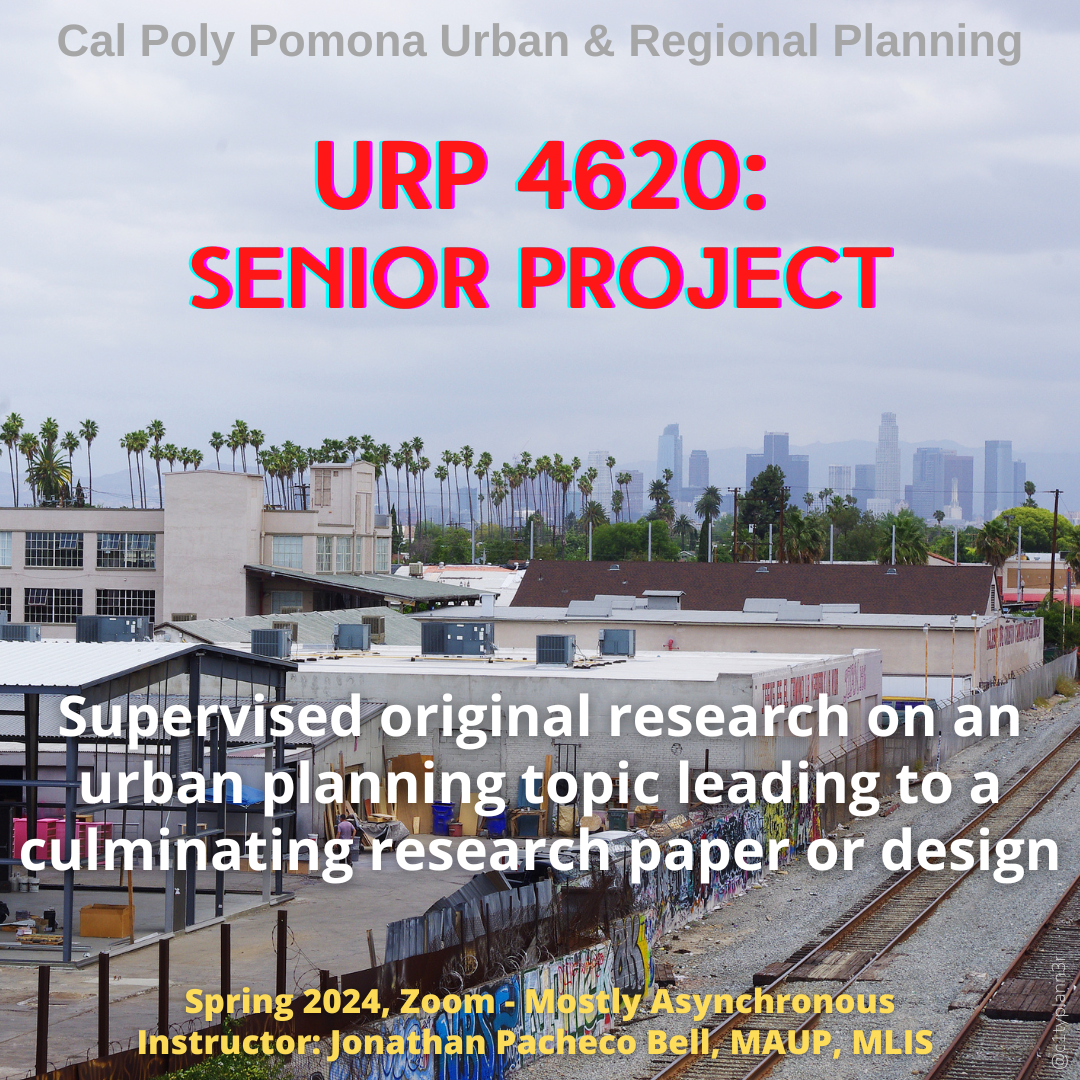
I’m back this semester teaching URP 4620 Senior Project. Building on research proposals developed in 4600A, this course is independent and student-driven. I’ll be guiding the student’s research process leading to an undergraduate capstone paper, project, or design.
[ Background photo by Misty Fong. A view of Downtown LA and South Central taken from the iconic pedestrian bridge over the Metro Blue Line in Florence-Firestone ]
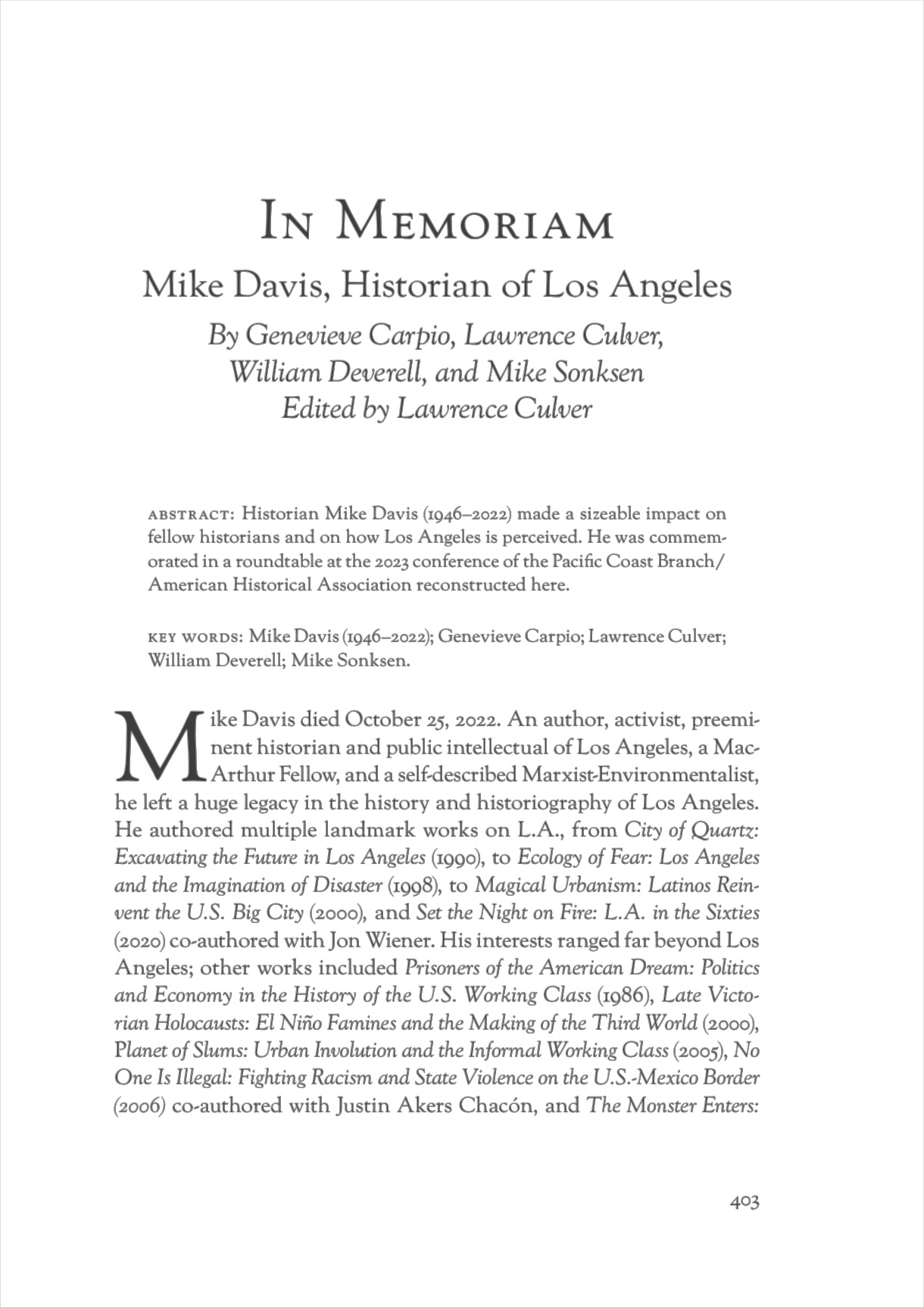
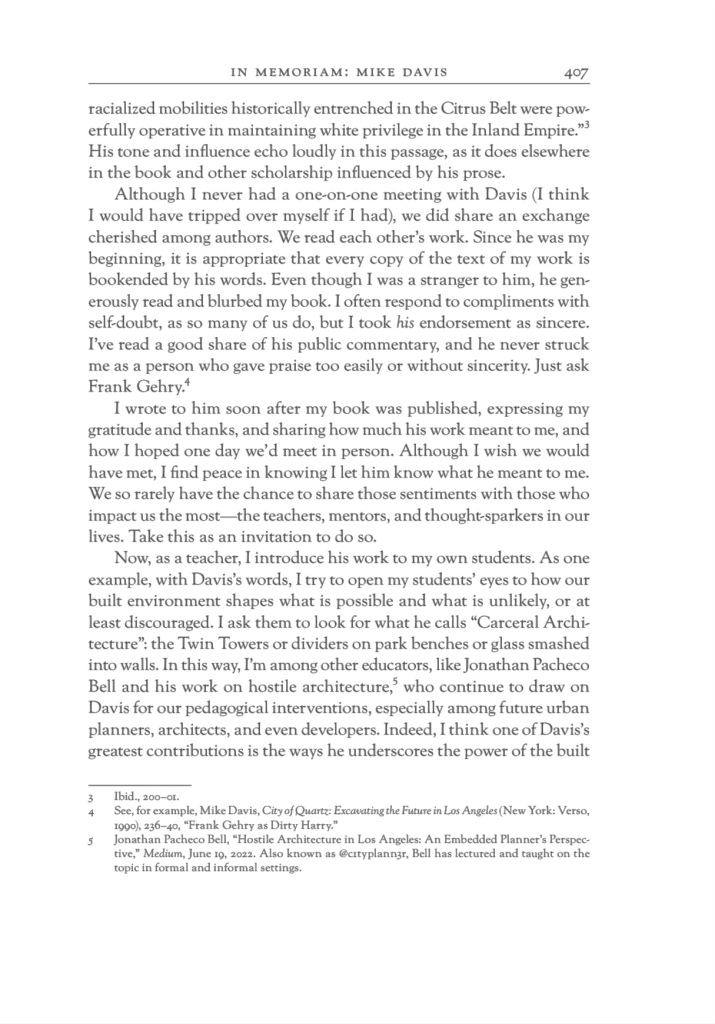
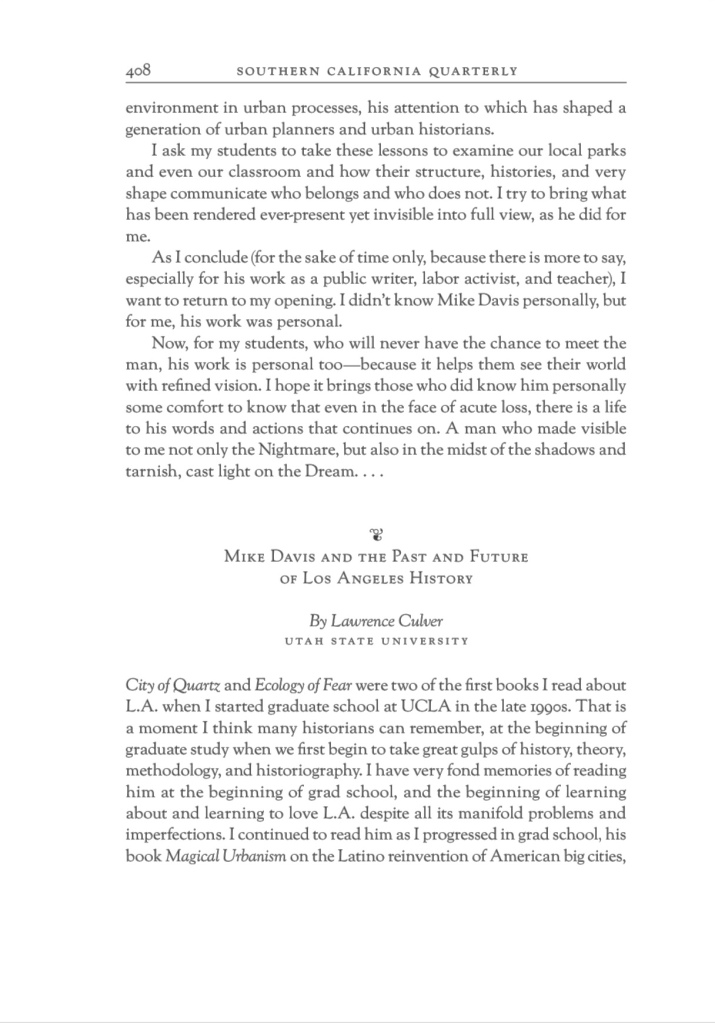
“Now, as a teacher, I introduce his work to my own students. As one example, with Davis’s words, I try to open my students’ eyes to how our built environment shapes what is possible and what is unlikely, or at least discouraged. I ask them to look for what he calls “Carceral Architecture”: the Twin Towers or dividers on park benches or glass smashed into walls. In this way, I’m among other educators, like Jonathan Pacheco Bell and his work on hostile architecture, who continue to draw on Davis for our pedagogical interventions, especially among future urban planners, architects, and even developers. Indeed, I think one of Davis’s greatest contributions is the ways he underscores the power of the built environment in urban processes, his attention to which has shaped a generation of urban planners and urban historians.”
Dr. Genevieve Carpio. “Mike Davis’s Enduring Impact: A Reflection on Sunshine and Noir in the Junkyard of Dreams.” 105, no. 4, Southern California Quarterly (Winter 2023): 404-408.
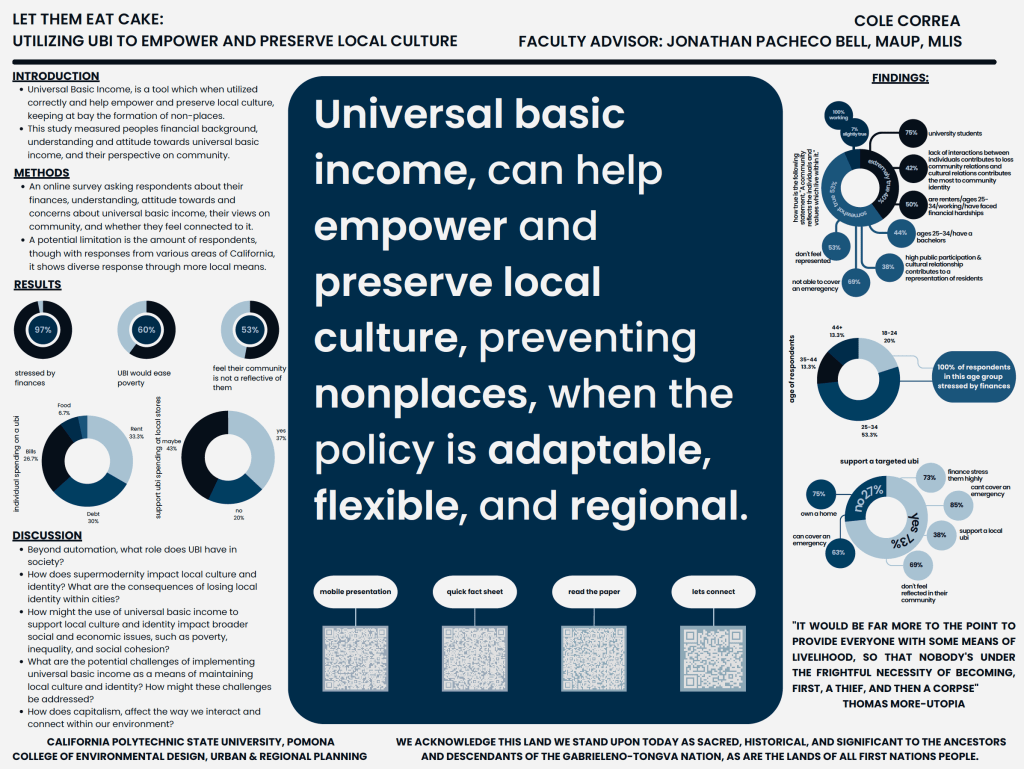
Let Them Eat Cake: Utilizing UBI to Empower and Preserve Local Culture. By: Cole Correa
Celebrating the graduates in my 2023 Senior Projects class at Cal Poly Pomona Department of Urban and Regional Planning. Today we big up this researcher:
Let Them Eat Cake: Utilizing UBI to Empower and Preserve Local Culture
By: Cole Correa
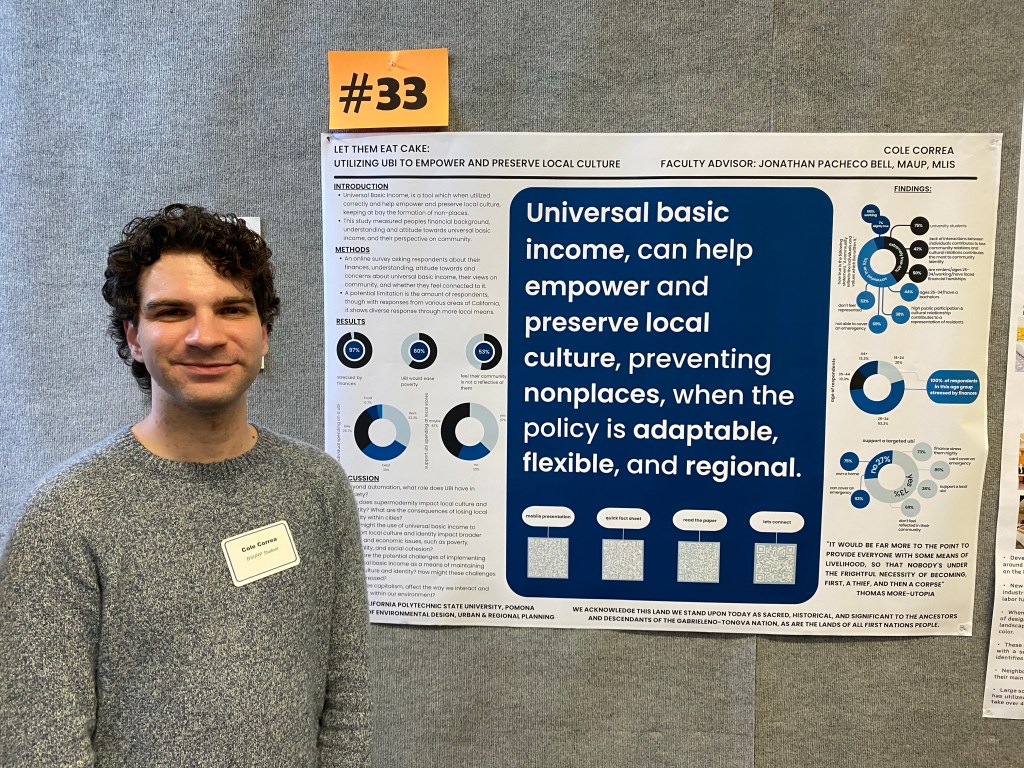
This study examines the potential role of universal basic income (UBI) in maintaining local culture and identity within cities as a response to the negative effects of supermodernity. A descriptive and correlational research design was used to collect data through an online survey of randomly selected individuals in California. The survey gathered information on respondents’ income, connection to their communities, and attitudes toward the use of UBI as a means of preserving local culture. The data was analyzed to identify correlations between these variables and to draw conclusions about the potential effectiveness of using #UBI for this purpose.
The findings suggest that there is a positive correlation between income and connection to local culture and identity, and that UBI has the potential to empower communities and support local culture. However, the study also highlights some potential limitations of using UBI in this way, including the need for careful program design and implementation to avoid unintended consequences. The study concludes by suggesting that further research is needed to explore the potential of UBI to support local culture and identity, and to identify best practices for program design and implementation. This study provides important insights into the potential role of UBI in maintaining local culture and identity within cities. The findings can inform policy and practice in this area and contribute to the growing literature on UBI as a means of addressing broader social and economic issues.
Researcher presenting at the 2023 Cal Poly Pomona Urban & Regional Planning Senior Projects Day. Photo: Jonathan Pacheco Bell









You must be logged in to post a comment.