I Always Stop in Baker, California — and Not Just for Gas, on Medium

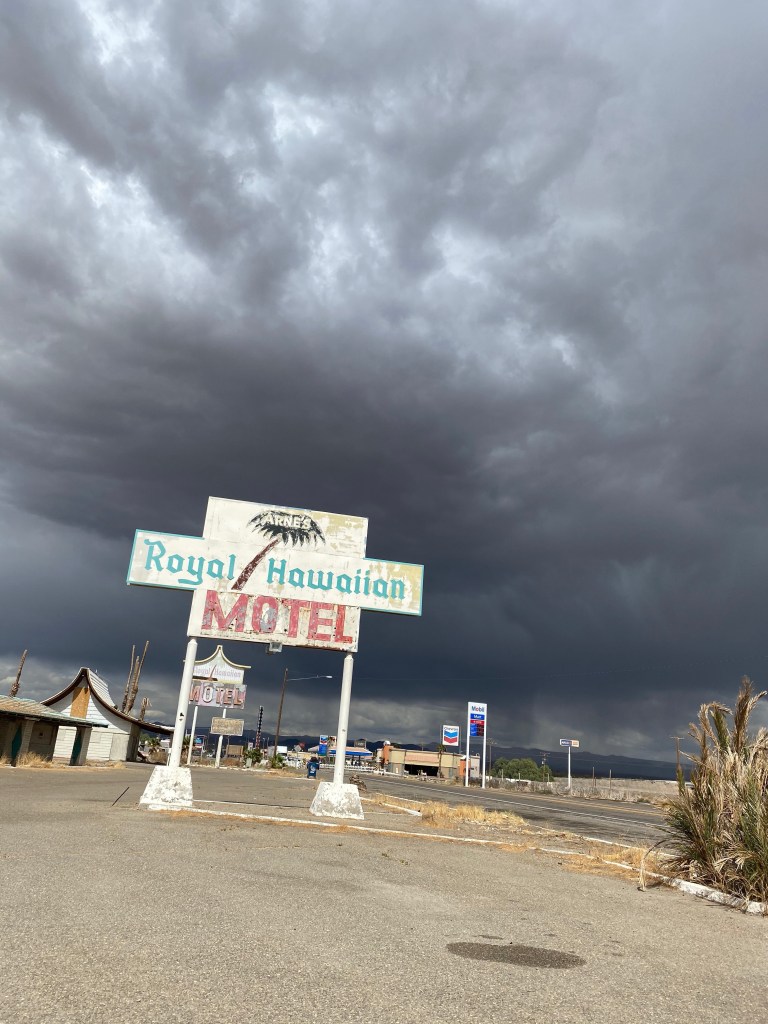
Baker, California. Photo by Jonathan Pacheco Bell

Read my latest, “I Always Stop in Baker, California — and Not Just for Gas” on Medium.

Excerpt:

“My family does that pit stop in Baker en route between Nevada and Pasadena. Before getting back on the 15, I like to visit Arne’s. It is always haunting seeing it up close rather than mediated through filtered #urbex depictions. This business was once somebody’s American Dream. I see memories of past grand ambitions working against all odds in the harsh California desert, still there but withering away.

Naysayers might describe Baker in those words. I don’t, because I haven’t given up on this place. The remaining residents, businesses, sites, stories, memories, and histories make this a community.“

Hostile Architecture Interview on KJZZ NPR Phoenix

Informal ADUs Webinar

Reelected as Vice President of the Florence-Firestone Community Organization

With my fellow FFCO Board Members Ramsey Nicholson and Art Jones. Photo by Aditi Peyush

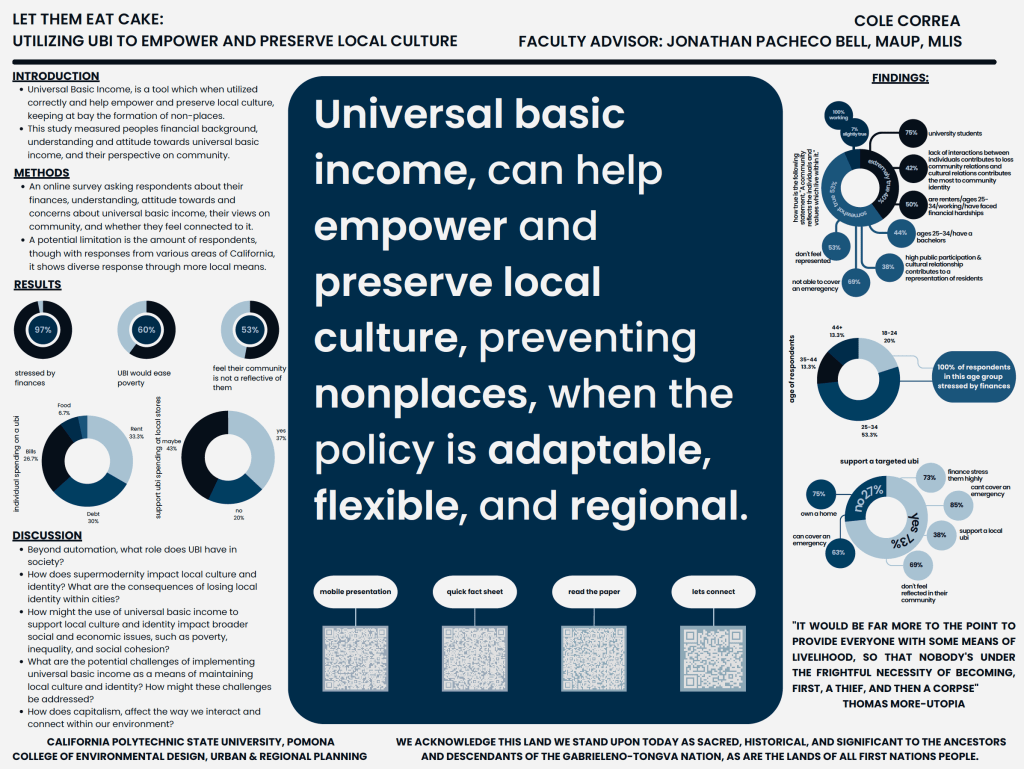
Let Them Eat Cake: Utilizing UBI to Empower and Preserve Local Culture

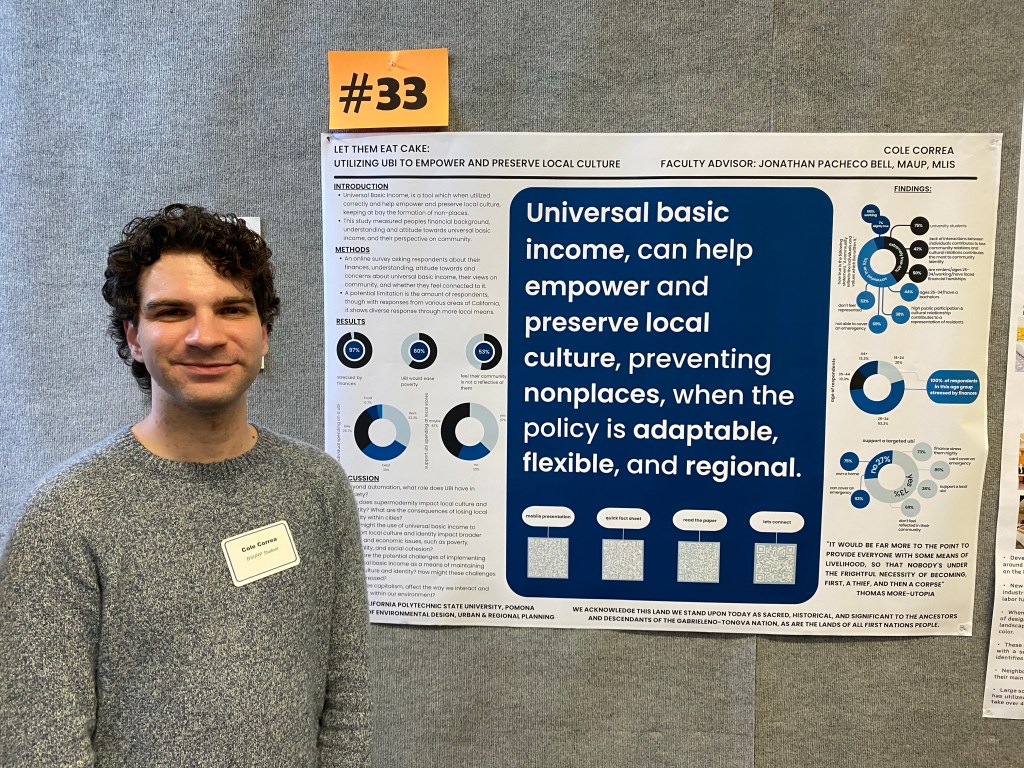
Let Them Eat Cake: Utilizing UBI to Empower and Preserve Local Culture. By: Cole Correa
Researcher presenting at the 2023 Cal Poly Pomona Urban & Regional Planning Senior Projects Day. Photo: Jonathan Pacheco Bell

Housing Resource Fair

Navigating the Nexus Panel

Shout out to Cal Poly Pomona students in URP 5400 for organizing the panel, “Navigating the Nexus: Politics, Planning, and Policy.”

I enjoyed sharing space with fellow panelists and students.

We shared stories, reflections, and tactics for navigating the politics of planning.

I got the chance to talk with a new audience about Embedded Planning as a method to bridge the theory/practice gap.

Voices of the Streets: The Lived Experiences of Street Vendors in the Community of Florence-Firestone

Voices of the Streets: The Lived Experiences of Street Vendors in the Community of Florence-Firestone. By: Sergio Saldana

Celebrating the graduates in my 2023 Senior Projects class at Cal Poly Pomona Department of Urban & Regional Planning. Today we big up this researcher:

Voices of the Streets: The Lived Experiences of Street Vendors in the Community of Florence-Firestone

By: Sergio Saldaña

Abstract: The street vendors in Florence-Firestone, an unincorporated community in Los Angeles County, have been left alone by County entities and enjoyed a certain degree of autonomy. However, this has also led to neglect on the part of the County towards the street vending community. Despite the existence of resources to help street vendors with issues such as rent relief, food, and public safety, the County has failed to address these concerns. Qualitative research in the form of in-person surveys was conducted with street vendors and sheds light on this community’s lived experiences. While street vendors appreciate the County’s hands-off approach, the lack of attention from the County has resulted in many problems for street vendors. Many of them struggle to make ends meet and need assistance. They also face public safety concerns, such as the risk of theft or harassment while working on the street.

Based on interview data from street vendors in Florence-Firestone, the County should take a more proactive role in addressing the concerns of the street vendors. The data derived from this study can play an essential part in helping County officials understand the needs and desires of street vendors by knowing their struggles. To give insight into challenges faced by street vendors as well as areas where they may require additional support, County officials can create an actionable plan to support street vending activity more effectively in future. This data can be used to assist officials with addressing regulatory issues preventing street vendors from succeeding. Officials can take measures such as providing education and guidance on compliance or revising regulations to be more vendor friendly. In the culmination of this paper, it is recommended that the County update the Florence-Firestone Community Plan with a new section addressing the concerns of street vendors and direct them towards available resources that may help.

Researcher presenting at the 2023 Cal Poly Pomona Urban & Regional Planning Senior Projects Day. Photo: Jonathan Pacheco Bell

Female Perceptions of Parking Safety at the First/Last Mile: An Analysis of Cal Poly Pomona

Female Perceptions of Parking Safety at the First/Last Mile: An Analysis of Cal Poly Pomona. By: Nikole J. Sanchez & Jaden R. Oloresisimo
Research team presenting at the 2023 Cal Poly Pomona Urban & Regional Planning Senior Projects Day. Photo: Jonathan Pacheco Bell

Next Chapters Await. This Work Continues

I appreciate the opportunity to grow with a strong team at the COG. They inspire me.

Vision Zero Community Walk in Florence-Firestone

In support of Vision Zero, join us for a community walk in Florence-Firestone Sunday, July 23rd from 10am to 1pm. FFCO’s Ramsey Nicholson and I will highlight landmarks, social history, and community issues on the route. No registration required! Just come through.

Meeting place:
Florence-Firestone Community Organization (501c3)
6940 Compton Avenue, Los Angeles 90001

Route includes:
Compton Avenue, Florence Avenue, Maie Avenue, Graham Avenue, Miramonte Boulevard, E. 66th Street

Florence-Firestone Community Organization in partnership with Estolano Advisors, BikeLA, Los Angeles County Department of Public Health, & California Office of Traffic Safety

Quoted in LAist on Student Debt

Image: LAist

I’m interviewed about the history of student debt in this excellent long form reporting by Julia Barajas at LAist. I thought about my urban planning students at Cal Poly Pomona and Pitzer College for this one.

Excerpt:

In May 2022, the Washington Post reported that White House officials were exploring the promised cancellation of $10,000 in student debt per borrower, but limiting efforts to people who earned less than $150,000 last year.

Opponents to this proposal can be found across the political spectrum.

Jonathan Pacheco Bell, an urban planner and adjunct professor at Cal Poly Pomona and Pitzer College, said he appreciates that Biden has not forgotten his campaign promise, but $10,000 is insufficient.

“It’s a way to split the difference so that you make some people happy and some people mad, but you’re not going to piss off the other side of the aisle, because you didn’t wipe away all the debt. It’s a very comfortable and extremely safe position,” he said.

Some of his students have taken on tens of thousands of dollars in debt, he added. “Meanwhile, the U.S. seems to be endlessly funding wars and other priorities with almost no hesitation, but it hesitates to invest in its own workforce.”

Cal Poly Pomona Senior Project: ADUs in the City of La Habra

Senior Project poster by Victor Rosales. Image credit: Victor

I’m celebrating the graduates in my Senior Projects class at Cal Poly Pomona Department of Urban & Regional Planning! Today we big up this researcher:

Will ADU Resources Expedite Implementation?

By: Victor Rosales

Abstract: In the City of La Habra, California, there was not enough Accessory Dwelling Units (ADUs) being built to address the housing crisis. One of the main obstacles was a lack of ADU resources and materials available to the public. While the city’s municipal code is accessible for public review, a large portion of the community does not understand how to interpret zoning codes or how codes apply to individual projects.

With this understanding of the problem, I worked with city staff on creating supplemental ADU materials, with the intended goal of increasing the amount of ADUs built within city limits. In 2021, the city’s Senior Building Official created an ADU Summary handout with basic outlines of development standards and simple graphic aides. This newly introduced resource, along with the assistance and communication from staff to the community, resulted in an upsurge in ADU plan check submittals and new construction. City staff tracked the progression of these newly built ADUs though paid plan checks, Certificate of Occupancy, surveys, and California Department of Housing credit logs. The data showed an increased number of ADUs constructed in the last 6 months of 2021, which correlated with the timing of the implementation of the ADU Summary. By providing supplemental materials for ADUs, the City of La Habra was able to increase the amount of ADUs built in their community in 2021. Additionally, staff revised and enhanced these readily available resources to support ADU development. As a result, the amount of plan check submissions has nearly tripled in the first six months of 2022.

Upon studying the City of La Habra’s approach to ADUs, I offer several policy recommendations for resources and information that support expediting ADU implementation in cities.

Victor Rosales at CPP Senior Projects Poster Session 2022. Photo: Jonathan Pacheco Bell

Cal Poly Pomona Senior Project: Wildfire Mitigation and Resilience in SoCal

Senior Project poster by Stacy Lee and Eric Ji. Image credit: Stacy and Eric

I’m celebrating the graduates in my Senior Projects class at Cal Poly Pomona Department of Urban & Regional Planning! Today we big up this team:

Wildfire Mitigation & Resilience Strategies: Best Planning Practices across Local Jurisdictions in Southern California

By: Stacy Lee & Eric Ji

Abstract: Increasing forecasts of prolonged and more severe fire seasons can be attributed to several factors: urban density growth; fire suppression and fuel buildup; and climate change. Many of these issues are amplified in Southern California, especially in the wildland-urban interface (WUI). Land-use policies must begin to proactively strategize around the immutable outbreaks of future wildfires as expanding boundaries of development and very high fire severity zones cross onto each other.

This qualitative research empirically analyzes the survey response consisting of a list of 19 planning strategies for wildfire mitigation on a Likert scale on compatibility, feasibility, and necessity of each local jurisdiction across four counties. The Counties of Los Angeles, Orange, Riverside, and San Bernardino with areas of very high fire severity zones identified by CAL FIRE were contacted with the survey request. The 18 responding jurisdiction responses scored each strategy to display the compatibility, feasibility, and necessity on a scale from 0 to 4, and cross analyzed by any implemented strategies in the corresponding jurisdictions or alternative policies in lieu of the strategies presented in the survey.

These findings are used to develop a scale of adoptable strategies based on the context of each jurisdiction as well as possible alternatives and narratives to adopting feasible strategies.

Stacy and Eric at CPP Senior Projects Poster Session 2022. Photo: Jonathan Pacheco Bell

Cal Poly Pomona Senior Project: Youth Homelessness in East Riverside County

Senior Project poster by Thuy Le Xuan Cao and Alejandro De Loera. Image credit: Thuy and Alejandro

I’m celebrating the graduates in my Senior Projects class at Cal Poly Pomona Department of Urban & Regional Planning! Today we big up this team:

Youth Homelessness in Eastern Riverside County: A Mental Health Approach Towards Achieving Social Integration

By: Thuy Le Xuan Cao & Alejandro De Loera

Abstract: Youth homelessness is an ongoing crisis. Transitional-aged youth need support when exiting institutional systems. Without access to stable living environments, youth are exposed to trauma. Without coping strategies for stress, they’re vulnerable to chronic or cyclical homelessness. Hostile environments and poor living conditions create struggles for street survival. To combat this crisis, youth-centered housing and transitional programs target their unique needs. Youth mental healthcare influences this development as preexisting conditions including housing insecurity, mental health issues, substance use and family dysfunction have psychosocial consequences exacerbating barriers to housing stability. This project examines access to services for wellness and removal of hidden access barriers so unhoused youth can integrate into society.

Youth homelessness is prevalent in rural and nonrural areas and correlates to mental health issues magnified by rural conditions. Supportive services must be tailored to rural homeless youth needs. Beyond skill building, homeless youth require tailored interventions including non-housing case management, mentorship, counseling and mental health treatment. The creation of safe communal spaces promotes social cohesion where youth may interact and gain social capital from peer mentorship. Notably, planning itself creates a barrier to collective action due to formalities required for programs to exist legally.

We’ve created recommendations for 3 stages of intervention: Primary interventions include successful outreach focusing on preventative services for at-risk youth. Secondary programming offers local and short-term supportive programs with flexible hours for youth in crisis. Tertiary support prioritizes community partnerships to offer continuous, long-term services where homelessness occurs.
*Abbreviated from original

Thuy and Alejandro at CPP Senior Projects Poster Session 2022. Photo: Jonathan Pacheco Bell