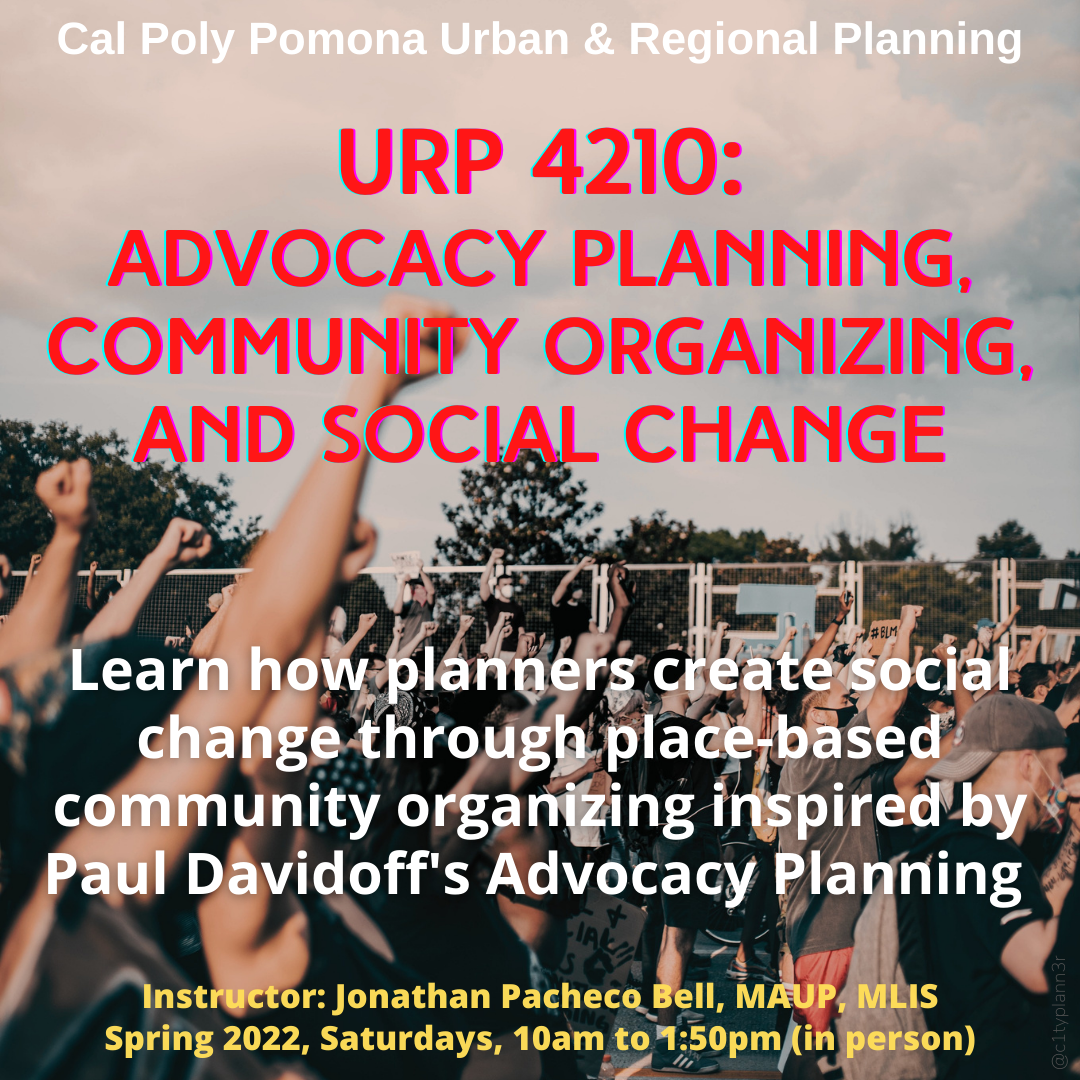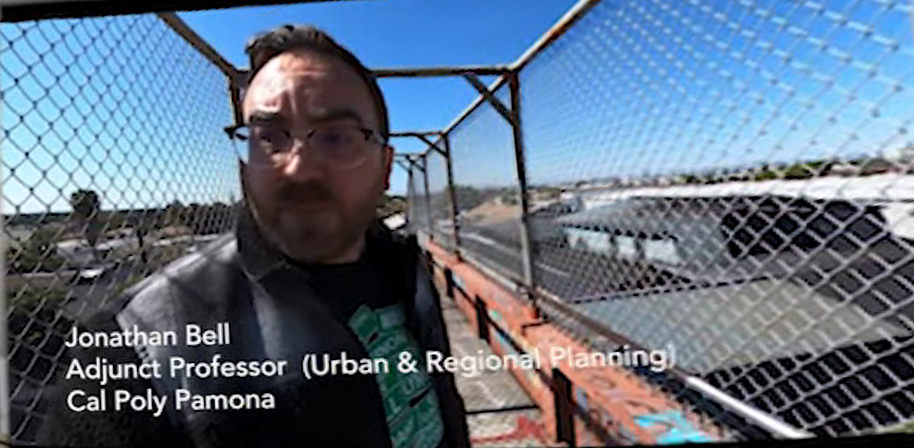
Next semester at Cal Poly Pomona Iβm teaching a course on Advocacy Planning, Community Organizing, and Social Change inspired by the work of the late Paul Davidoff: pauldavidoff.com

Next semester at Cal Poly Pomona Iβm teaching a course on Advocacy Planning, Community Organizing, and Social Change inspired by the work of the late Paul Davidoff: pauldavidoff.com

Cal Poly Pomona seeks a Dean of the College of Environmental Design
The new Dean must be an innovative, strategic, and collegial academic leader who embraces the mission of Cal Poly Pomona, is committed to student success, and will be a champion for CPPENV. Ideally, the new Dean of ENV will take office in the spring but is expected to do so no later than June 2022. Review of applications will begin December 6, 2021.
Academic Search is assisting Cal Poly Pomona in this search. Please see the profile for the position here:
To ensure full consideration, inquiries, nominations, and applications (PDF preferred) should be submitted electronically, in confidence, to: CPPENVDEAN@academicsearch.org
Nominations are encouraged. If you have a nomination for the position, please send the name, position, and institution along with an email address if you have it, to: CPPENVDEAN@academicsearch.org
Nominators and prospective candidates may also arrange a confidential conversation about this opportunity with the senior consultant leading this search, Cynthia M. Patterson, at: Cynthia.Patterson@academicsearch.org
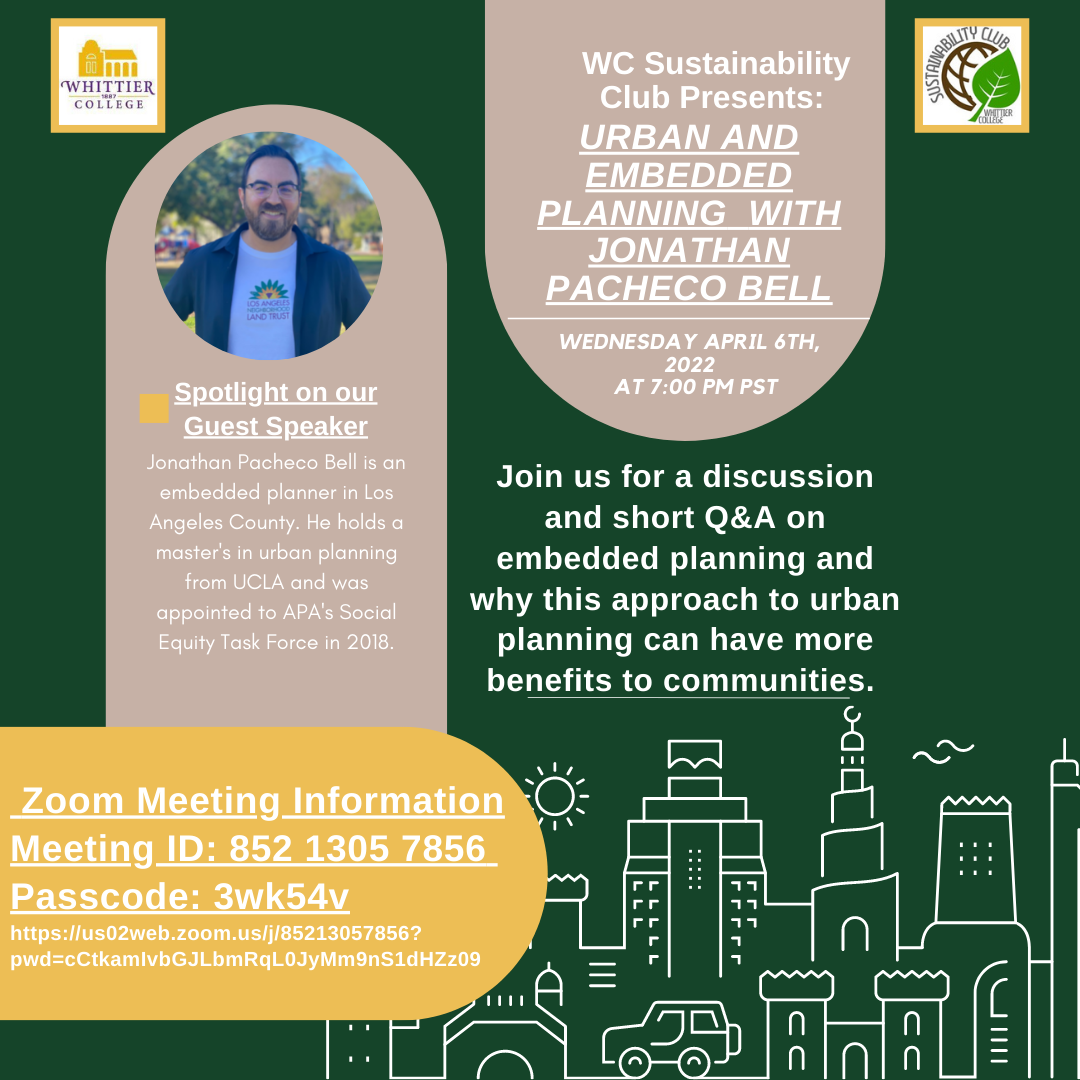
I spoke about #EmbeddedPlanning praxis at the 2021 AARP Livable Communities Workshop on engaging older adults. Shout out to my co-panelists. And big up to AARP organizers for the session transcript and video. Check it out.
Transcript and video together: https://www.aarp.org/livable-communities/about/info-2021/2021-Livable-Workshop-Collaborating-With-Community.html

Thank you to AARP Livable Communities Workshop organizers and my fellow panelists for this week’s conversation on engaging older adults.
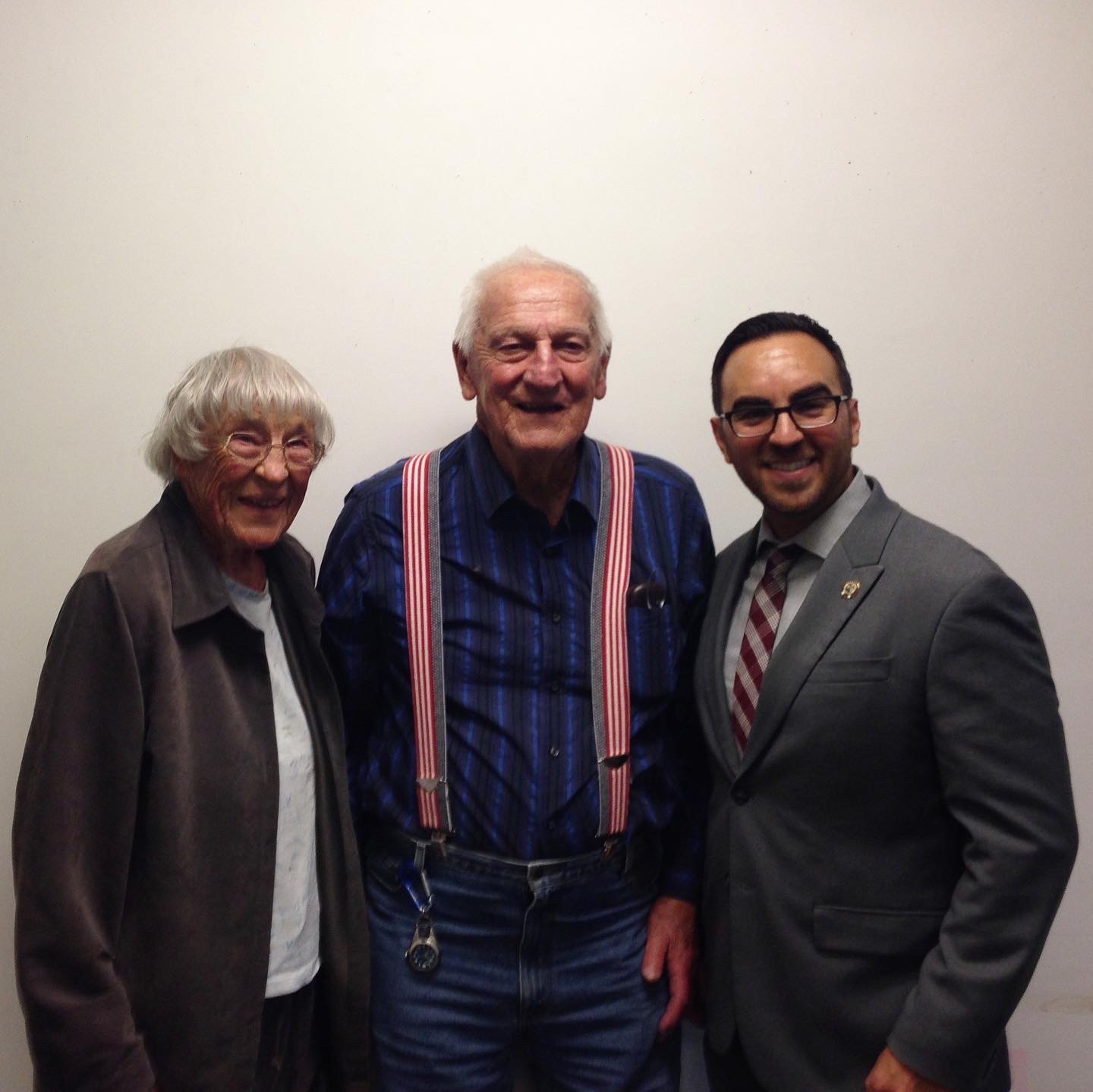
On September 13th, we lost Ms. Mary Rose Cortese, one of our community elders in South Central LAβs Florence-Firestone community. Mary has joined her brother Joe Titus in the next chapter. I know theyβre up there still advocating for Florence-Firestone.
Mary and Joe welcomed me into the community on Day 1 in 2009. They were honorary abuelitos to me and many others. Hug your elders. Ask them to tell you stories. Document their lives. Cherish them every day.
At the end of this #AARP session, I dedicated my presentation to Mary Rose Cortese ππ½π

Iβm speaking about #EmbeddedPlanning praxis at the AARP Livable Communities Workshop, Wednesday, September 22, 2021 at 10am Pacific. Weβre exploring ways to engage older adults and community elders in these times. The virtual event is FREE TO ALL. Come through.
Register here.

With Supervisor Janice Hahnβs fine-free library motion going to the Board of Supervisors tomorrow, I wrote a piece urging Supervisors to abolish fines at LA County Library.
Shout out to Laura Scarano and UCLA Luskin School of Public Affairs for spotlighting my work and C1TYPLANN3RCo in Luskin Forum Summer 2021, “Alumnus Founds Company to Promote Embedded Planning.”
WE CANNOT PLAN FROM OUR DESKS.

The Boyz N The Hood film and years of street reporting on NWA albums helped me become an urban planner in/for South Central LA.
I learned the word βgentrificationβ from Furious Stylesβs speech on the street corner in Compton.

I started tutoring students online during the COVID-19 pandemic and brought together my passions in Librarianship and Urban Planning. In this Medium article, I wrote about becoming a Virtual Librarian with specializations in Urban Studies, Urban Planning, and Library & Information Science.
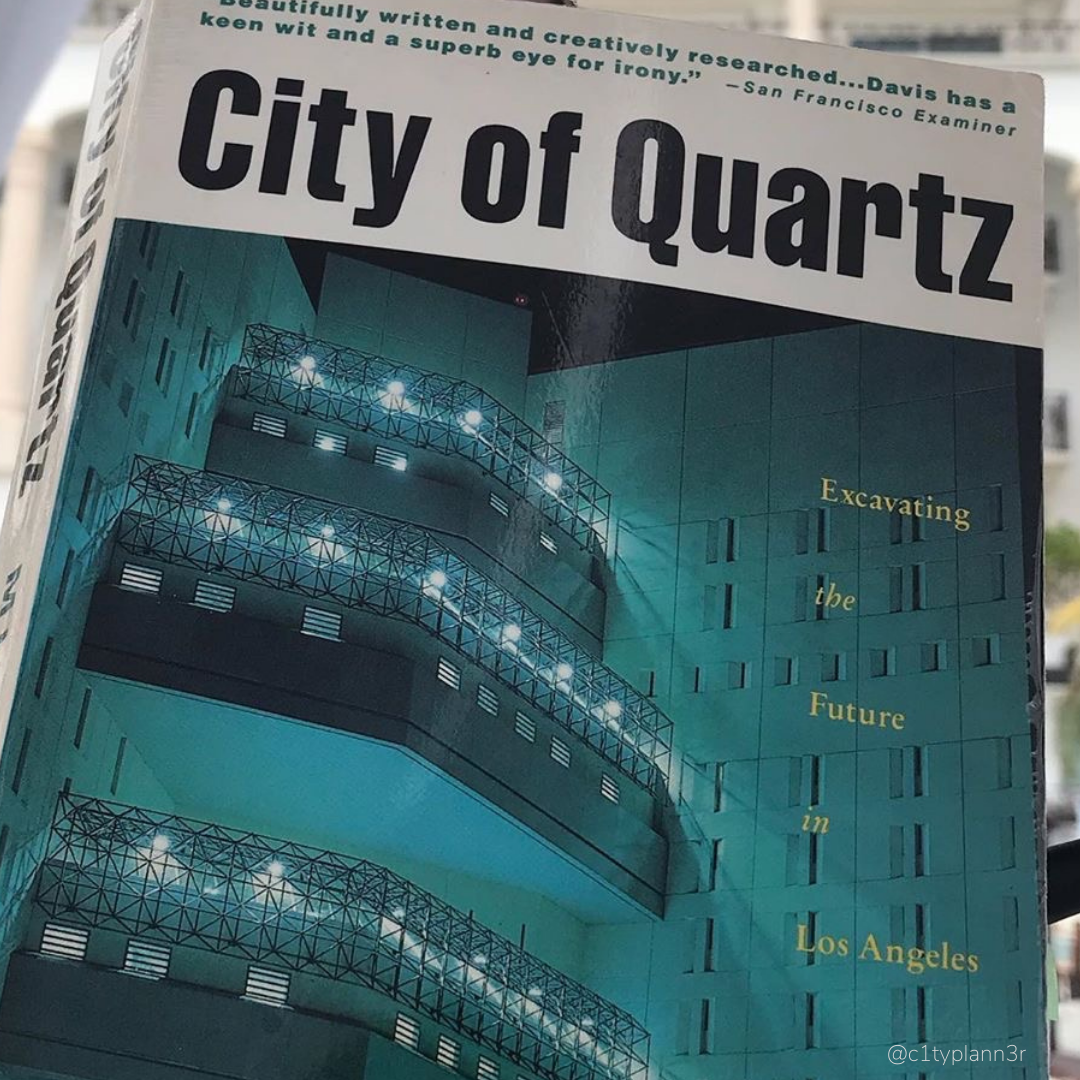
Recorded January 18, 2019 at American Planning Association HQ amidst our work on the national Social Equity Task Force. Since then, #EmbeddedPlanning has exploded onto the scene. And as my mentees will attest, I continue to big up Mike Davisβs City of Quartz: Excavating the Future in Los Angeles (1990). Start with the Fortress LA chapter. Itβs a groundbreaking critique of #HostileArchitecture βοΈ

In November 2020, I was interviewed by grad students from the UCLA Urban Humanities Initiative. Their research methods seminar examined LA urban theory + praxis through the lens of Reyner Banhamβs Los Angeles: The Architecture of Four Ecologies (1971).
I spoke at length about @EmbeddedPlanning praxis, west coast hip hop origins, and South Central LA.
The group distilled our conversation into a dope podcast called, βFlatlands: We Cannot Pod From Our Desks.β
Listen to my podcast interview and view the companion Thick Map of South Central LA β portion of it is this postβs image. Check out all project podcasts and infographics.
Thank you to Samantha Solis, Miranda Hirujo-Rincon, Carrie Gammell, and Celia Sanchez Zelaya.
I wrote a microessay about the #abandoned Arneβs Royal Hawaiian Motel in Baker, CA
Itβs up on my personal Instagram: @c1typlann3r
For a micro-donations platform, I use Ko-fi (coffee, but it rhymes with “No Fee”)
Ko-fi enables folks to support my writing and publishing passion projects.
A key feature of the platform is that Ko-fi sends 100% of the donations to me as creator βοΈ
As my work on Embedded Planning praxis progresses, Iβm now starting, in earnest, to write on more topics close to my heart. This includes reflective autobiography, critical analysis of public space, Los Angeles and Southern California history, and profiles of community leaders written from my on-the-ground perspective.
Donations help fund many aspects in my creative process, such as research, printing, database access, copyediting fees, and of course, the iterative and emotional part of writing.
Anything helps.
If you support my writing, please consider donating through Ko-fi so I can bring these stories to the people.
Thank you,
Jonathan Pacheco Bell, MAUP, MLIS @c1typlann3r

On April 20, 2021, I delivered the guest lecture, “Creating Equitable Public Spaces Through Embedded Planning.”
It was originally scheduled for one graduate class at UCLA. By day’s end I added a second talk for undergraduates at Cal Poly Pomona.
The talk was created for the UP 279: Public Space Seminar at UCLA Urban Planning. This was one of my favorite courses when I was a student there. Professor Anastasia Loukaitou-Sideris invited me to return as a speaker. She was my advisor in the MAUP (now MURP) program at UCLA, and taught this course back then too.
The presentation traced my work since graduation in 2005. I explained how I’ve created inclusive public spaces, and interrogated exclusionary hostile architecture, through street-level planning praxis.
The second talk was an evening presentation in Professor Alvaro Huerta’s course, Planning for Minority Communities, at Cal Poly Pomona Urban & Regional Planning. I appreciated the students welcoming this unscheduled event. Fun fact: I met Alvaro when we were both MAUP students in Anastasia’s Introduction to the History of the Built Environment course at UCLA Urban Planning.
Many students said that this was their introduction to the concept of #HostileArchitecture. Students continue to show excitement for the idea of Embedded Planning — planning practice on the ground. As always, I learned a lot from both Q & A sessions. Every question, comment, and critique advances Embedded Planning.
Check out my πΎπ€πͺπ£π©ππ§π₯π€ππ£π©π¨ π©π€ πΌππΎπ in “The Road to AICP” webinar.
You must be logged in to post a comment.