I loved my time at Casita Coalition. The backbone of Casita is a passionate team working tirelessly to enact middle housing solutions nationwide. This role allowed me to advance the mission, grow as a professional and person, and meet many wonderful people along the way. Casita is growing exponentially under the leadership of Noerena Limon. Thank you for the opportunity.
This decision was difficult because I love the team. But after much reflection, I’ve made a key career decision: I’m transitioning back into municipal planning, fulfilling a longtime goal of returning to the public sector where my work began. Full circle. More to come soon.
I’m grateful for everyone who’s supported me on the journey. Thank you.
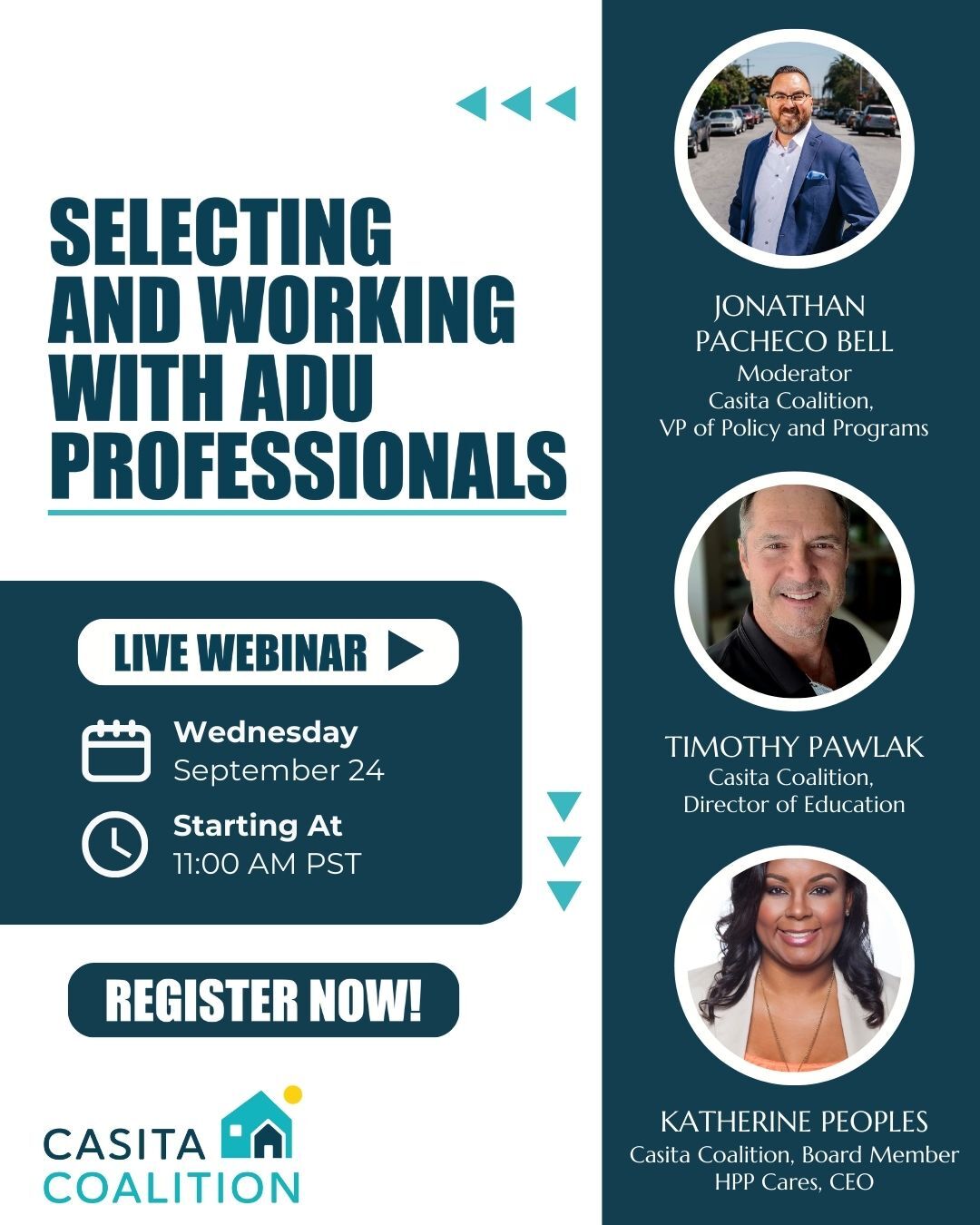
Want to build an ADU but feeling lost about who to work with? Don’t know where to start? Join us for this educational webinar focused on best practices for selecting and working with ADU professionals. Casita Coalition’s Director of Education, Timothy Pawlak, and Katherine Peoples, Casita Coalition Board Member and CEO of HPP Cares, will discuss the best ways to vet professionals, compare bids, review contracts, and protect yourself against fraud. This conversation will be moderated by Jonathan Pacheco Bell, VP of Policy and Programs at Casita Coalition.
Abstract: Legislatures across the country are saying “yes” to backyard housing and passing statewide accessory dwelling unit (ADU) reforms. This panel brings together leaders from successful pro-ADU movements in California, New Jersey, and Massachusetts to share lessons learned, best practices, and model legislation for legalizing second units in single-family areas.
Speakers: Max Dubler, California YIMBY, Policy Manager; Mike Kriesberg, Abundant Housing Massachusetts, Policy and Advocacy Manager; Marina Rubina, Who Killed The Starter Home? Podcast, Principal, Architect; Jonathan Pacheco Bell, Casita Coalition, VP of Policy and Programs
I learned so much from moderating this breakout session at the Build the Middle National Housing Convening 2025. And from feedback received thus far, session attendees gained many insights, tools, and practical action steps.
Big thanks to our panelists: Diana Gonzalez from Los Angeles County Department of Regional Planning, Tennis Wick from Permit Sonoma, Derek Ouyang from Stanford RegLab, and Awais Azhar from HousingWorks Austin.
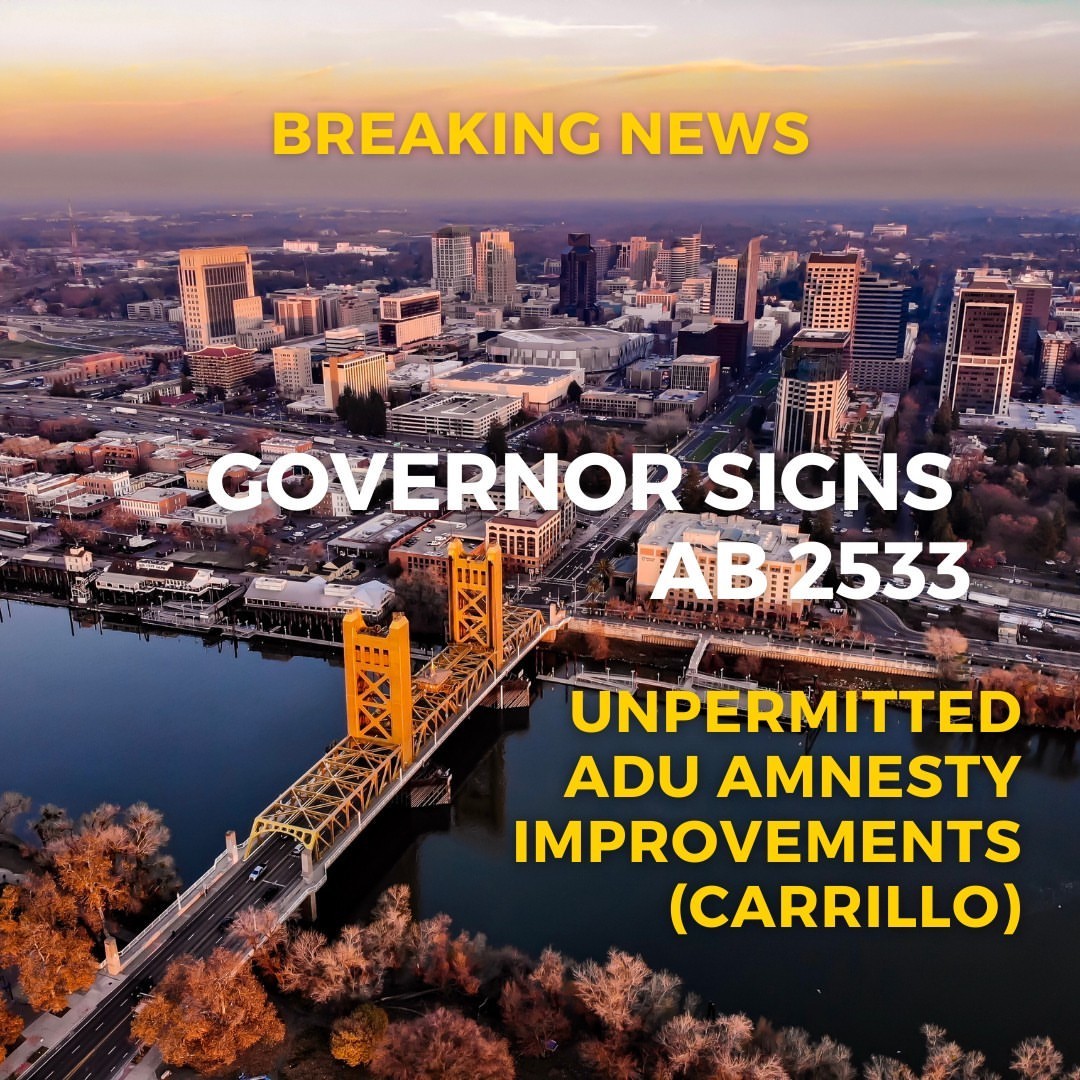
Governor Gavin Newsom has signed AB 2533 expanding amnesty for unpermitted ADUs. I’m proudly part of this effort in partnership with Casita Coalition, and the community of Florence-Firestone plays a role in the story. Shout out to Assemblymember Carrillo for authoring the legislation. Check out my reflections on AB 2533 as a former Zoning Enforcement Planner in Casita Coalition’s article authored by Board Chair Rafael Perez: https://www.casitacoalition.org/casita-coalition-blog/bringing-californias-hidden-housing-out-of-the-shadows-adu-amnesty-reform
From Casita Coalition social media:
Exciting News! Governor Newsom has signed Casita-sponsored AB 2533 into law! This bill is a game changer for legalizing unpermitted ADUs, making it easier, more affordable, and predictable for homeowners. Now, more homeowners can bring their units up to safety standards without breaking the bank, helping to preserve a critical segment of California’s naturally affordable rental housing market. This is a huge win for renters, homeowners, and housing stability in our communities! We thank Asm. Carrillo for championing this effort and everyone who supported this vital step toward advancing housing equity and preserving much-needed affordable homes. Our Board Chair, Rafael Perez, has authored a blog on AB 2355, titled “Bringing California’s Hidden Housing Out of the Shadows: ADU Amnesty Reform.” It features powerful insights from urban planner Jonathan Pacheco Bell @c1typlann3r and remarks from Assemblymember Juan Carrillo, highlighting the positive benefits this reform will unlock for communities.
Join me this Friday, March 29th at 11:00am PST for an update on the important topic of unpermitted or informal ADUs and efforts to make the process of legalization easier and less costly, hosted by Casita Coalition, a statewide nonprofit. Our panel will cover:
– The current process for legalizing an unpermitted unit under state law – How a safety-first legalization process can help preserve existing homes – Designing an ADU amnesty program that addresses common barriers for homeowners – AB 2533 (Carrillo)—a bill Casita Coalition is supporting to improve current ADU amnesty provisions
This webinar is generously sponsored by the City of Piedmont.
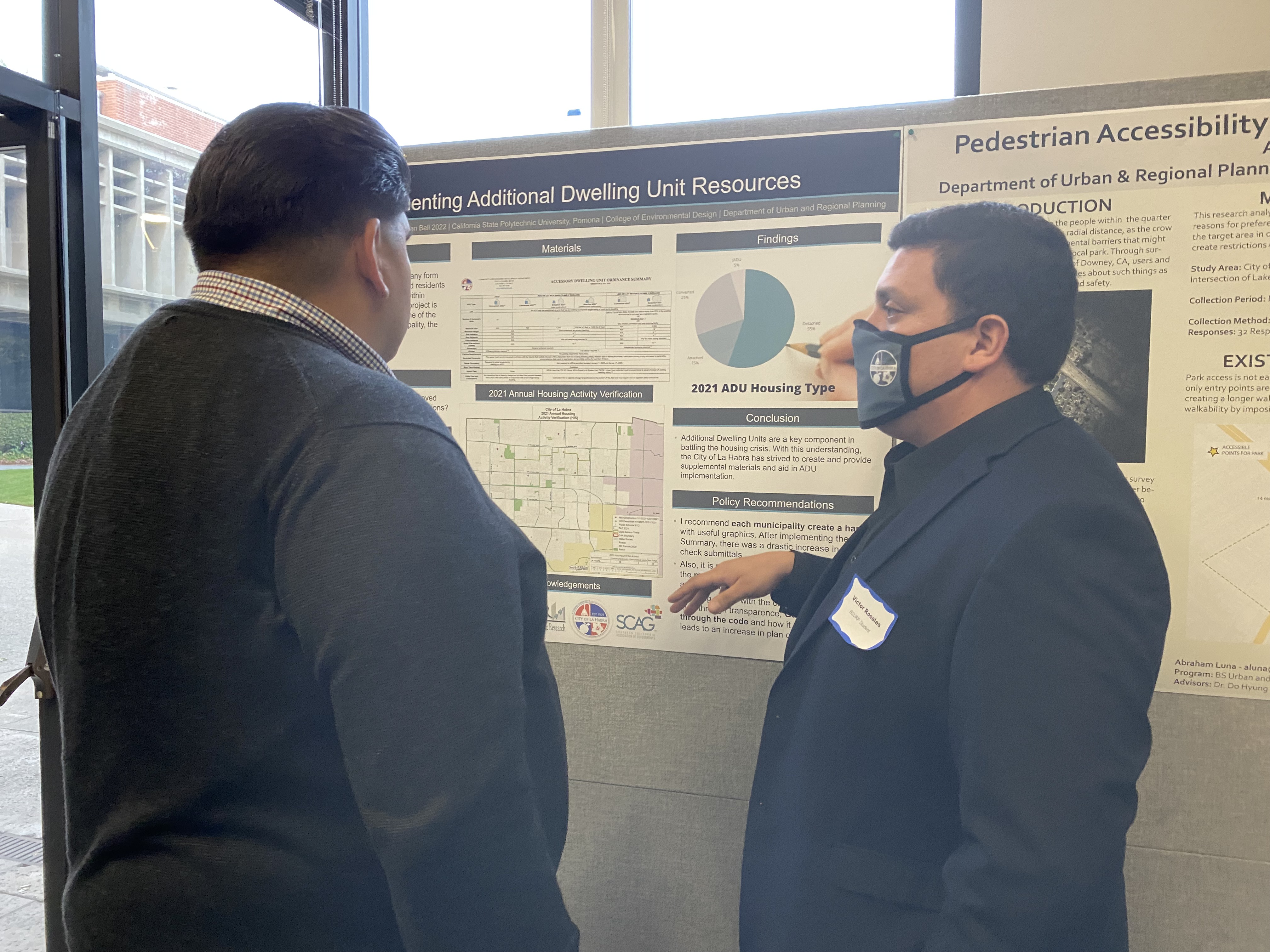
Senior Project poster by Victor Rosales. Image credit: Victor
I’m celebrating the graduates in my Senior Projects class at Cal Poly Pomona Department of Urban & Regional Planning! Today we big up this researcher:
Will ADU Resources Expedite Implementation?
By: Victor Rosales
Abstract: In the City of La Habra, California, there was not enough Accessory Dwelling Units (ADUs) being built to address the housing crisis. One of the main obstacles was a lack of ADU resources and materials available to the public. While the city’s municipal code is accessible for public review, a large portion of the community does not understand how to interpret zoning codes or how codes apply to individual projects.
With this understanding of the problem, I worked with city staff on creating supplemental ADU materials, with the intended goal of increasing the amount of ADUs built within city limits. In 2021, the city’s Senior Building Official created an ADU Summary handout with basic outlines of development standards and simple graphic aides. This newly introduced resource, along with the assistance and communication from staff to the community, resulted in an upsurge in ADU plan check submittals and new construction. City staff tracked the progression of these newly built ADUs though paid plan checks, Certificate of Occupancy, surveys, and California Department of Housing credit logs. The data showed an increased number of ADUs constructed in the last 6 months of 2021, which correlated with the timing of the implementation of the ADU Summary. By providing supplemental materials for ADUs, the City of La Habra was able to increase the amount of ADUs built in their community in 2021. Additionally, staff revised and enhanced these readily available resources to support ADU development. As a result, the amount of plan check submissions has nearly tripled in the first six months of 2022.
Upon studying the City of La Habra’s approach to ADUs, I offer several policy recommendations for resources and information that support expediting ADU implementation in cities.
Victor Rosales at CPP Senior Projects Poster Session 2022. Photo: Jonathan Pacheco Bell
Embedded Planning in Hannah Diaz’s MCP thesis Recommendations, MIT 2019
#EmbeddedPlanning has spread into urban planning student projects. One among many examples is Hannah Diaz’s MIT master’s thesis on Accessory Dwelling Unit (#ADU) pilot programs in Los Angeles, titled “Bidding AD(ie)U to Homelessness?”
Originally from California, Hannah wanted to write a thesis addressing the highly personal issue of homelessness back home. Affordable ADUs are part of the solution. Hannah interviewed me and several L.A. planning colleagues for this project. I shared my street-level experience with regulation and legalization of informal ADUs. I was honored to see Embedded Planning mentioned in Hannah’s Recommendations, as it implores planners to understand planning’s technocratic work from a “human perspective and weigh the effects of regulations on real, familiar lives.”
YES!
Congratulations Hannah Diaz on completing your Master in City Planning at MIT Urban Planning#MITDUSP! Onward to professional praxis 🙌
We brought the Medina Family ADU Story to Stanford Engineering on November 15, 2018. The Medina Family experience happens across all spaces, places, geographies, and jurisdictions. We need new audiences and new advocates. Photo courtesy of Derek Ouyang at Stanford SUS.
If you’ve been to my Medina Family ADU Story, or plan to attend an upcoming talk, you’ll see I get choked up. Happens every time. I don’t even try to suppress it anymore. This was a harrowing experience for the Medinas, and for me. My #EmbeddedPlanning praxis rejects the technocratic detachment of Rational Planning orthodoxy. When we shed tears, those tears are earned.
For the Medinas, removing the backyard dwelling built to generate income after the passing of their head of household worsened the stress that started it all. Ordering the removal after knowing the Medinas’ story made me question strict enforcement of #InformalHousing. The dwelling was not substandard—it was simply out of zoning compliance. All of this predated California’s relaxed State ADU Laws, so the only option was to demolish it. This was in 2016. After 10 years on the job, I’d finally realized that “Penalties or Demolition” was a false dilemma fallacy in #ADU enforcement. We’re trying to change this outcome for other folx.
The ending part is emotional for me. I conclude with slides featuring each member of the Medina Fam. I wanted audience members to understand the impact of rigid zoning on real people. I wanted to evoke an emotional response. And every time it works . . . on ME.
The final slide is of little Janelle. Janelle represents the future of #LosAngeles.
Janelle represents the future of Los Angeles. This effort is for her. Photo courtesy of Amy Thomson at SPUR
People’s lives are at the heart of Planning. Planners: befriend the community, get to know constituents personally, invest your heart into bettering THEIR lives and you’ll always have a righteous mission.
I could not do this series of public talks on #InformalHousing without permission & support of the Medina Family. My regulatory responsibility resulted in the removal of their informal #ADU but ironically brought us closer together. Theirs was a hard first lesson in Planning & Zoning. They knew others endure the same struggle. The Medinas permitted my public talks because they knew sharing their experience would help other residents & Other Planners understand the street realities of informal housing in working-class communities of color. They entrusted me to tell their story. They granted me a righteous mission.
Planners! We must draw inspiration from The People we serve.
The Medina Family—Flora, Josefina, Maria, and Janelle—they inspire me. Janelle represents the future of #LosAngeles. THIS IS FOR HER ♥️
Gracias Fay Darmawi for including us in the 2018 SF Urban Film Fest, SPUR Urbanist for hosting us, & SPUR’s Amy Thomson for photographing this moment.







You must be logged in to post a comment.