The Biltmore Los Angeles in Downtown LA, October 9-12, 2025
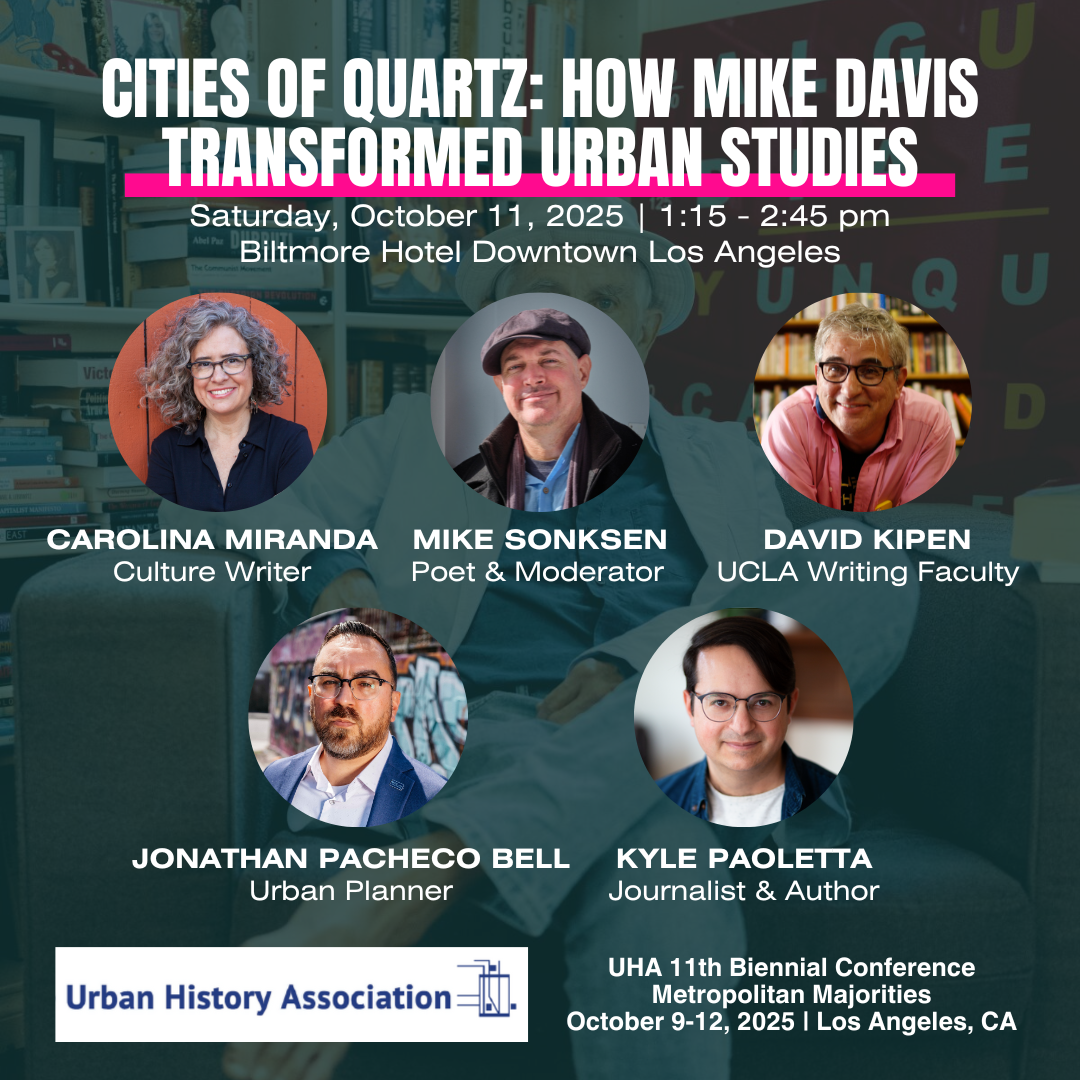
Cities of Quartz: How Mike Davis Transformed Urban Studies (Roundtable)
Saturday, October 11, 2025 | 1:15-2:45pm
Abstract:
In this roundtable discussion, a group of writers, academics, and urban planners will discuss the life and work of Mike Davis. With books like City of Quartz, Ecology of Fear, and Planet of Slums, Davis played an irreplaceable role in pushing urban scholars to foreground questions of equity, justice, and sustainability in their work. Each of Davis’ books and articles was grounded in a clear-eyed assessment of the power dynamics that create unequal societies, and throughout his life he remained a forceful advocate for the moral necessity that poor and working-class communities — whatever their ethnic or racial makeup — have the same chance at opportunity as the ruling class.
To illuminate Davis’ legacy, our discussion will begin with the impact he had on how the city of Los Angeles understands itself, before we open our inquiry into applying his method to cities everywhere and incorporating his ethos into future urban plans.
The roundtable will be moderated by Mike Sonksen, a poet and former Woodbury University professor who was mentored by Mike Davis and remained friends with him for over two decades.
The Strength of Street Knowledge: Embedded Planning as Community-Based Praxis
This talk introduces a new method of urban planning called Embedded Planning Praxis. Embedded Planning revolutionizes practice by emphasizing street-level planning within the community rather than traditional desk-based methods. Developed by Jonathan Pacheco Bell in South Central LA as an outgrowth of code enforcement work, Embedded Planning has evolved into a community-based praxis that seeks to rebuild trust and foster meaningful relationships with marginalized communities historically harmed by inequitable planning.
Embedded Planning is working directly from community spaces and places. Embedded planners engage residents in everyday environments, evolving practice from desk-based policy formation to on-the-ground collaboration in and from the neighborhood. This immersive approach helps planners gain a deeper understanding of local needs and aspirations, ensuring that community voices and needs significantly shape planning decisions. Embedded Planning is a timely evolution in the field that aligns with growing calls for more equity-centered, place-based, participatory practices. By embedding themselves into neighborhoods, planners build strong and authentic relationships, moving beyond one-off, transactional consultations to create lasting and impactful partnerships.
Using a reflective practitioner framework, Jonathan will illustrate what Embedded Planning looks like, explain its role as his motivating throughline, highlight embedded planners implementing these inclusive methods coast to coast, while highlighting the challenges and benefits of this praxis. Attendees will learn how this emerging movement represents a crucial shift towards centering planning as an active and continuous process from within the community and represents the future of planning.
Speaker:
Jonathan Pacheco Bell is an urban planner with two decades of experience in California working across the public, private, and nonprofit sectors. For 14 years, he served as a Los Angeles Zoning Enforcement Officer building partnerships on the ground in communities of color. During this time, he witnessed the harms of inequitable zoning, inspiring him to create new forms of street-level planning advocacy —what he calls Embedded Planning Praxis.
Jonathan is the VP of Policy and Programs at Casita Coalition, a nonprofit that advocates for middle housing solutions. In addition to full-time practice, he volunteers as an Executive Board Member of the nonprofit Florence-Firestone Community Organization in South Central Los Angeles and was an Adjunct Professor at Cal Poly Pomona Department of Urban and Regional Planning from 2021-2025.
Jonathan has guest lectured nationally on Embedded Planning, with speaking engagements at Columbia University, Duke, Ohio State, University of Utah, Pratt Institute, Stanford Engineering, and UCLA; state and national APA Conferences in California, Iowa, Louisiana, and Indiana; and public forums such as AARP Livable Communities and the San Francisco Urban Film Fest.
A leader in the American Planning Association for over a decade, Jonathan is a member of the Latinos and Planning Division and is published in APA’s practitioner magazine, Planning. He previously served as APA Los Angeles section’s Social Media Director and was the Southern California representative on the APA National Social Equity Task Force.
Jonathan’s dedication to advocacy has earned him industry accolades, including the Planning Advocate Award of Excellence from APA Los Angeles and Planning Pioneer Award of Excellence from APA Inland Empire in 2024. He holds an MA in Urban Planning from UCLA Luskin and additional degrees in architecture, political science, and information science.
The Biltmore Los Angeles in Downtown LA, October 9-12, 2025
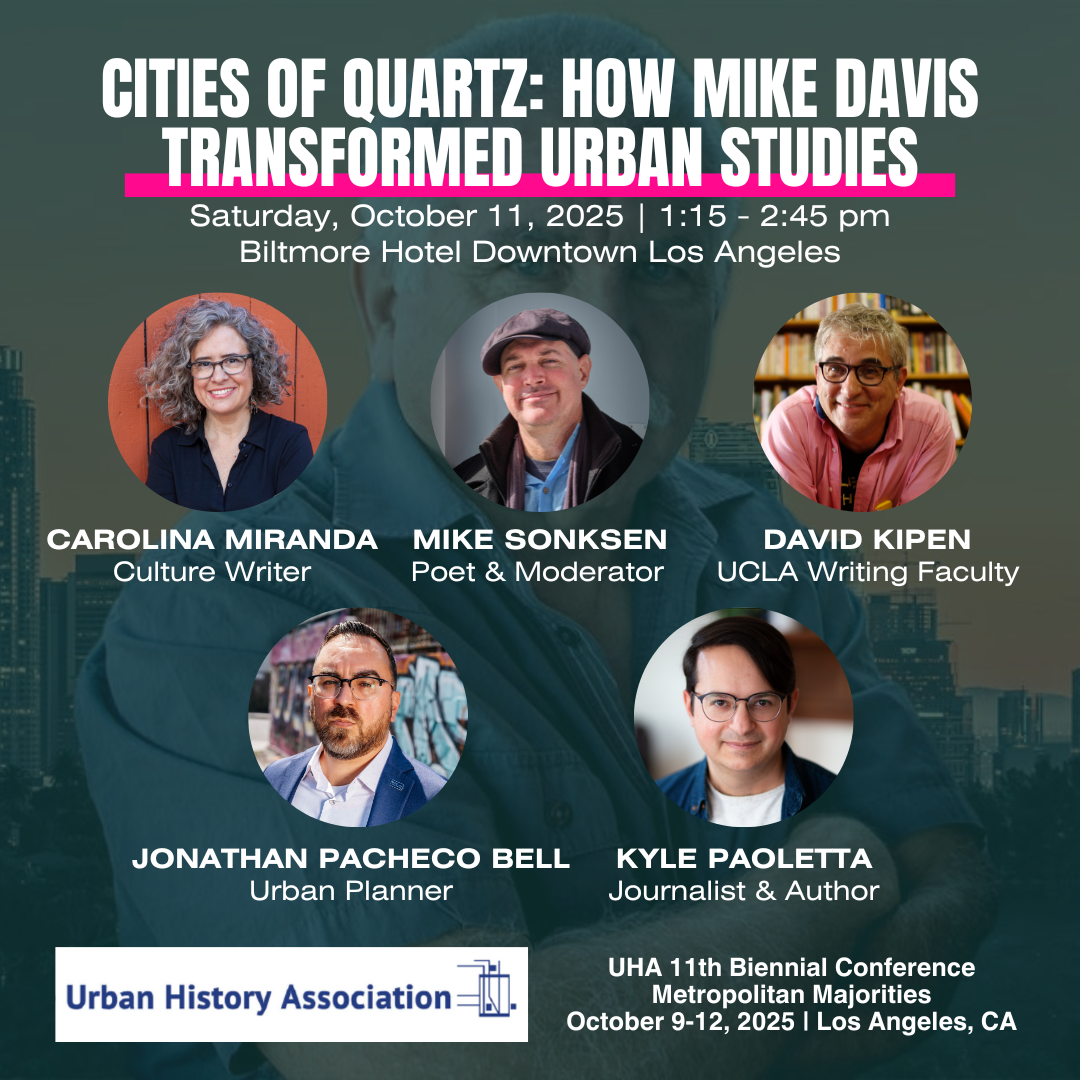
Cities of Quartz: How Mike Davis Transformed Urban Studies (Roundtable)
Saturday, October 11, 2025 | 1:15-2:45pm
Abstract:
In this roundtable discussion, a group of writers, academics, and urban planners will discuss the life and work of Mike Davis. With books like City of Quartz, Ecology of Fear, and Planet of Slums, Davis played an irreplaceable role in pushing urban scholars to foreground questions of equity, justice, and sustainability in their work. Each of Davis’ books and articles was grounded in a clear-eyed assessment of the power dynamics that create unequal societies, and throughout his life he remained a forceful advocate for the moral necessity that poor and working-class communities — whatever their ethnic or racial makeup — have the same chance at opportunity as the ruling class.
To illuminate Davis’ legacy, our discussion will begin with the impact he had on how the city of Los Angeles understands itself, before we open our inquiry into applying his method to cities everywhere and incorporating his ethos into future urban plans.
The roundtable will be moderated by Mike Sonksen, a poet and former Woodbury University professor who was mentored by Mike Davis and remained friends with him for over two decades.
The Biltmore Los Angeles in Downtown LA, October 9-12, 2025
Cities of Quartz: How Mike Davis Transformed Urban Studies (Roundtable)
Saturday, October 11, 2025 | 1:15-2:45pm
Abstract:
In this roundtable discussion, a group of writers, academics, and urban planners will discuss the life and work of Mike Davis. With books like City of Quartz, Ecology of Fear, and Planet of Slums, Davis played an irreplaceable role in pushing urban scholars to foreground questions of equity, justice, and sustainability in their work. Each of Davis’ books and articles was grounded in a clear-eyed assessment of the power dynamics that create unequal societies, and throughout his life he remained a forceful advocate for the moral necessity that poor and working-class communities — whatever their ethnic or racial makeup — have the same chance at opportunity as the ruling class.
To illuminate Davis’ legacy, our discussion will begin with the impact he had on how the city of Los Angeles understands itself, before we open our inquiry into applying his method to cities everywhere and incorporating his ethos into future urban plans.
The roundtable will be moderated by Mike Sonksen, a poet and former Woodbury University professor who was mentored by Mike Davis and remained friends with him for over two decades.
I learned so much from moderating this breakout session at the Build the Middle National Housing Convening 2025. And from feedback received thus far, session attendees gained many insights, tools, and practical action steps.
Big thanks to our panelists: Diana Gonzalez from Los Angeles County Department of Regional Planning, Tennis Wick from Permit Sonoma, Derek Ouyang from Stanford RegLab, and Awais Azhar from HousingWorks Austin.
I’m moderating the panel session “We’re In This Together: Improving Communities Through Planning and Code Enforcement Collaboration” at the 2024 APA CA Conference in Riverside. Our session is on September 28th, Conference Day 1, at 2:45pm. Come through.
Session description:
Planning and code enforcement are highly specialized and frequently politicized municipal services. At times this results in competing priorities and differing work styles, but fundamentally planners and code enforcement inspectors share the goal of creating community wellness. We best achieve this through intentional collaboration.
This session brings together planners and code enforcement professionals for a candid conversation about collaborative practice. Panelists will draw from personal reflections, scenarios, and case studies, and respond to interactive audience questions, to illustrate code enforcement and planning collaboration opportunities that benefit the community. By working collaboratively, planners and code enforcement avoid conflicting outcomes and reduce costs while co-creating better plans, policies, and programs and advancing fairness in land use regulation.
The moderator will facilitate a discussion exploring how effective communication, desire for mutual learning, and partnerships among planners, code enforcement regulators, and the community can increase equitable and inclusive planning, leading to more successful outcomes. Using interactive digital and in-person engagement methods, the audience will be empowered to guide the conversation in this forum. Attendees will gain insights and tools that they can apply in a variety of organizational settings to build collaborative opportunities for code enforcement and planning professionals.
I’m moderating the panel session “Land Use Hot Topics and Code Enforcement” at the 2024 APA CA Conference in Riverside. Our session is on September 28th, Conference Day 1, at 1:30pm. Come through.
Session description:
In an era of evolving regulations and shifting political landscapes, code enforcement officers and planners face unique challenges when addressing land use issues related to cannabis operations, massage parlors, and sidewalk vending. This session will explore the delicate balance between upholding local regulations and navigating the complex web of state rights and political sensitivities.
Our expert panel will share insights and strategies from jurisdictions across Southern California that have successfully tackled these challenging enforcement areas. Attendees will gain valuable knowledge on:
– Developing effective communication strategies to educate stakeholders on local regulations while respecting state rights.
– Collaborating with code enforcement and other agencies to address illegal operations and ensure public safety.
– Implementing innovative approaches to code enforcement that prioritize community engagement and voluntary compliance.
– Navigating political pressures and maintaining professionalism in sensitive enforcement situations.
Through interactive discussions and real-world case studies, participants will leave equipped with practical tools and best practices to manage politically sensitive land use issues in their own jurisdictions. This session aligns with the conference theme by emphasizing the importance of adaptability, collaboration, and innovation in the face of evolving challenges in code enforcement.




You must be logged in to post a comment.