I joined a chorus of voices sharing the impact of the late urban historian Mike Davis. I mean every word ❤ I’m an LA urban planner because of Mike. Embedded Planning praxis exists because of his teachings.
Community engagement must evolve. We planners engage the public when we need feedback. People are consulted; input is gathered; and plans, for the most part, incorporate public input — then the relationship concludes, only to restart with the next project. Such transactional planning does little to build long-term stakeholder relationships.
In a time of increasing interrogation of planning and its legacies of inequity, planners today are seeking better ways to build and sustain meaningful partnerships. Urban planner Jonathan Pacheco Bell (@c1typlann3r) proposes #EmbeddedPlanning as a way to fundamentally restructure community engagement and practice. Embedded Planning means planning from the street, not from a desk. Embedded Planners work in the spaces and places of community members. Embedded Planners build bridges with marginalized communities harmed by past planning practices. Embedded Planning is a praxis that puts theory into action to better this world. Since Bell declared Embedded Planning exists in 2018, it has grown into an international movement embraced by emerging planners.
Through storytelling and personal reflection, Bell will illustrate how Embedded Planning is being used to build lasting community partnerships that center engagement as an ongoing process. Attendees will learn the benefits and challenges of Embedded Planning, including takeaways for implementation, and understand why this #praxis is the future of planning.
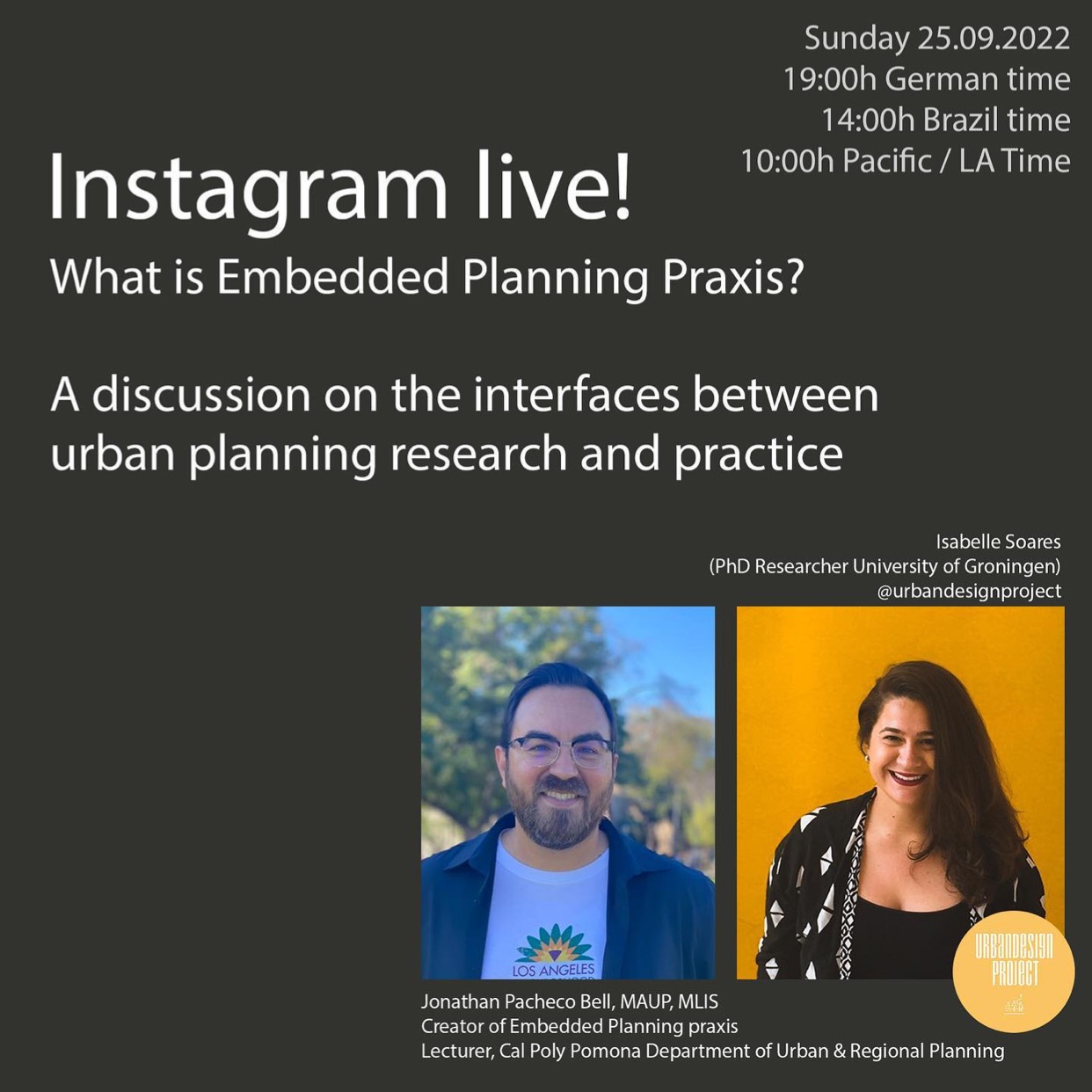
Infographic by Isabelle Soares @UrbanDesignProject
I enjoyed discussing Embedded Planning praxis on Instagram Live with Isabelle Soares @urbandesignproject. Planners and designers from Brazil, Germany, Netherlands, Canada and the US took part in the event, making it the first international conversation I’ve done on Embedded Planning. I learned a lot from Isabelle and the audience. Every chat advances the praxis. More to come.
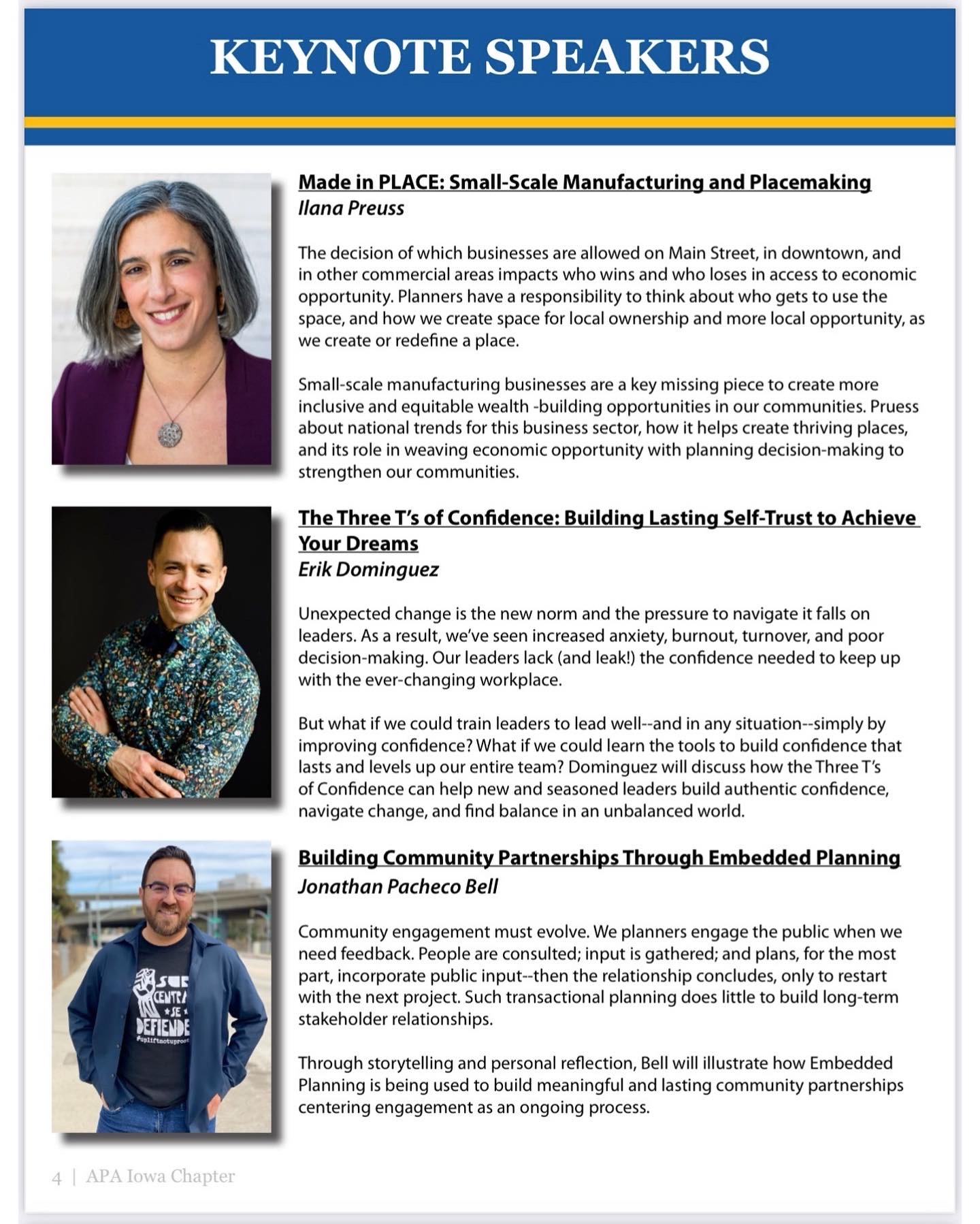
Building Community Partnerships Through Embedded Planning
Community engagement must evolve. We planners engage the public when we need feedback. People are consulted; input is gathered; and plans, for the most part, incorporate public input — then the relationship concludes, only to restart with the next project. Such transactional planning does little to build long-term stakeholder relationships.
In a time of increasing interrogation of planning and its legacies of inequity, planners today are seeking better ways to build and sustain meaningful partnerships. Urban planner Jonathan Pacheco Bell (@c1typlann3r) proposes Embedded Planning as a way to fundamentally restructure community engagement and practice. Embedded Planning means planning from the street, not from a desk. Embedded Planners work in the spaces and places of community members. Embedded Planners build bridges with marginalized communities harmed by past planning practices. Embedded Planning is a praxis that puts theory into action to better this world. Since Bell declared Embedded Planning exists in 2018, it has grown into an international movement embraced by emerging planners.
Through storytelling and personal reflection, Bell will illustrate how #EmbeddedPlanning is being used to build lasting community partnerships that center engagement as an ongoing process. Attendees will learn the benefits and challenges of Embedded Planning, including takeaways for implementation, and understand why this #praxis is the future of planning.
I appreciate UC Irvine ProfessorMichael Mendezciting me and Embedded Planning in his article, “The Reflective Practitioner in the Context of Racial and Environmental Justice” in Planning Theory & Practice 2022. This is the Repair and Healing issue co-edited by ProfessorCourtney Knapp.
This is the first mention of Embedded Planning praxis in a peer-reviewed journal! The entire issue is Open Access. Read Dr Méndez and all the insightful articles.
Here’s the excerpt:
“Allowing time for critical reflective practice can be a powerful tool for planners to think purposively about their prior actions and to learn how in the future they can better challenge multiple forms of inequality embedded in the urban planning profession. Such an approach has led one county planner, Jonathan Pacheco Bell, to advocate broadly for planners to step away from their office desks and embed themselves in local communities, in what he calls, “Embedded Planning.” He believes that “for planning to achieve equity in communities, planners need to see the realities of community life…[and] connect with the people we serve” (Pacheco Bell, 2018). While he still works in an office and attends community meetings, he argues for prioritizing street-level engagement. Pacheco Bell often goes directly to constituents’ localized spaces: homes, churches, businesses, and bus stops to perform plain language outreach, conduct neighborhood organizing, give walking tours, mentor students, do empathetic code enforcement, and more. Pacheco Bell argues that working in such a manner helps produce more equitable plans, policies, and ordinances.
This type of emerging embedded planning offers a multidimensional view of the interactions between people’s well-being and the varying contexts of climate or environment or community shaped by wider political, institutional, economic, and social structures (Goldsmith et al., 2021; Mendez et al., 2020). For practitioners, in particular, such an approach can provide valuable contextual analysis and reflection on what hinders racial and environmental justice reform within the planning and regulatory institutions.”
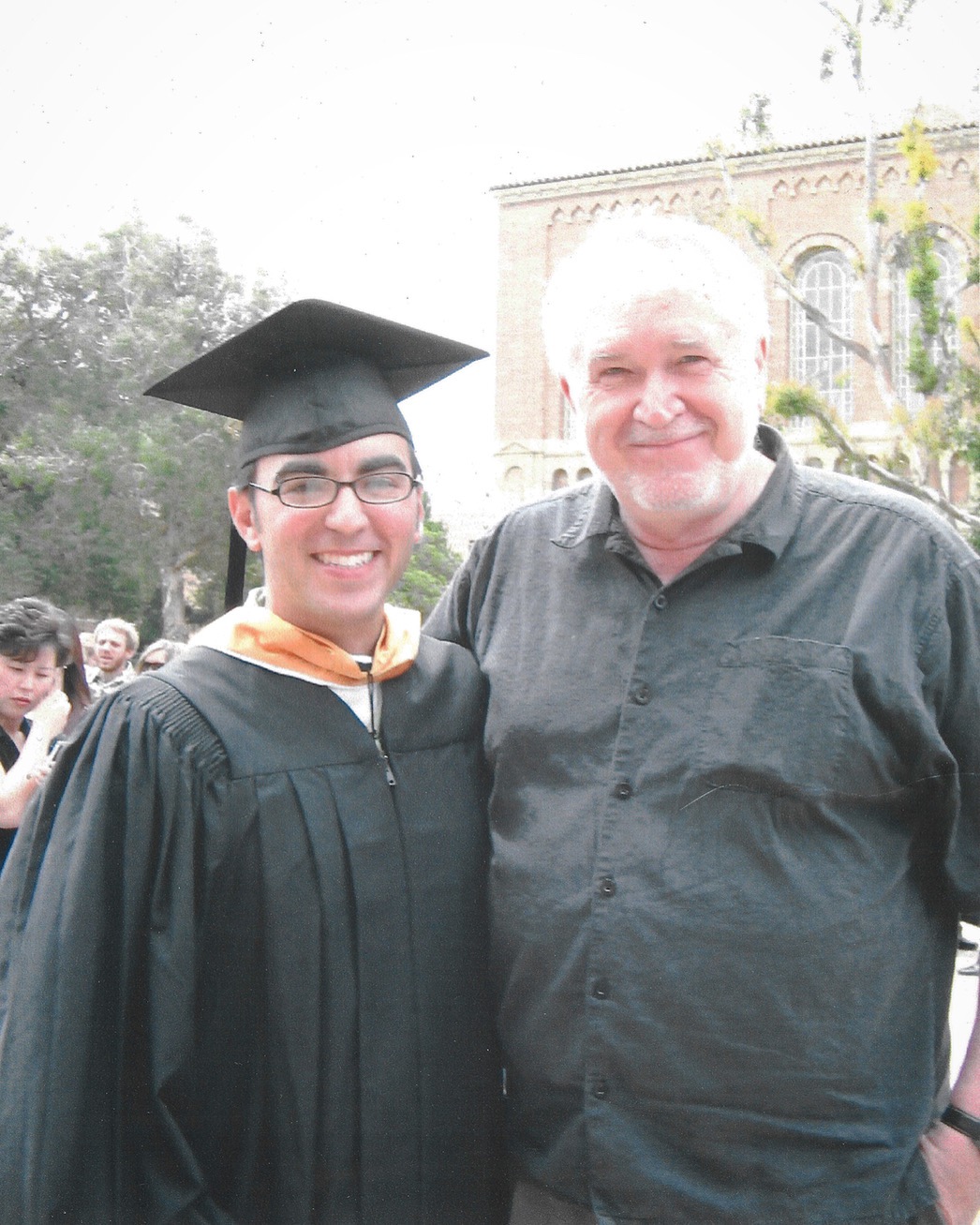
Edward W. Soja and me on graduation day June 17, 2005 at UCLA Urban Planning. Photo by Jonathan Pacheco Bell
Edward Soja and me on graduation day 17 years ago today. Grad school was tough. I felt the weight of the neighborhood on my shoulders. I nearly dropped out 5 times, but Ed inspired me to stay and keep at it. My work with Soja would help me create Embedded Planning years later. The moral of the story: Find mentors who inspire you.
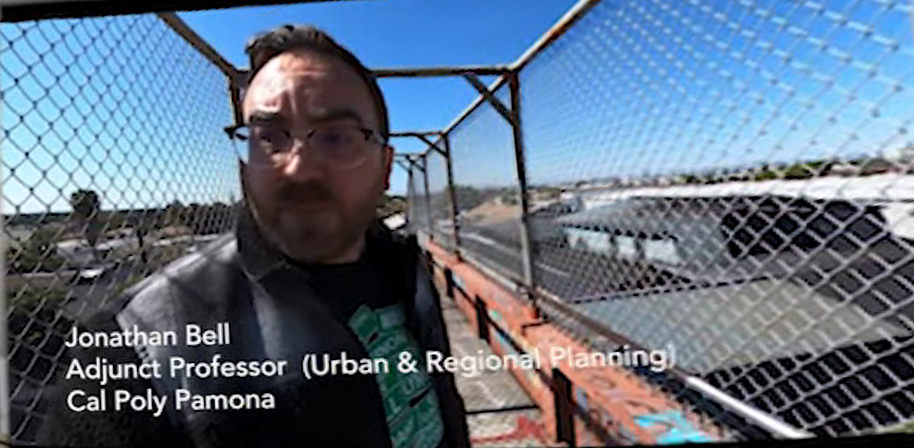
Still image from “Reflections of the LA Uprising” 30 Years Later
The 1992 Los Angeles Uprising began thirty years ago today — April 29, 1992.
I was interviewed for “Reflections of the LA Uprising”30 years later. This is a collaboration by JOVRNALISM, USC Annenberg, KCET, and LA Times.
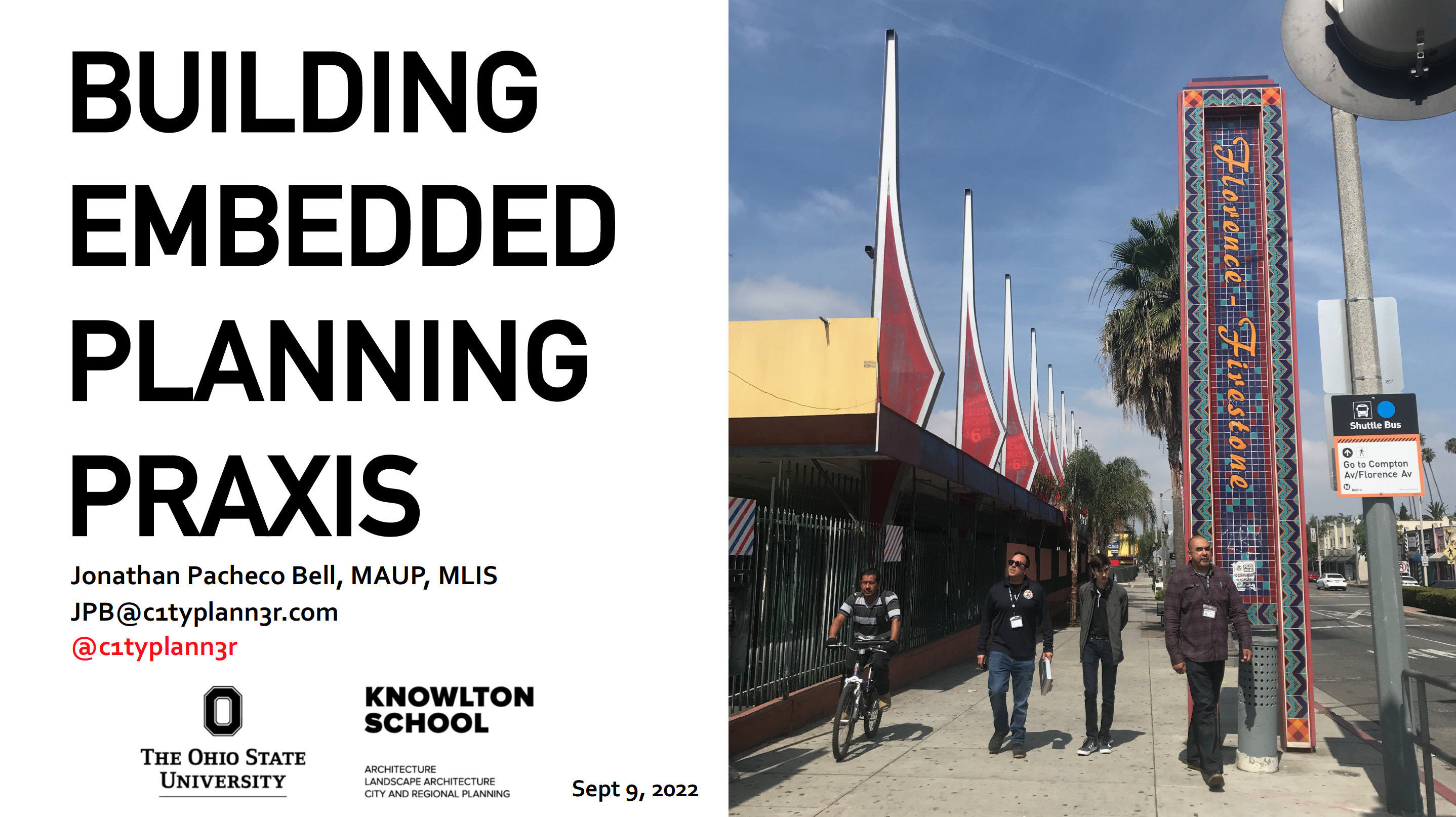
I shared how the unrest led me on a path toward urban planning in/for South Central LA. And I testified this path would inspire me to create Embedded Planning as an LA County planner on the ground in Florence-Firestone.
Rightfully, this interview was done at the landmark Roosevelt Park pedestrian bridge over the Blue Line.
Many community voices are part of this project. Check out the immersive video “Echoes of the Uprising” where we share our memories and oral histories.
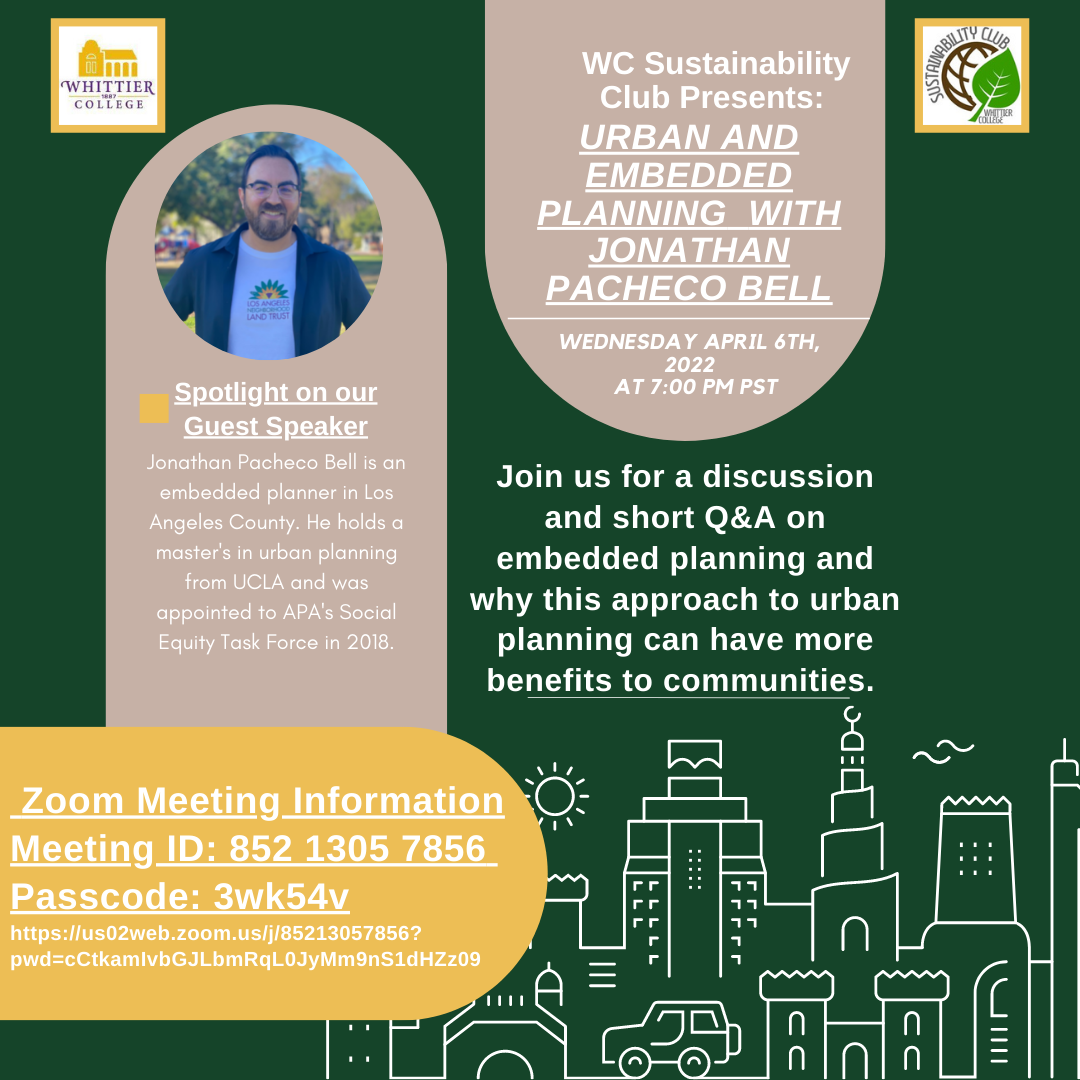
Shout out to the Whittier CollegeSustainability Club for hosting my talk tonight on Embedded Planning. Special thank you! to Ashley Dueñas for her leadership bringing this talk to students. Street-level praxis resonated. It is the future of planning. We cannot plan from our desks.
The latest instanceof our Embedded Planning movement coming up favorably in a job interview.
We are everywhere.
We cannot plan from our desks.
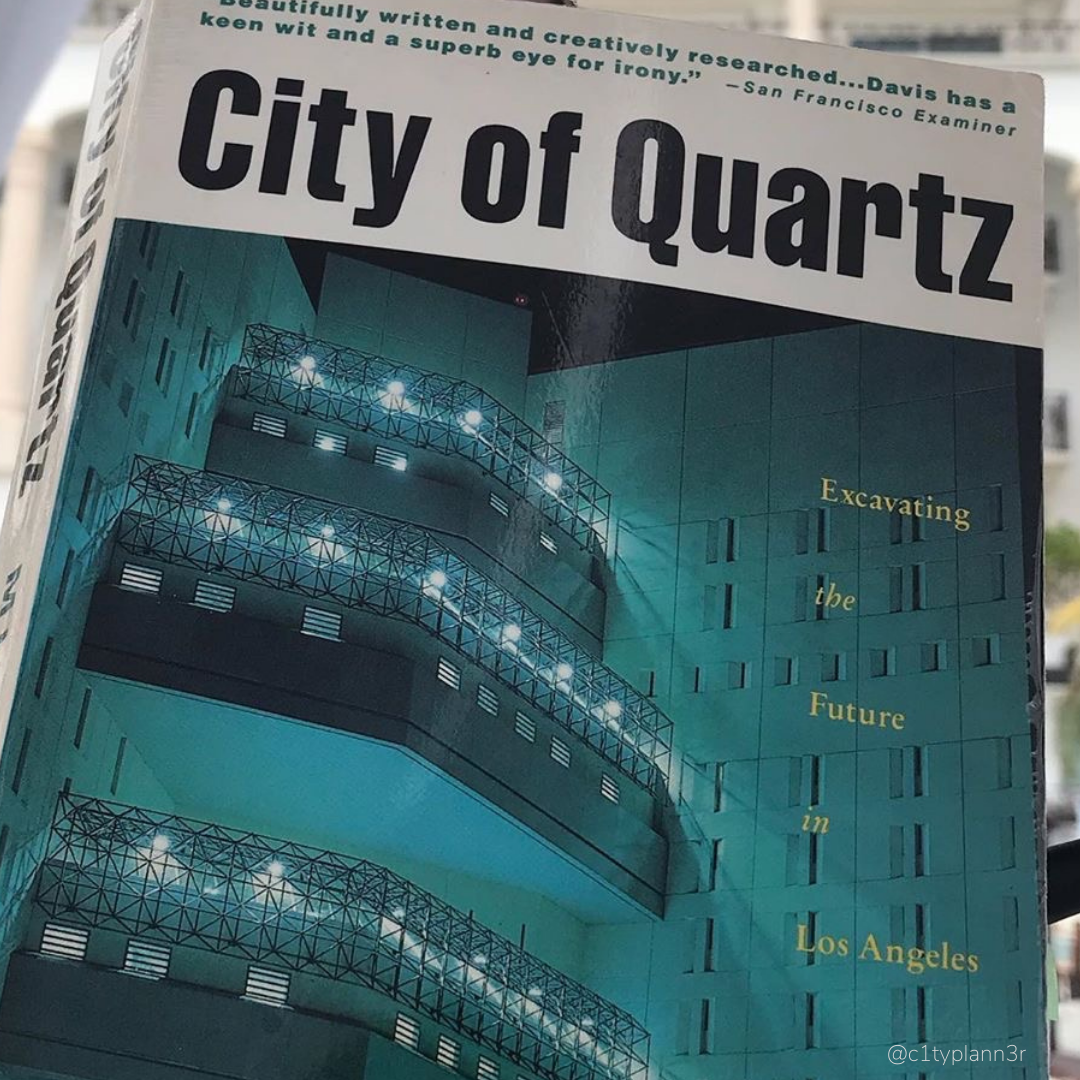
Background image: The book I recommend to every critical planner and embedded planner — especially the Fortress LA chapter — is City of Quartz: Excavating the Future in Los Angeles, by Mike Davis.








You must be logged in to post a comment.