This is the next chapter of the Embedded Planning story.
This is the next chapter of the Embedded Planning story.

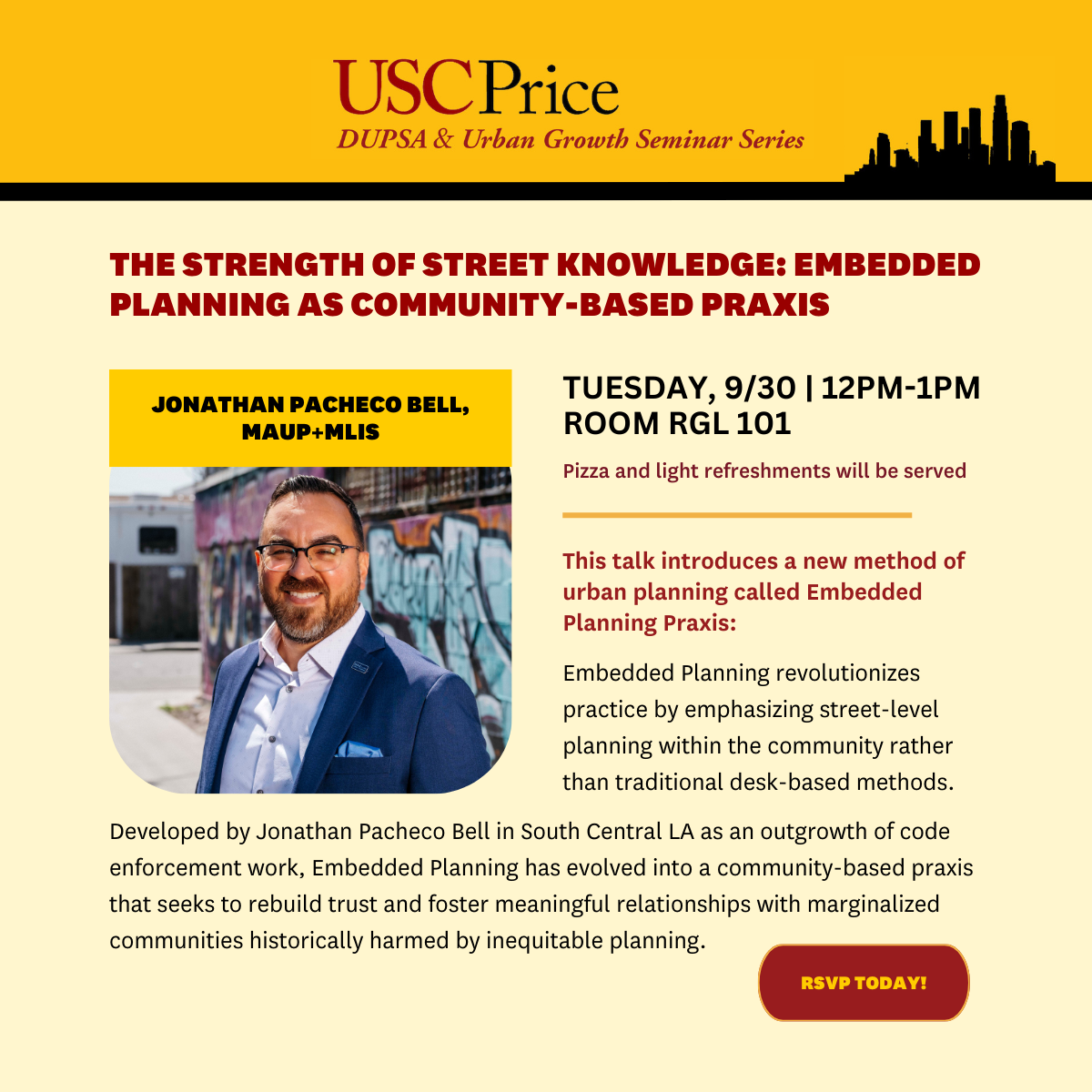
The Strength of Street Knowledge: Embedded Planning as Community-Based Praxis
This talk introduces a new method of urban planning called Embedded Planning Praxis. Embedded Planning revolutionizes practice by emphasizing street-level planning within the community rather than traditional desk-based methods. Developed by Jonathan Pacheco Bell in South Central LA as an outgrowth of code enforcement work, Embedded Planning has evolved into a community-based praxis that seeks to rebuild trust and foster meaningful relationships with marginalized communities historically harmed by inequitable planning.
Embedded Planning is working directly from community spaces and places. Embedded planners engage residents in everyday environments, evolving practice from desk-based policy formation to on-the-ground collaboration in and from the neighborhood. This immersive approach helps planners gain a deeper understanding of local needs and aspirations, ensuring that community voices and needs significantly shape planning decisions. Embedded Planning is a timely evolution in the field that aligns with growing calls for more equity-centered, place-based, participatory practices. By embedding themselves into neighborhoods, planners build strong and authentic relationships, moving beyond one-off, transactional consultations to create lasting and impactful partnerships.
Using a reflective practitioner framework, Jonathan will illustrate what Embedded Planning looks like, explain its role as his motivating throughline, highlight embedded planners implementing these inclusive methods coast-to-coast, while highlighting the challenges and benefits of this praxis. Attendees will learn how this emerging movement represents a crucial shift towards centering planning as an active and continuous process from within the community and represents the future of planning.
Speaker bio
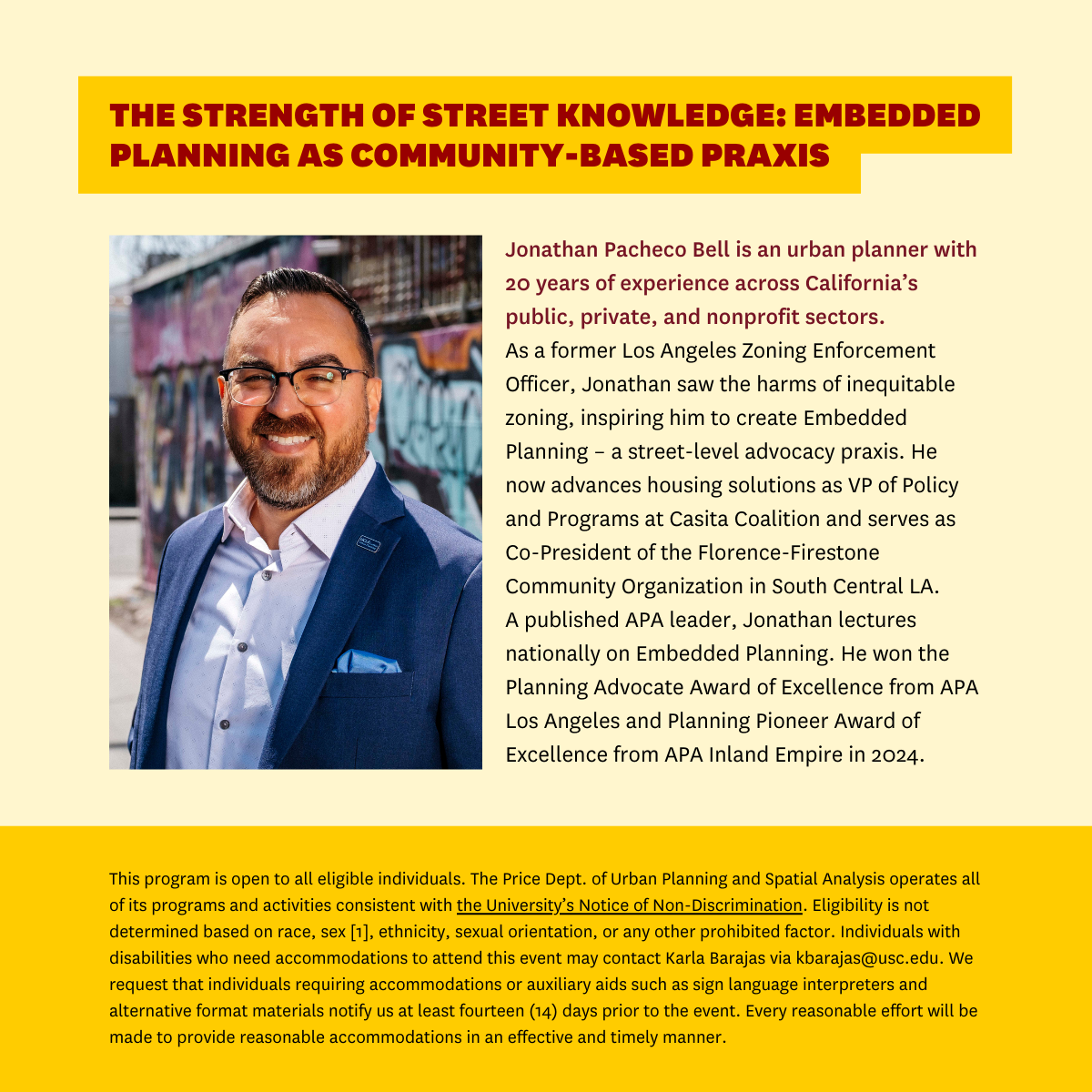
Jonathan Pacheco Bell is an urban planner with two decades of experience in California working across the public, private, and nonprofit sectors. For 14 years, he served as a Los Angeles Zoning Enforcement Officer building partnerships on the ground in communities of color. During this time, he witnessed the harms of inequitable zoning, inspiring him to create new forms of street-level planning advocacy – what he calls Embedded Planning praxis.
Jonathan works as VP of Policy and Programs at Casita Coalition, where he advances middle housing solutions with a strong focus on equity, access, and neighborhood-level impact. In addition to full-time practice, he serves as Co-President of the nonprofit Florence-Firestone Community Organization in South Central LA and was an Adjunct Professor at Cal Poly Pomona Urban and Regional Planning from 2021-2025.
Jonathan has guest lectured nationally on Embedded Planning, with speaking engagements at Columbia University, Duke, Ohio State, University of Utah, Pratt Institute, Stanford Engineering, and UCLA; state and national APA Conferences in California, Iowa, Louisiana, and Indiana; and public forums such as AARP Livable Communities and the San Francisco Urban Film Fest.
A leader in the American Planning Association for over a decade, Jonathan is a member of the Latinos and Planning Division and is published in APA’s practitioner magazine, Planning. He previously served as Social Media Director of APA Los Angeles and was the Southern California representative on the APA National Social Equity Task Force.
Jonathan’s dedication to communities has earned him industry accolades, including the Planning Advocate Award of Excellence from APA Los Angeles and Planning Pioneer Award of Excellence from APA Inland Empire in 2024. He holds an MA in Urban Planning from UCLA Luskin and additional degrees in architecture, political science, and information science.

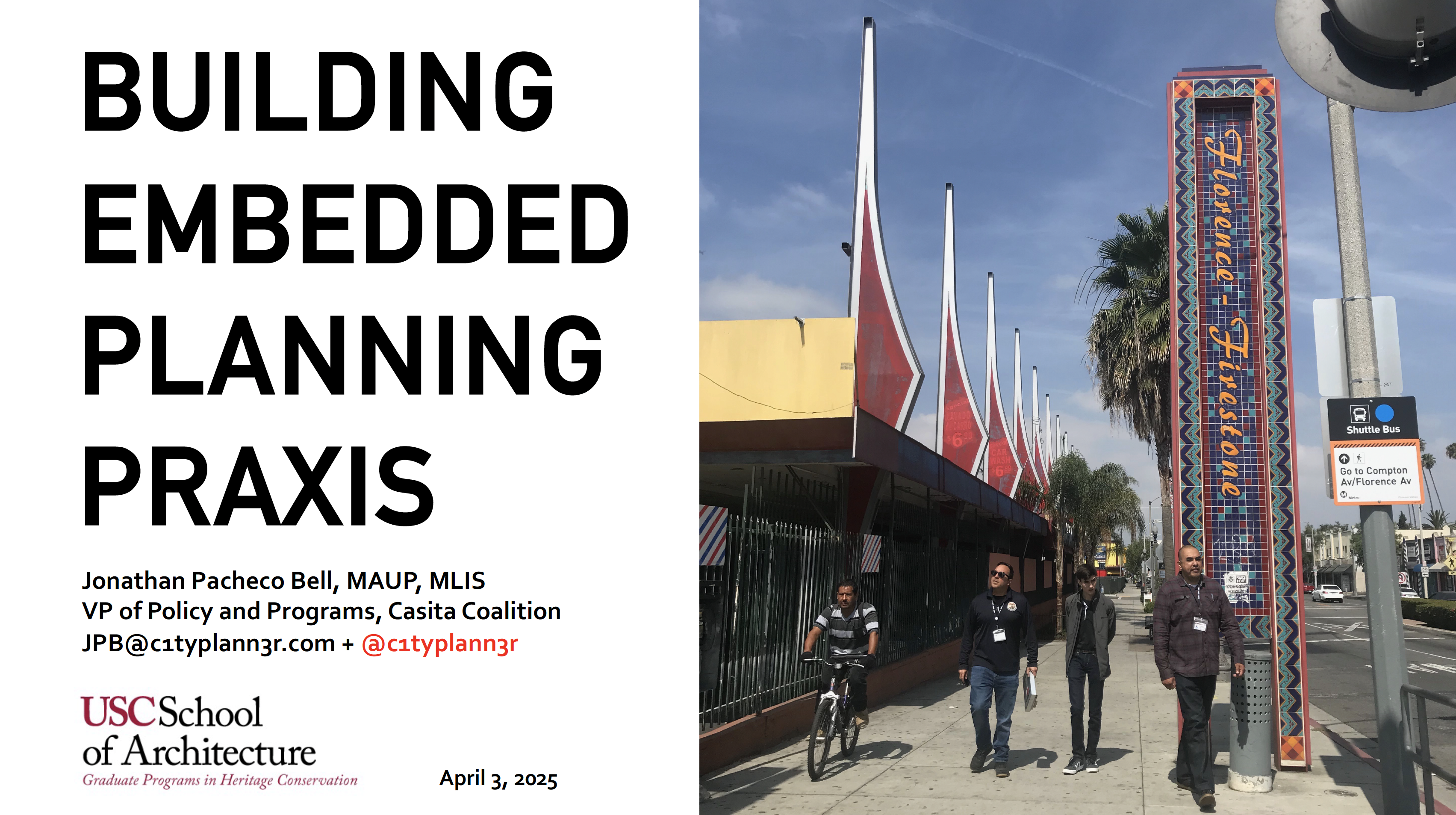
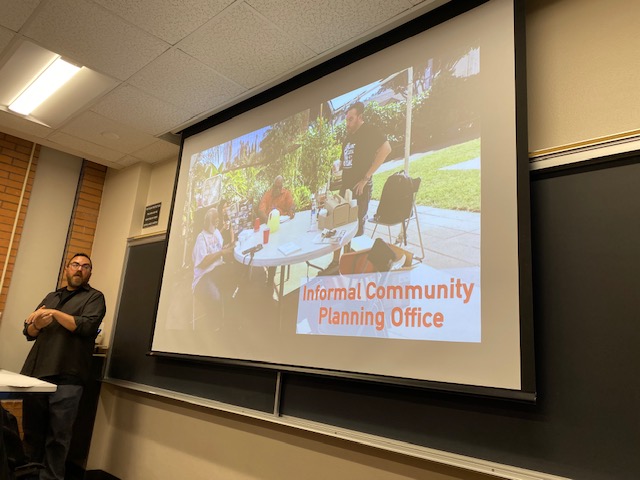
Scenes from USC Architecture from my 4/3 guest talk, “Building Embedded Planning Praxis.” The invited lecture was delivered in the USC Master of Heritage Conservation graduate course, Heritage Conservation Policy and Planning.
This is chapter 1 in the story of Embedded Planning praxis.
I lay out my path to Embedded Planning which includes coming up as graffiti writer and hip hop kid in the 80s & 90s, dropping out of architecture school in ‘98, and then finding urban planning thanks to Mike Davis and Edward W. Soja (both rest in power). Embedded Planning was co-created with community members in Florence-Firestone in South Central LA.
Who’s the cat in the photo?! In 2003 in the MAUP program at UCLA Luskin Department of Urban Planning, I took an architecture theory course where I learned Professor Gregory Ulmer’s CATTt method for writing a manifesto. I would go on to use the CATTt to write my 1-page manifesto on Embedded Planning titled, “We Cannot Plan From Our Desks,” published in the October 2018 issue of APA’s Planning Magazine.
And now we’re a worldwide movement in planning theories and practices.
Photos by Meredith Drake Reitan, Professor & Associate Dean. Thanks for the invite to speak with your MHC students!



Celebrating the graduates in my 2024 Senior Project class at Cal Poly Pomona Department of Urban and Regional Planning. Today we uplift this researcher:
Roles of Place Design in Creating a Sense of Community Between Conventional Homes and Student Housing in South Central Los Angeles
By: Osvaldo Martinez
Abstract:
For the last 4 to 5 years, the community around the University of Southern California in South Central LA has experienced an increase in student housing development where conventional, longtime residents live. This development wave not only introduces student housing in new neighborhoods but also implements unprecedented design that strays from existing neighborhood architectural styles and densities. This phenomenon raises the question of how these new forms of student housing affect residents’ perceptions of community identity, and how it affects community interactions with USC students.
Through qualitative research, I interviewed residents about new housing design and social interactions with USC students to understand the role of place design in creating a cohesive community. Residents agreed that the new forms of student housing should align with the community’s existing architectural styles, and that new student housing is being built to profit from the student market. Many residents felt that housing developers were intentional about creating a brand within the neighborhood rather than making developments that contribute to the neighborhood.


In partnership with @UPatPrice, I’m doing the talk “Embedded Planning is Worth The Struggle” at USC Price on Oct 27, 2023. The event is in person.
Register: bit.ly/USCembedplan
Description:
Planning is political. Decisions about the built environment inherently impact people’s lives. Everything planners do involves a struggle over “who gets what, when, where, how, and why?” Planners respond to this debate but many of our practices have resulted in unjust planning.
In this time of increasing interrogation of planning’s legacies of inequity, planners are moving with intention to be better partners. As part of repair and healing, planners are seeking more ways to build meaningful community partnerships. No longer is Rational Planning the default. But while the pivot to participatory methods helped democratize the planning process, professional practice still prefers project-based, one-off, transactional engagement.
Orthodox planning must evolve.
A better way is possible.
LA-based urban planner Jonathan Pacheco Bell urges practitioners to consider Embedded Planning praxis. Developed by Bell on the ground in South Central LA, Embedded Planning is a way to fundamentally restructure community engagement & practice. Embedded Planning means planning from the street, not from a desk. Embedded Planners work in the spaces & places of community members, building bridges with marginalized communities harmed by inequitable planning. Embedded Planning is a praxis that puts theory into action to better the world. Since Bell declared Embedded Planning exists in 2018, it has grown into an #international movement among emerging planners.
Community members have embraced Embedded Planning because they feel seen and included as partners. Yet despite the praxis bringing ignored voices to the table, Bell encountered blatant hostility from planning figureheads who judged Embedded Planning as “too political.” Through storytelling and personal reflection, Bell will illustrate the struggle to carry out Embedded Planning in the face of power. Attendees will learn the challenges and benefits of this unorthodox approach and understand why this praxis is the future of planning.

You must be logged in to post a comment.