Yesterday I was interviewed by an author writing a novel set in the time of the 1992 LA Uprising. I shared memories of interpreting the unrest through my eyes at the time, a high school graffiti tagger in Montebello navigating the larger LA hip hop scene. I’ll share the book when it’s published.
I started a Ko-fi page. Ko-fi (☕️ but it rhymes with “No Fee”) is a micro-donations platform for creators. Ko-fi enables folks to support my writing passion projects. And, Ko-fi sends 100% of the donations to the creator, me!
I launched this because in 2021, I’m ramping up writing about Embedded Planning, my praxis that situates the work of city planners on the streets, not behind a desk. I’m also writing about Public Space, Los Angeles, and more.
Wanna be a part of these efforts?! Your donations will help fund my process, including research, printing, web and database access, copyediting fees, and of course, the iterative and emotional part of writing. Anything helps!
Please consider supporting my writing and praxis that advances equity in urban planning. Thank you so much.
Here’s a good critique of the emerging medium of writing + publishing through Substack. Also reads as a Big Up to old school blogging, with rich links to blogs past and present.
I was a contributing writer for UrbDeZine from 2014 to 2019. UrbDeZine is/was an online magazine covering urban planning, historic preservation, and architecture in seven US cities. Why the slash/verbs? Because the fate of the magazine is unknown. From its aggregator page at Planetizen, we see the last original article published in October 2019. UrbDeZine has been offline since late that year undergoing a “redesign and reorganization” as described on its currently-staticholding page. I write this entry in the waning days of November 2020 noting the relaunch period listed is Summer 2020. I hold out hope it’ll go-live again, but I’ve come to grips with the possibility that UrbDeZine may not come back.
This is dispiriting for a few reasons. First, because UrbDeZine was a passion project of its editor, who always supported the contributing writers, including unpublished and unknown authors, myself included. Second, because the writers added so many original essays, critical reflections, and news stories that advanced conversations on the built environment. Third, and most personally, because I started to find my voice on its pages. My earliest public commentaries on urban planning appeared in UrbDeZine.
My personal attachment wants to see these back online, and there’s interest from some readers, too. The articles pop up in searches but the links don’t work. Now and then, a reader will contact me asking where they’re at. There was enough interest to create a workaround.
Below are my writings from UrbDeZine, in PDF. This list entails works wherein I manually saved the article before it went offline. Most of my articles are accounted for. Some, but not all, of the PDFs retain working hyperlinks in the text. Also, a disclaimer: some of my views have evolved since the original publication of these commentaries (most notably, I’m no longer so stringent about informal housing).
By providing access to these works, I hope to contribute to the public discourse that helped me develop and mature my thinking about today’s vexing urban planning problems.
“We Are a Movement”: Students Advance Embedded Planning at the 2019 National Planning Conference, UrbDeZine. May 14, 2019.
An Open Letter to the Pasadena Planning Commission Urging a Comprehensive Overhaul of the Second Dwelling Unit Ordinance, UrbDeZine. December 12, 2016.
Paragraph from a paper on #EmbeddedPlanning by CPPENV MURP student Gaby Ruiz. Source: @EmbeddedPlanning on Instagram.
I’ve been doing more talks about Embedded Planning in high school and college classes, as well as meeting students for one-on-one conversations about my praxis, all through Zoom during this Coronavirus pandemic. I realized that I was sending lots of follow up emails providing links to my writings. After copy-pasting the same content several times, it became apparent that there was a more efficient way. This is it.
This post serves as the first compilation of my public works (writings, interviews, and more) on Embedded Planning. As my work on this street-level planning praxis evolves, I’ll share updated compilations as new posts on this infrequently updated blog.
Questions about Embedded Planning? Hit me up here.
WRITINGS
We Cannot Plan From Our Desks, Planning. October 2018.
Mike Davis examined the bird flu threat in, “The Monster at Our Door: The Global Threat of Avian Flu” (2005)
Mike Davis has been commenting extensively about the current global Coronavirus / COVID-19 pandemic. I’m sharing his analysis on my social media spaces, as I often do with City of Quartz for urban planning students. For better or worse, Davis avoids social media and has no personal website with links to his work. Fortunately for readers, several outlets are making available without a paywall his works on COVID-19. It just takes some searching.
As I usually do with Davis, I found myself scouring Twitter and Google to find these commentaries. I know others are doing the same. We need his analysis to show us a pathway forward — and we need to get it beyond his faithful readers. So, to help boost readership, I’m aggregating links in this post to Mike Davis’s COVID-19 writings, comments, podcast interviews, etcetera.
There will be cross-posted duplicates from the various publications involved. I’m okay with doubling up. This increases reader access and helps overcome potential link rot. Also there will shorter and longer versions of his articles depending on the publication’s version. All is worth reading.
I’ll update this blog post as often as possible. Readers can recommend relevant works at this Contact page. Thank you. ~JPB
Update: New citations will end on May 31, 2020. This post will stay up as a resource on Mike Davis and COVID-19.
Mike Davis on COVID-19: The Monster Is at the Door
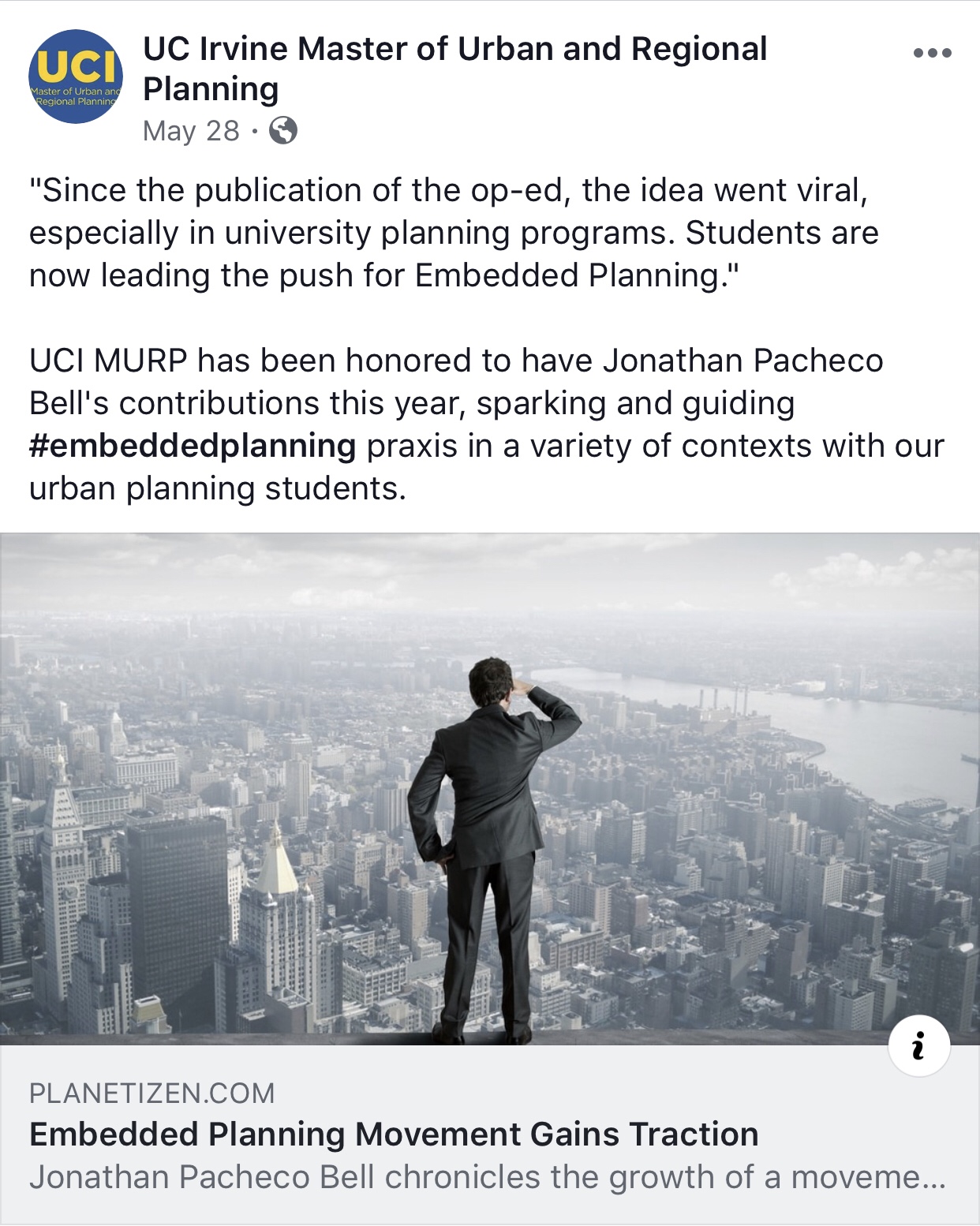
Among the many excellent urban planning programs in the Los Angeles region, UCI MURP has been one of the strongest supporters of advancing #EmbeddedPlanning praxis. To the students, faculty, and staff: THANK YOU!
Looking forward to growing our partnership and developing future critical planners & Embedded Planners.
I was not raised speaking Spanish. When Nana Josephine Pacheco née Ontiveros came to #LosAngeles from #Texas, the school teachers struck her with rulers por hablando Español en clase. So Nana didn’t teach my mom. And nobody taught me. I learned Español in earnest in the last 8 years working as an Embedded Planner on the ground in Florence-Firestone. For real I’m at like 6th grade level, pero sabes que, es mejor que nada!
On arrival Friday in #CDMX, I quickly had to adjust to Español. It was thrilling. I found myself absorbing the spoken word, the unique rhythm, cadence, & dialect of #Chilango, the Spanish of Mexico City. Immediately I found myself translating signs, speech, & writing intuitively. Dormant neurotransmitters began firing. Parts of my brain were trabajando overtime to help situate myself in this new space & culture.
I recognized this feeling. It had been awhile but I’d felt it long before. I told mi esposita that this exhilaration must have been the same stimulating experience of learning Inglés as a child con mi familia on the streets of East Los Angeles y Montebello 40+ years ago.








You must be logged in to post a comment.