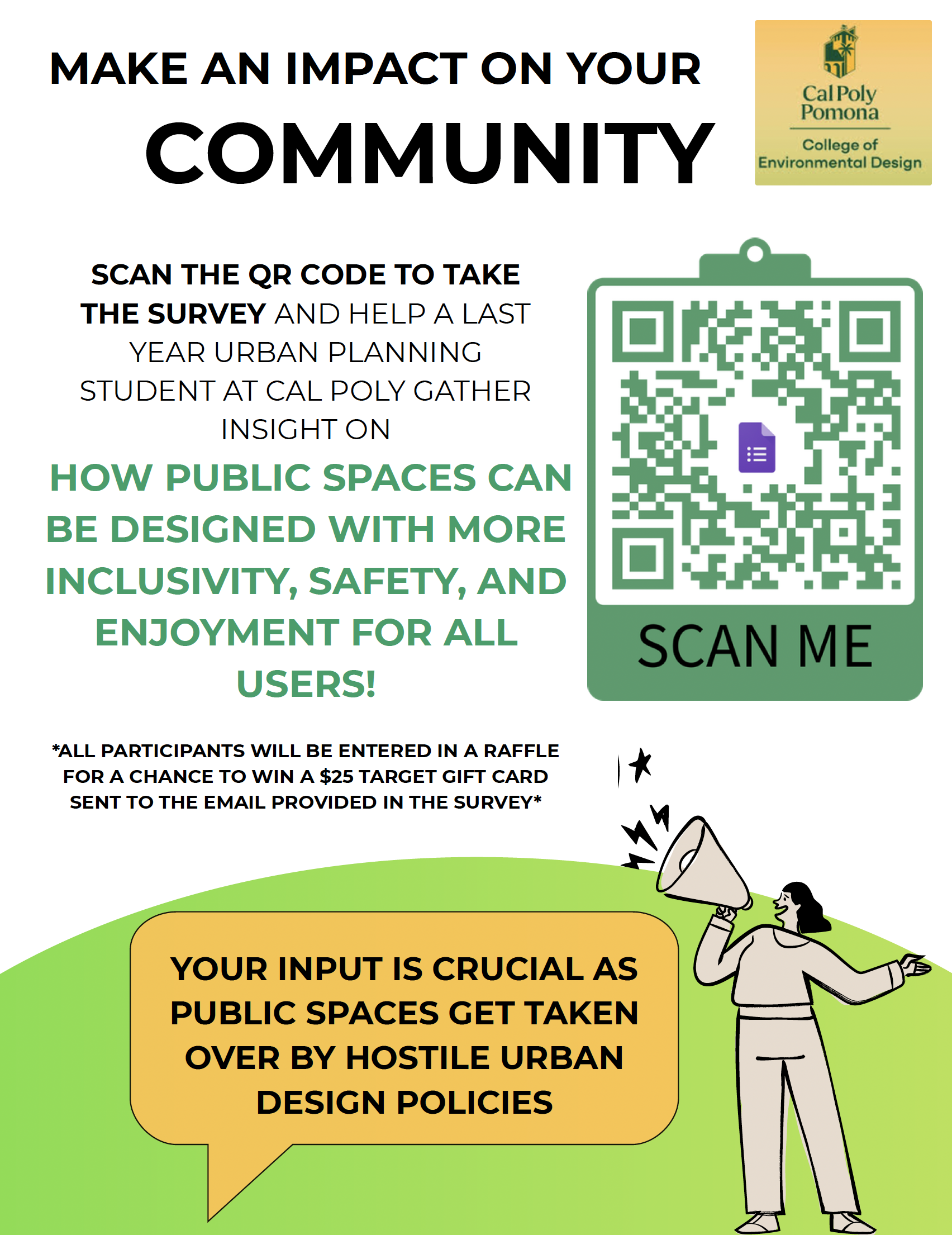
Planners + Community: Zena Al-Beitawi is doing an urban planning senior project examining how public spaces can be designed for inclusivity, safety, and enjoyment versus Hostile Architecture in Pomona, CA.
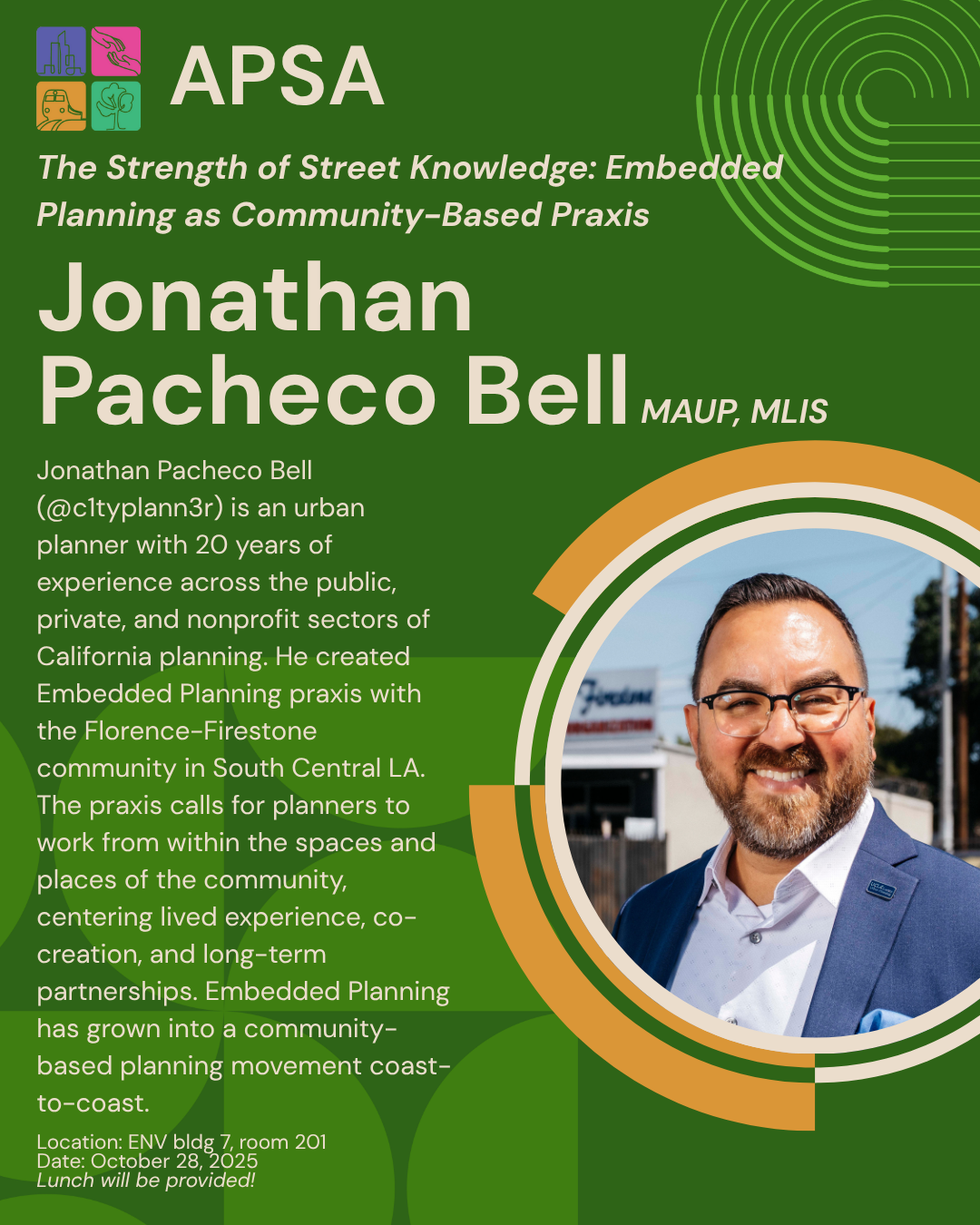
The Strength of Street Knowledge: Embedded Planning as Community-Based Praxis
Jonathan Pacheco Bell, MAUP, MLIS
Speaker bio:
Jonathan Pacheco Bell is an urban planner with 20 years of experience across the public, private, and nonprofit sectors of design and planning. He’s a former graffiti writer and West Coast Hip Hop kid, who learned to navigate urban space crisscrossing 1990s LA tagging and doing graffiti murals. These early street-level experiences would inspire Jonathan in college to switch from architecture to urban planning.
Jonathan earned a Master’s in Urban Planning at UCLA in 2005 and began his career as an LA County Zoning Enforcement Planner, building partnerships in communities like Florence-Firestone in South Central LA. During this time, he witnessed the harms of inequitable zoning, inspiring him to create new forms of street-level planning advocacy – what we now call Embedded Planning Praxis!
He has lectured on Embedded Planning across the U.S., with guest talks at Columbia University, Duke, Ohio State, USC Architecture, & Stanford Engineering, and presentations at APA Conferences in California, Washington, Indiana, Louisiana, and Iowa.
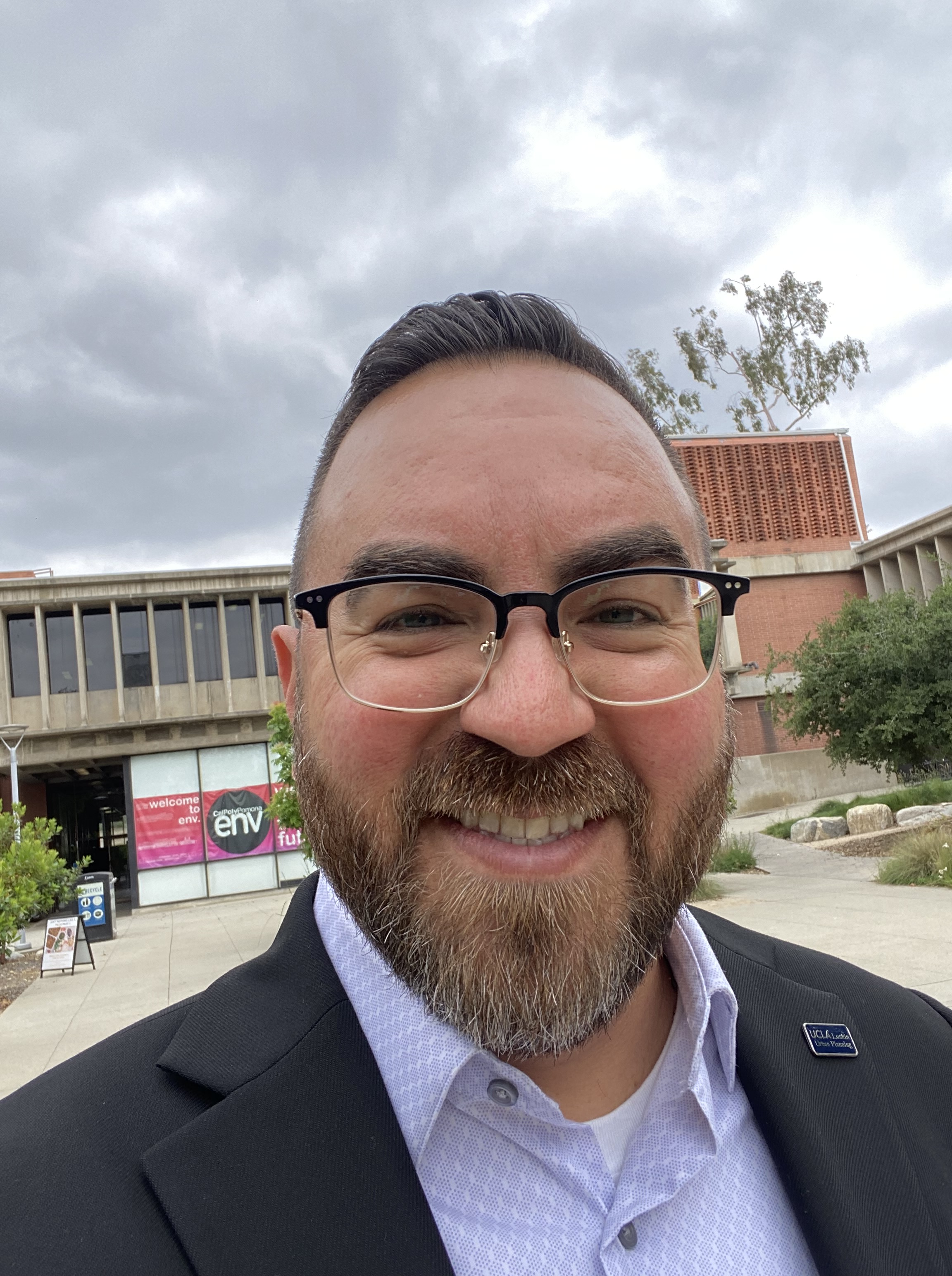
Jonathan currently serves as Co-President of the nonprofit Florence-Firestone Community Organization, in the neighborhood where Embedded Planning was born. From 2021 to 2025, he was an Adjunct Professor in the Department of Urban and Regional Planning at Cal Poly Pomona and remains a mentor to emerging Bronco Planners.
This Saturday 9/27 the Florence-Firestone Community Organization hosted the annual community walk in Florence-Firestone with the 1st year MURP cohort at Cal Poly Pomona College of Environmental Design. MURP students learned about urban planning through storytelling, social history, and immersive Embedded Planning with our community members. This is a mutually beneficial long term partnership! Shout out to professors and students for spending an afternoon with us in South Central LA.
In 2005, I graduated from UCLA Urban Planning with my MAUP and took a photo on graduation day with my mentor, Professor Edward W. Soja. In 2025, I got to take photos with my urban planning and landscape architecture students on graduation day at Cal Poly Pomona Urban and Regional Planning. We’re all on a journey.
This video is cross-posted on my LinkedIn, Instagram, YouTube, and c1typlann3r.blog.
My time at Cal Poly Pomona has come to an end. The last 4 years were a dream come true. In 2021, I’d never have imagined that 1 lower division course would blossom into 6 across our bachelor’s and MURP programs, including my personal goal of teaching planning theory (my favorite at UCLA Luskin!). With that accomplished, I’ve decided to exit on a high note. This move makes space for new lecturers . . . new ideas, new lessons, new texts, new assignments, new theories, new planning methods, new pedagogies, new critiques, new praxis.
I’ll miss my students. My greatest joy was being a part of their journeys. I got to see folks new to the field evolve before my eyes into fierce urban planners—change agents. I hope my ramblings contributed to their growth. My students give me boundless hope. The future of urban planning is in good hands.
I was a mentor before CPP and I remain one. I’ve formed lifelong relationships with CPP students, faculty, and university fam. Many believe in Embedded Planning and other forms of activist praxis. We have momentum.
So this isn’t a “goodbye” but rather a “see you out there, in the neighborhoods, alongside our community members, planning and organizing, with your feet on the street.”
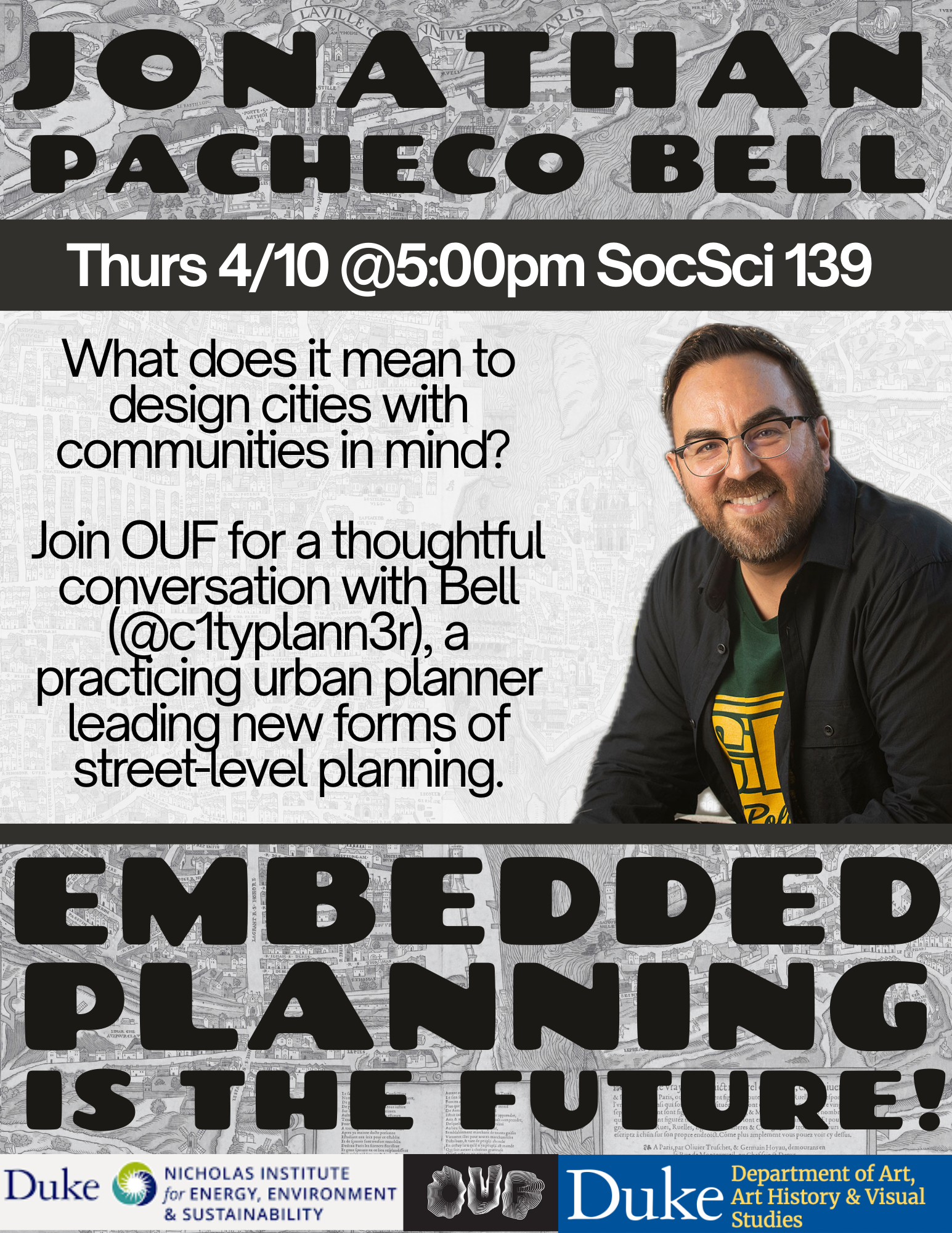
Infographic courtesy of Duke’s undergraduate student group, Our Urban Future
On April 10th, I’m at Duke University with Our Urban Future for the invited public talk, “Embedded Planning is the Future.” I consider this Chapter 3 in the Embedded Planning speaking series. We’ll discuss Embedded Planning’s trajectory — including origins, challenges, and benefits — and examine why this praxis is the future of planning.
Identifying the Constraints to Implementing a Vegetation Barrier along Valley Boulevard. By: Taylor Galindo
Celebrating the graduates in my 2024 Senior Project class at Cal Poly Pomona Department of Urban and Regional Planning. Today we uplift this researcher:
Identifying the Constraints to Implementing a Vegetation Barrier along Valley Boulevard
By: Taylor Francis Galindo
Abstract:
Ambient air pollution is a significant health concern where industrial zones directly border residential zones. Numerous studies suggest the effectiveness of implementing vegetation to serve as a mitigative strategy in addressing ambient air pollution. This paper will examine the complexities of implementing vegetation as a barrier to mitigate air pollution in an environmental justice community located along Valley Boulevard in Southern California’s San Gabriel Valley. The qualitative data featured in the study collected interviews with local community stakeholders and professionals from various professional backgrounds. These insights provide a foundation of what agencies would need to overcome to implement a vegetation barrier along Valley Boulevard.
Keywords: Public Health, Environmental Injustice, Tree Canopy, Green Barriers, Sustainable Solutions, Ambient Air Pollution, and Industrial Zoning
Taylor presenting at the 2024 Cal Poly Pomona Urban & Regional Planning Senior Projects Day. Photo: Jonathan Pacheco Bell
Multi-use Trails: A Path to a Third Place at The Tracks at Brea Trail. By: David Pascual
Celebrating the graduates in my 2024 Senior Project class at Cal Poly Pomona Department of Urban and Regional Planning. Today we uplift this researcher:
Multi-use Trails: A Path to a Third Place at The Tracks at Brea Trail
By: David Pascual
Abstract:
This research examines the role of The Tracks at Brea Trail (TAB trail), a multi-use trail located in Brea, California, in Orange County, as a new Third Place among the existing Third Places that Americans identify, such as coffee shops, restaurants, libraries, shops, and even local community centers. Currently, the American adult population is experiencing high stress levels and sedentary lifestyles, increasing mental health problems and fatalities. With rising concerns about mental well-being among adults, there are limited Third Places to improve well-being, which is difficult to do outside peaceful environments.
Eleven walking tours were conducted with thirteen participants and photo evidence was taken, documenting how individuals perceive the greenspace and trail design elements TAB trail offers. The participants’ commentary highlighted their limited knowledge of Third Places, awareness of wildflowers and treescapes along the trail, and sense of isolation in certain trail sections. Participants who experienced distress commented that the trail helped improve their current emotions.
Multi-use trails shed awareness on how transportation planners must consider the greenspaces that individuals use to enhance their well-being while preserving the natural environment for local wildlife and plants and creating sections along those greenspaces. Cities and planners need to move forward in promoting spaces in and among multi-use trails to improve an individual’s social and mental well-being.
David presenting at the 2024 Cal Poly Pomona Urban & Regional Planning Senior Projects Day. Photo: Jonathan Pacheco Bell
Roles of Place Design Between Conventional and Student Housing in South Central Los Angeles. By: Osvaldo Martinez
Celebrating the graduates in my 2024 Senior Project class at Cal Poly Pomona Department of Urban and Regional Planning. Today we uplift this researcher:
Roles of Place Design in Creating a Sense of Community Between Conventional Homes and Student Housing in South Central Los Angeles
By: Osvaldo Martinez
Abstract:
For the last 4 to 5 years, the community around the University of Southern California in South Central LA has experienced an increase in student housing development where conventional, longtime residents live. This development wave not only introduces student housing in new neighborhoods but also implements unprecedented design that strays from existing neighborhood architectural styles and densities. This phenomenon raises the question of how these new forms of student housing affect residents’ perceptions of community identity, and how it affects community interactions with USC students.
Through qualitative research, I interviewed residents about new housing design and social interactions with USC students to understand the role of place design in creating a cohesive community. Residents agreed that the new forms of student housing should align with the community’s existing architectural styles, and that new student housing is being built to profit from the student market. Many residents felt that housing developers were intentional about creating a brand within the neighborhood rather than making developments that contribute to the neighborhood.
Osvaldo presenting at the 2024 Cal Poly Pomona Urban & Regional Planning Senior Projects Day. Photo: Jonathan Pacheco Bell
Planning For The Prestigious Poor. A Critical Analysis of Cal Poly Pomona’s Initiatives Addressing Student Homelessness and Housing Instability. By: Eileen Ramos
Celebrating the graduates in my 2024 Senior Project class at Cal Poly Pomona Department of Urban and Regional Planning. Today we uplift this researcher:
Planning for the Prestigious Poor: A Critical Analysis of Cal Poly Pomona’s Initiatives Addressing Student Homelessness and Housing Instability
By: Eileen Ramos
Excerpt:
This study assesses the ability of housing-insecure college students at Cal Poly Pomona to access support services to meet their needs. It identifies successes, limitations, and areas of improvement within the existing support system.
I will be coining the term the ‘prestigious poor’ in this research, which is in conversation with the concept of The Privileged Poor coined by Anthony Abraham Jack. Jack explores, “the experiences of those who live in poor, often segregated communities but enter college from elite boarding, day, and preparatory schools like Exeter, Choate, or Dalton those whom I call the Privileged Poor.” In contrast, I approach “The Prestigious Poor” from the lens of the most disadvantaged and vulnerable student populations in any university setting. I define the “Prestigious Poor” as college students who lack basic necessities like housing and food while simultaneously working towards a degree to better their socioeconomic status. While the concept of the ‘privileged poor’ portrays the struggles faced by low-income students in contrast to their Ivy League legacy wealthy students, the ‘prestigious poor’ encompasses all disadvantaged students facing critical disruptive instability like homelessness compared to secure students.
Questions driving this research are: “Do the resources provided by Cal Poly Pomona fulfill the needs of students facing housing instability?” and “How can Cal Poly Pomona make these resources more accessible to students in need?”
Eileen presenting at the 2024 Cal Poly Pomona Urban & Regional Planning Senior Projects Day. Photo: Jonathan Pacheco Bell
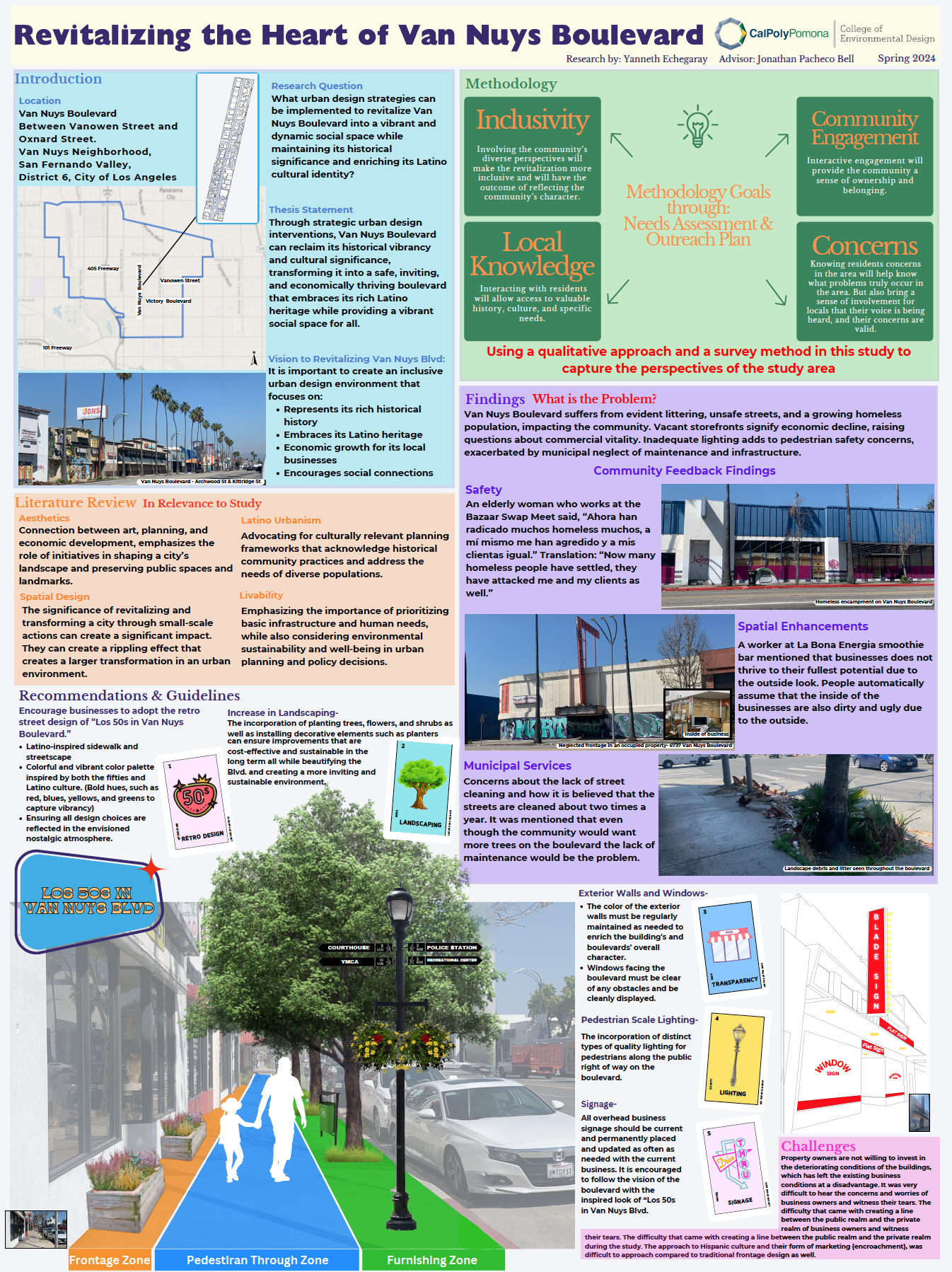
Revitalizing the Heart of Van Nuys Boulevard Through Urban Design. By: Yanneth Echegaray
Celebrating the graduates in my 2024 Senior Project class at Cal Poly Pomona Department of Urban and Regional Planning. Today we uplift this researcher:
Revitalizing the Heart of Van Nuys Boulevard Through Urban Design
By: Yanneth Echegaray (1st Place Poster Winner!)
Excerpt:
This study seeks to address the question, “What urban design strategies can be implemented to revitalize Van Nuys Boulevard into a vibrant and dynamic social space while maintaining its historical significance and enriching its Latino cultural identity?”
The proposed section of Van Nuys Blvd is between Vanowen and Oxnard St in the Van Nuys neighborhood in the San Fernando Valley in Los Angeles County in the State of California. Through strategic urban design interventions, Van Nuys Boulevard can reclaim its historical vibrancy and cultural significance, transforming it into a safe, inviting, and economically thriving boulevard that embraces its rich Latino heritage while providing a vibrant social space for all.
Revitalization Vision:
“To enhance the heart of Van Nuys Blvd, between Vanowen St and Oxnard St, it is important to create an inclusive urban design environment that focuses on its rich historical significance, embraces its Latino heritage, fosters economic growth for its local businesses, and encourages social connections. Through various design strategies, this study aims to revitalize this boulevard into a dynamic and vibrant public space for all.”
Specifications within this study will be Guidelines for redesigning store frontage to enhance the environment through cohesively connecting the public to the private realm. Redesigning the streetscape to capture vibrant and welcoming aspects, while prioritizing lighting and safety features, and embracing the rich and significant Latino culture that has organically been embedded on Van Nuys Boulevard – all of this is aimed at creating a suppositional nexus that will positively affect the economic development of the local businesses inhabiting the boulevard.
Yanneth presenting at the 2024 Cal Poly Pomona Urban & Regional Planning Senior Projects Day. Photo: Jonathan Pacheco Bell
Florence-Firestone Community Organization. Photo by Aditi Peyush
In Fall 2024, the Florence-Firestone Community Organization (FFCO) — where I proudly serve as VP — is partnering with Cal Poly Pomona and UCLA to integrate the neighborhood into these Urban Planning and Chicano Studies courses:
URP 5050: Planning and Place
URP 5120: Planning Ideas and Action
URP 5010: How Planning Works
CCAS M122: Planning Issues in Latino Communities (UCLA)
Building on our past efforts, FFCO will host neighborhood walking tours and discussions, conduct in-class guest lectures, and provide readings and resources (see below) to learn about the Florence-Firestone community in South Central LA.
Local news coverage of Florence-Firestone lamentably focuses on social ills. While the community endures challenges and struggle, there is more to it than the clickbait headlines. Our decades-long community-driven work proves it. The creation of Embedded Planning in Florence-Firestone (now a worldwide movement!) proves it. The birth of FFCO as a community advocacy voice during COVID proves it. Florence-Firestone is a vibrant and historic community. Students will experience it.
Below is a variety of key resources on Florence-Firestone. I am proud to have worked on most of these projects. These help reframe the narrative about our community. They tell a fuller story of partnerships, solidarity, and hope.
Note: This is a living document updated as needed throughout the semester/quarter. Any revision history will be indicated at the bottom of this page.
Florence-Firestone Community Organization and SELA Collaborative interview, including Embedded Planning origins in Florence-Firestone (starts at 5:25 min mark):
How a Tire Shop in South L.A. Became a Community Hub for Locals:
I’m returning to teach this MURP course, URP 5120: Planning Ideas and Action, aka Planning Theories and Practices.
Course Description: There are competing views about what planning is and what processes planners should use to carry out their work, including arguments for technocratic, communicative, advocacy, and radical approaches. These views stem from differing understandings in philosophy, political economy, and justice. The course asks you to learn about and critically evaluate alternative planning approaches in the context of planning practice. You will be challenged to explore how to put complex ideas into action as part of planning praxis – putting theories into practice to better the world. By the end of the course, you should be able to recommend planning processes that are appropriate to a given planning problem. You should also be able to articulate the relationship of your recommendations to your own values and those of the profession. Fundamentally, the course is about how to plan. We emphasize processes by which planners can add reason and judgment to planning “messes,” recognizing the rarity of well-defined, purely technical problems in communities.
Fall 2024, Tuesdays 7:30-9:15pm, with alternating instruction in person & virtual weeks.
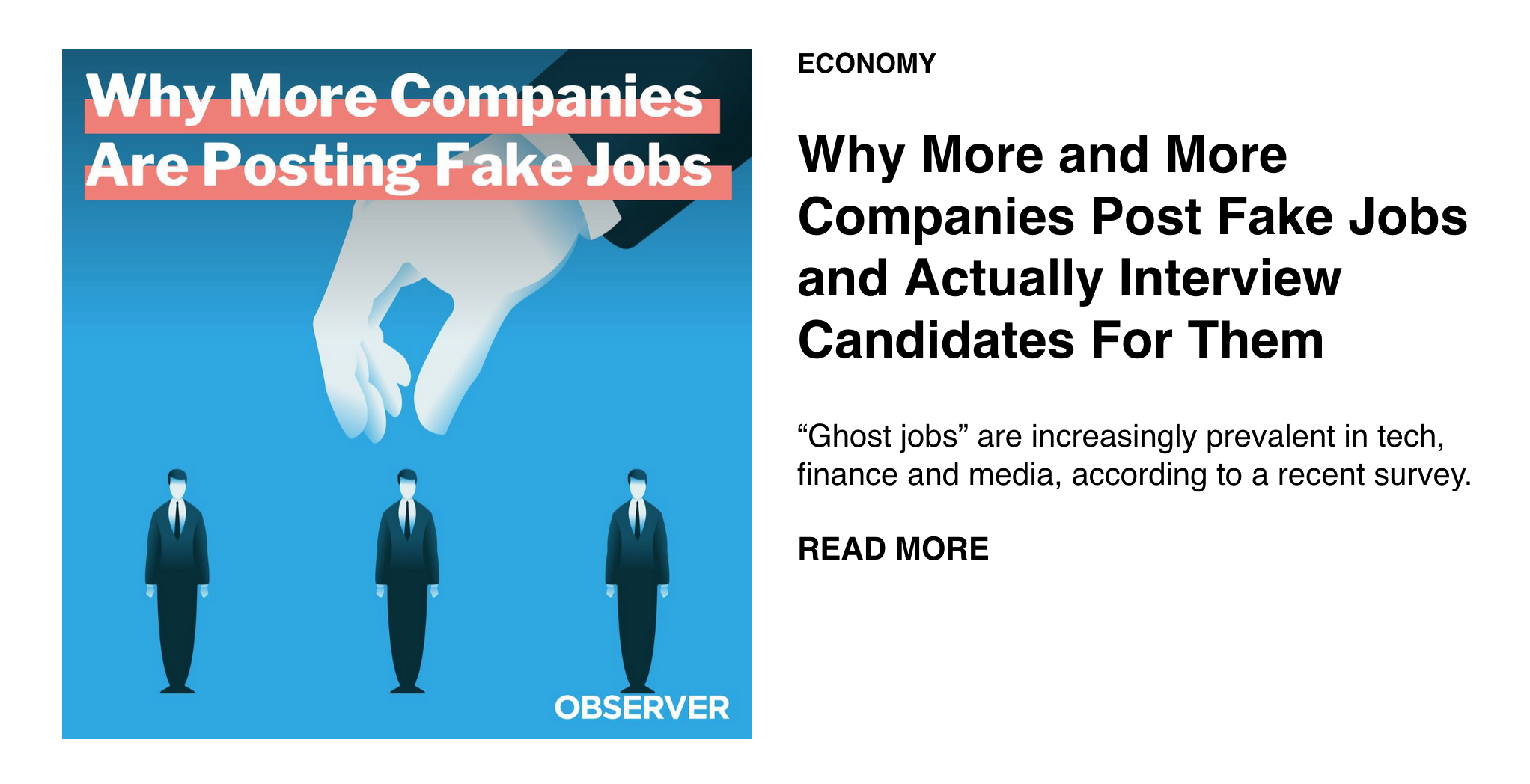
I was interviewed by Abigail Bassett in the Observer for this article on fake jobs. I told the story of receiving a cold call offering me a job at an architecture firm that does not exist.







You must be logged in to post a comment.