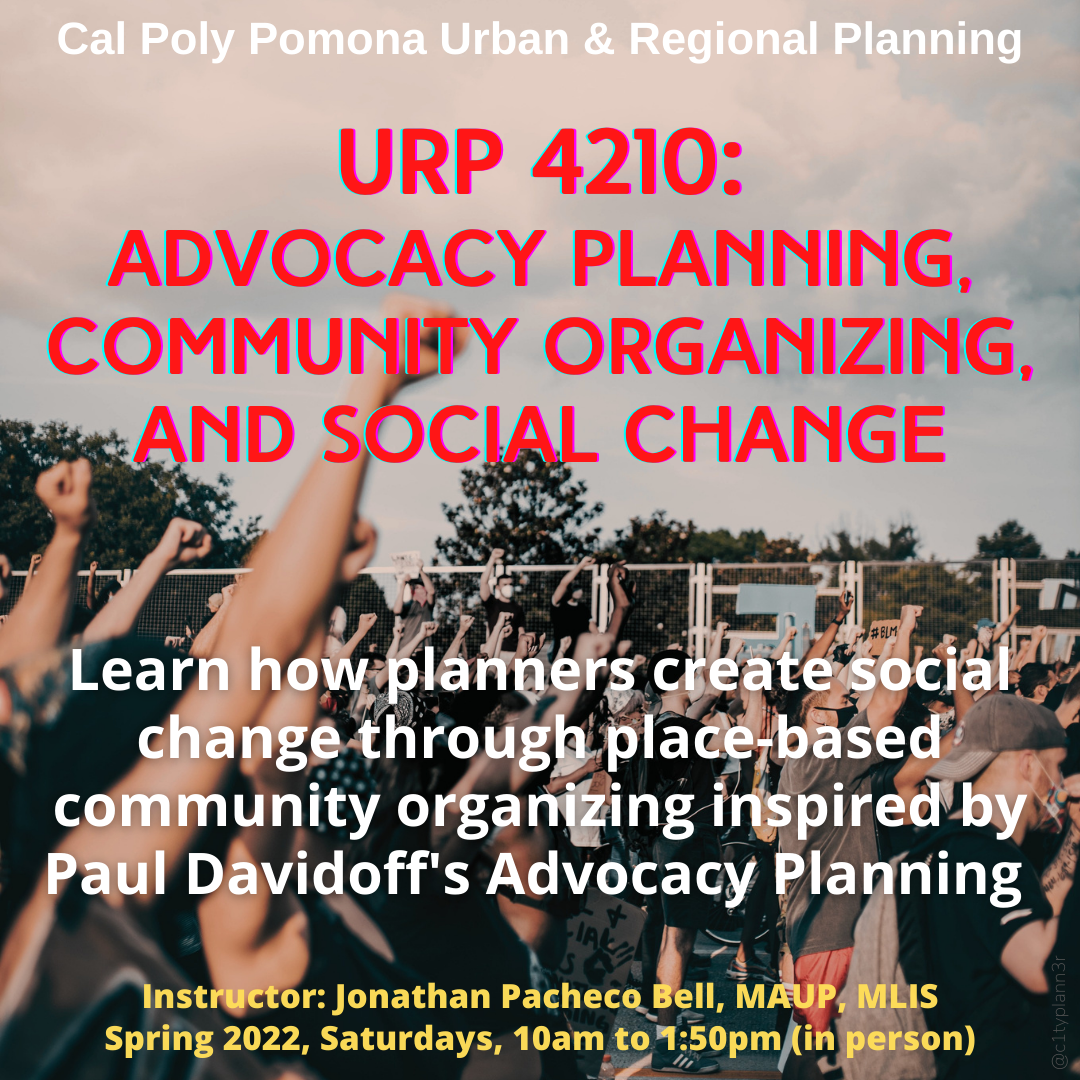
Next semester at Cal Poly Pomona I’m teaching a course on Advocacy Planning, Community Organizing, and Social Change inspired by the work of the late Paul Davidoff: pauldavidoff.com
Next semester at Cal Poly Pomona I’m teaching a course on Advocacy Planning, Community Organizing, and Social Change inspired by the work of the late Paul Davidoff: pauldavidoff.com

Cal Poly Pomona seeks a Dean of the College of Environmental Design
The new Dean must be an innovative, strategic, and collegial academic leader who embraces the mission of Cal Poly Pomona, is committed to student success, and will be a champion for CPPENV. Ideally, the new Dean of ENV will take office in the spring but is expected to do so no later than June 2022. Review of applications will begin December 6, 2021.
Academic Search is assisting Cal Poly Pomona in this search. Please see the profile for the position here:
To ensure full consideration, inquiries, nominations, and applications (PDF preferred) should be submitted electronically, in confidence, to: CPPENVDEAN@academicsearch.org
Nominations are encouraged. If you have a nomination for the position, please send the name, position, and institution along with an email address if you have it, to: CPPENVDEAN@academicsearch.org
Nominators and prospective candidates may also arrange a confidential conversation about this opportunity with the senior consultant leading this search, Cynthia M. Patterson, at: Cynthia.Patterson@academicsearch.org
The Boyz N The Hood film and years of street reporting on NWA albums helped me become an urban planner in/for South Central LA.
I learned the word “gentrification” from Furious Styles’s speech on the street corner in Compton.
Recorded January 18, 2019 at American Planning Association HQ amidst our work on the national Social Equity Task Force. Since then, #EmbeddedPlanning has exploded onto the scene. And as my mentees will attest, I continue to big up Mike Davis’s City of Quartz: Excavating the Future in Los Angeles (1990). Start with the Fortress LA chapter. It’s a groundbreaking critique of #HostileArchitecture ⚔️

Join us for “The Road to AICP,” a comprehensive conversation about the prevailing planners’ certification in the US.
I’m a panelist delivering the segment, 𝘾𝙊𝙐𝙉𝙏𝙀𝙍𝙋𝙊𝙄𝙉𝙏𝙎 𝙏𝙊 𝘼𝙄𝘾𝙋.
Friday, March 19th at 10am PDT / 1pm EDT. Webinar is free to all.
Registration: https://www.planning.org/events/eventsingle/9212130/.
Sponsored by APA Women & Planning Division / APA Ohio.

I was a contributing writer for UrbDeZine from 2014 to 2019. UrbDeZine is/was an online magazine covering urban planning, historic preservation, and architecture in seven US cities. Why the slash/verbs? Because the fate of the magazine is unknown. From its aggregator page at Planetizen, we see the last original article published in October 2019. UrbDeZine has been offline since late that year undergoing a “redesign and reorganization” as described on its currently-static holding page. I write this entry in the waning days of November 2020 noting the relaunch period listed is Summer 2020. I hold out hope it’ll go-live again, but I’ve come to grips with the possibility that UrbDeZine may not come back.
This is dispiriting for a few reasons. First, because UrbDeZine was a passion project of its editor, who always supported the contributing writers, including unpublished and unknown authors, myself included. Second, because the writers added so many original essays, critical reflections, and news stories that advanced conversations on the built environment. Third, and most personally, because I started to find my voice on its pages. My earliest public commentaries on urban planning appeared in UrbDeZine.
My personal attachment wants to see these back online, and there’s interest from some readers, too. The articles pop up in searches but the links don’t work. Now and then, a reader will contact me asking where they’re at. There was enough interest to create a workaround.
Below are my writings from UrbDeZine, in PDF. This list entails works wherein I manually saved the article before it went offline. Most of my articles are accounted for. Some, but not all, of the PDFs retain working hyperlinks in the text. Also, a disclaimer: some of my views have evolved since the original publication of these commentaries (most notably, I’m no longer so stringent about informal housing).
By providing access to these works, I hope to contribute to the public discourse that helped me develop and mature my thinking about today’s vexing urban planning problems.
“We Are a Movement”: Students Advance Embedded Planning at the 2019 National Planning Conference, UrbDeZine. May 14, 2019.
https://c1typlann3r.blog/wp-content/uploads/2020/11/we-are-a-movement-urbdezine.pdf
An Urban Planner on the Ground in South Central Los Angeles, UrbDeZine. January 30, 2018.
An Open Letter to the Pasadena City Council Urging a Comprehensive Overhaul of the Second Dwelling Unit Ordinance, UrbDeZine. January 29, 2017.
An Open Letter to the Pasadena Planning Commission Urging a Comprehensive Overhaul of the Second Dwelling Unit Ordinance, UrbDeZine. December 12, 2016.
Epitaph for Edward W. Soja, UrbDeZine. December 17, 2015.
Reyner Banham, Mike Davis, and the Discourse on Los Angeles Ecology, UrbDeZine. July 14, 2015.
Response to Comments: The Informal Housing Debate Remains Open, UrbDeZine. November 12, 2014.
Converting Garages into a Dissertation: A Conversation with Jacob Wegmann, UrbDeZine. June 17, 2014.
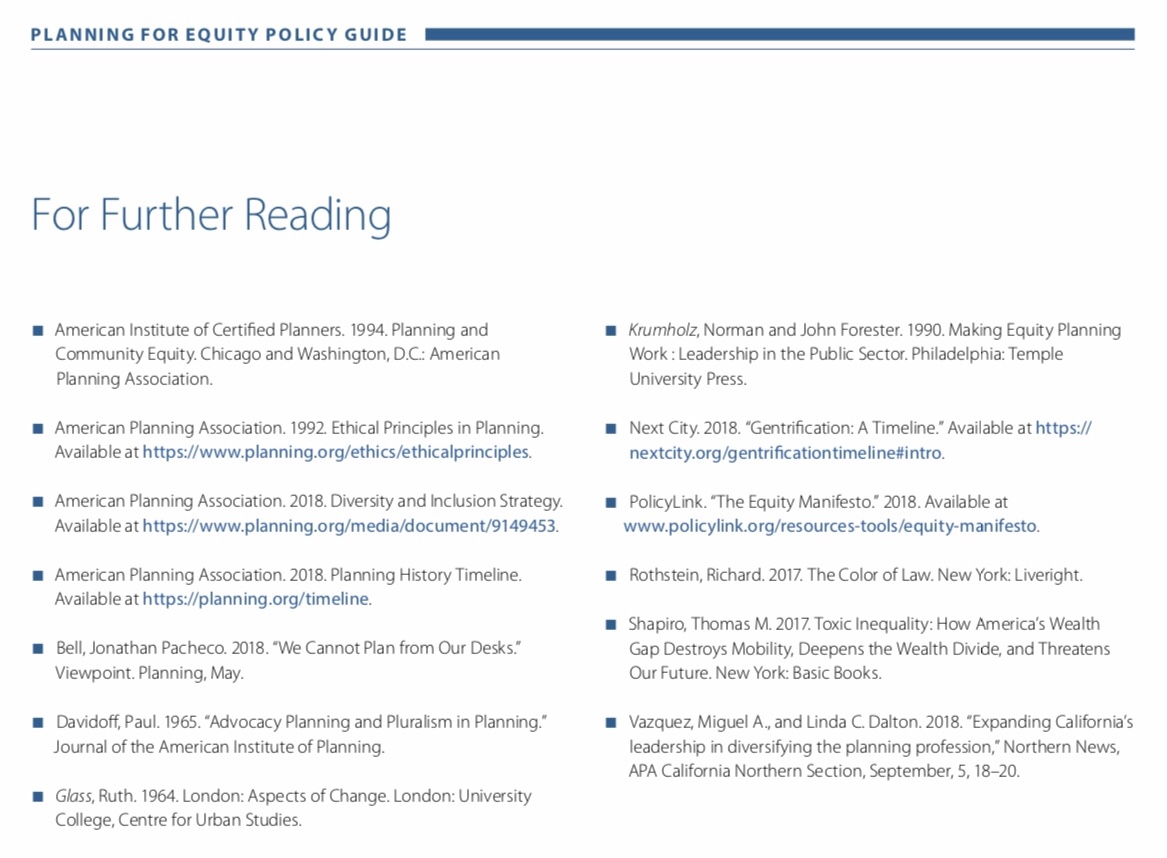
The American Planning Association just published the Planning for Equity Policy Guide and #EmbeddedPlanning praxis is featured in the Further Reading section.
Thank you Miguel Angel Vazquez, AICP for your ongoing support and all committee authors for including the #PlanMag op-ed in this important resource for planners.
It’s incredibly humbling to be listed alongside planning luminaries Paul Davidoff, Norm Krumholz, John Forester, and Ruth Glass, who created the term #gentrification.
From Los Angeles to Seattle to Detriot to Boston to Norfolk, VA and back: “WE ARE A MOVEMENT” 📢

TODAY—I’m at @ucimurp delivering the Medina Family ADU Story in Prof. Lynda Hikichi’s class UPPP 275: Site Development. This is the 9th rendition of this public talk and the 2nd time UCI Urban Planning & Public Policy hosts it, thank you! If you’re on campus or nearby, come through: Room 3240 in the SBSG-Social & Behavioral Sciences Gateway building, 11:30am—12:30pm.
ABSTRACT: This presentation puts a human face on California’s housing crisis. Through storytelling, reflection and #EmbeddedPlanning praxis, presenter Jonathan Pacheco Bell @c1typlann3r, a zoning enforcement planner in South Central #LosAngeles, presents the story of the Medina Family from the #SouthCentralLA community of @FlorenceFirestone, who built an informal backyard Accessory Dwelling Unit #ADU for extra income after the sudden passing of their head of household. An anonymous complaint triggered inspection and eventual demolition of the dwelling for code violations. Jonathan himself ordered its removal. Attendees will understand the emotional roller coaster the family endured while embroiled in this regulatory process, and Jonathan’s inner conflict with the outcome. To help himself cope emotionally and to spotlight this family’s housing struggle, Jonathan has turned the experience into a speaking tour offering takeaways for planning policy, practice, and pedagogy. Jonathan will explain the @EmbeddedPlanning approach at the story’s core. This talk will inspire emerging planners to adapt and respond to the problem of housing insecurity with empathetic, activist, street-level planning #praxis.

If you’ve been to my Medina Family ADU Story, or plan to attend an upcoming talk, you’ll see I get choked up. Happens every time. I don’t even try to suppress it anymore. This was a harrowing experience for the Medinas, and for me. My #EmbeddedPlanning praxis rejects the technocratic detachment of Rational Planning orthodoxy. When we shed tears, those tears are earned.
For the Medinas, removing the backyard dwelling built to generate income after the passing of their head of household worsened the stress that started it all. Ordering the removal after knowing the Medinas’ story made me question strict enforcement of #InformalHousing. The dwelling was not substandard—it was simply out of zoning compliance. All of this predated California’s relaxed State ADU Laws, so the only option was to demolish it. This was in 2016. After 10 years on the job, I’d finally realized that “Penalties or Demolition” was a false dilemma fallacy in #ADU enforcement. We’re trying to change this outcome for other folx.
The ending part is emotional for me. I conclude with slides featuring each member of the Medina Fam. I wanted audience members to understand the impact of rigid zoning on real people. I wanted to evoke an emotional response. And every time it works . . . on ME.
The final slide is of little Janelle. Janelle represents the future of #LosAngeles.
This effort is for her.
Gracias Derek Ouyang, Tyler Pullen, and Stanford Engineering Sustainable Urban Systems.
We Cannot Plan From Our Desks.
Planning practioners, students, and professors: WE CANNOT PLAN FROM OUR DESKS.
We need to get out there and connect.
#EmbeddedPlanning praxis means planning in streets, not from the comfort of your desk.
My op-ed publishes in APA’s Planning Magazine #PlanMag October 2018, just in time for #PlanningMonth.

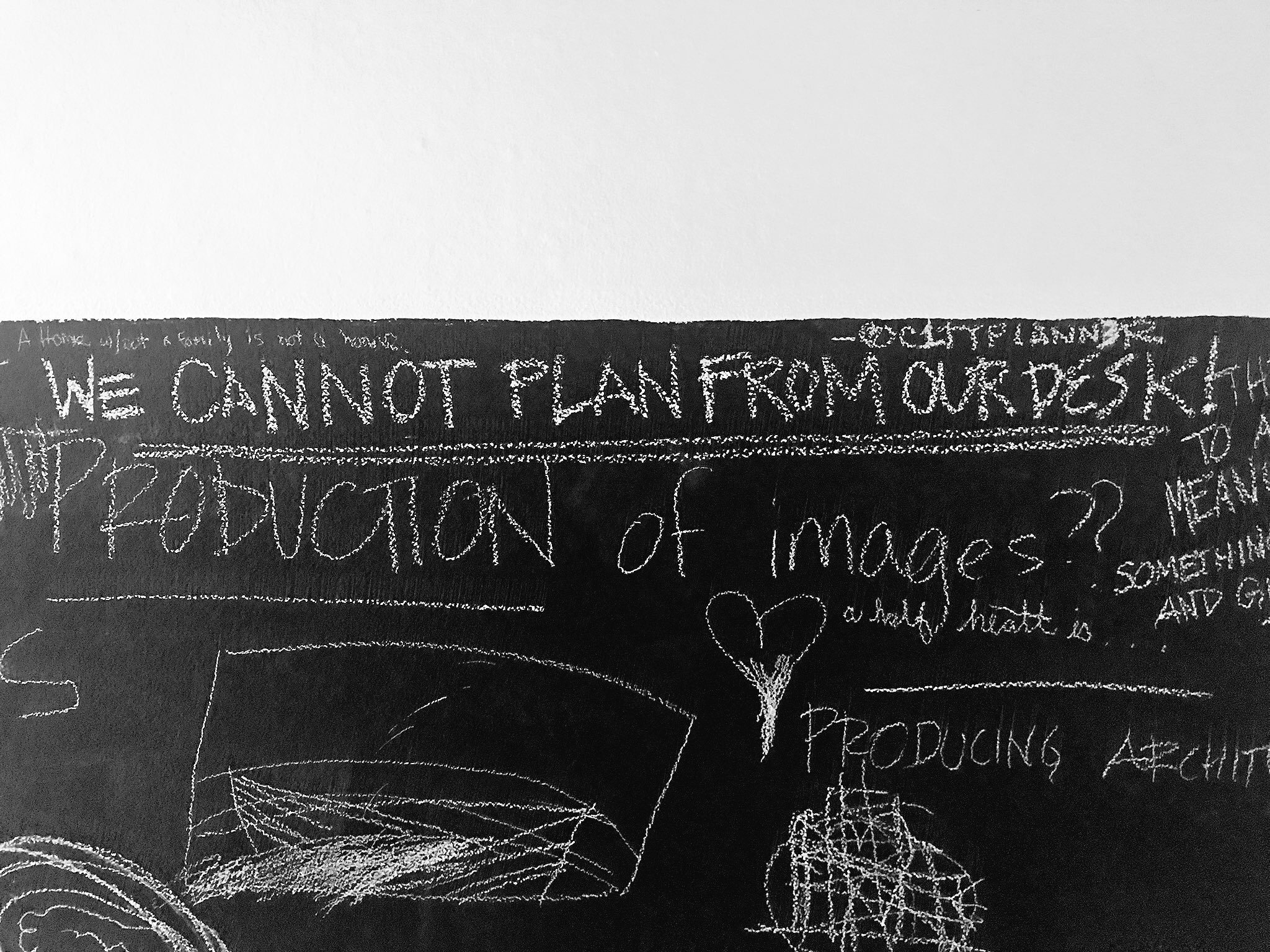
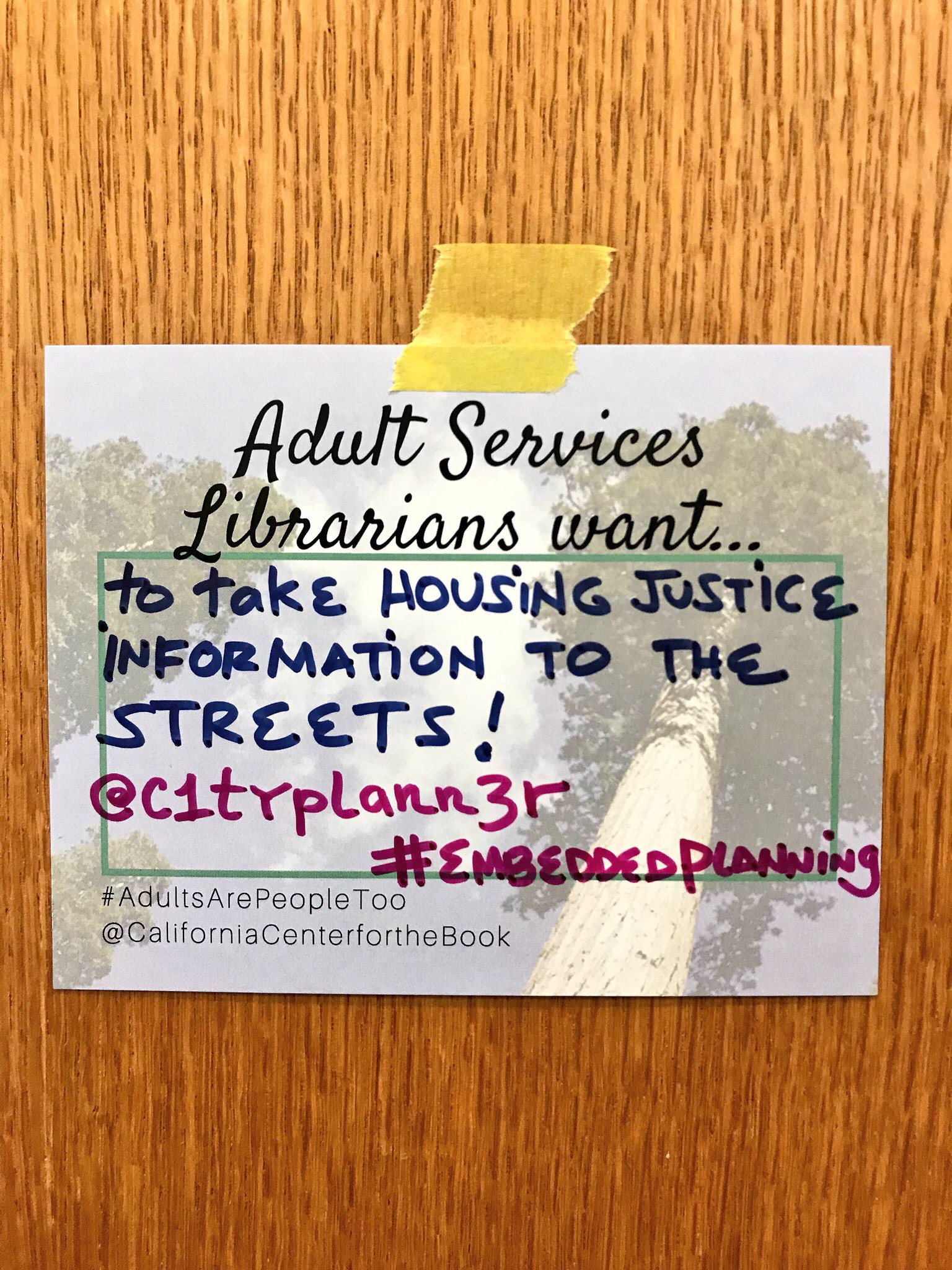

I’m writing an invited op-ed on Embedded Planning. It’s a challenging but rewarding exercise. This has been an amorphous idea swirling in my head for years. I knew what it was intuitively, but I hadn’t defined it. This op-ed is pushing me to define, outline, & explain the benefits of my #EmbeddedPlanning praxis.
The piece draws on my ideas developed over 12 years doing urban planning on-the-ground, from my #MLIS experience in which I regularly wrote about librarians breaking free from the reference desk to do LIS work out in the neighborhood, & from my speaking tour on the Medina Family #ADU saga.
My most fruitful thinking on this op-ed has been away from a desk. On Thursday morning, stuck in #LosAngeles traffic, I had a eureka! moment about the title of my public talk, “A Matter of Necessity”: Understanding Informal Housing through Storytelling. The reason I can tell the Medina Family story is because I earned their trust, at their doorstep, through my Embedded Planning praxis.
Thus far I’ve delivered the Medina Family ADU talk at CSUN, Woodbury University, Cal Poly Pomona, UCLA Luskin, & the American Planning Association #NPC18 Conference in New Orleans under the “Storytelling” title. It’s high time for an update. It’s time to revise my title to underscore that the lessons learned result from Embedded Planning.
Henceforth the title of my talk on the Medina Family ADU story is:
“A Matter of Necessity”: Understanding Informal Housing through Embedded Planning
Only through Embedded Planning do we arrive at my thesis: “Behind every informal unit there’s a story to tell, a human dimension that needs light.”

The present post serves as a hyperlinked footnote (“comparable demographics”) from this paragraph in my article titled, “My Afternoon Doing Urban Planning on the Ground in South Central Los Angeles,” to be published shortly in UrbDeZine:
Yet despite familiar appearances, ERD’s renaming was less a matter of “Compton stigma” and more about autonomy. Unlike the five cities who’d whitewashed Compton Boulevard from their maps, ERD reflected comparable demographics for African-American and Latino residents as the City of Compton. ERD wasn’t dissociating from the local populations; rather, it embraced them under a new, shared ethos within its borders. And while some stakeholders saw better economic development potential with the new name, backers argued that the rebrand would establish the autonomous identity rightly owed to this community. “I think we deserve it,” declared ERD leader Margaret Comer. These days, any definitive motivation for the name change remains up for debate – but what’s irrefutable is that this episode in local politics rendered publicly the fiercely independent spirit that defines East Rancho Dominguez.
The below chart includes selected 1990 Census data on those comparable demographics for the City of Compton and unincorporated East Compton—now called East Rancho Dominguez. The data are drawn from social, economic, population, and housing characteristics with the base geographic area of Place and County subdivision, 2,500 person or more.
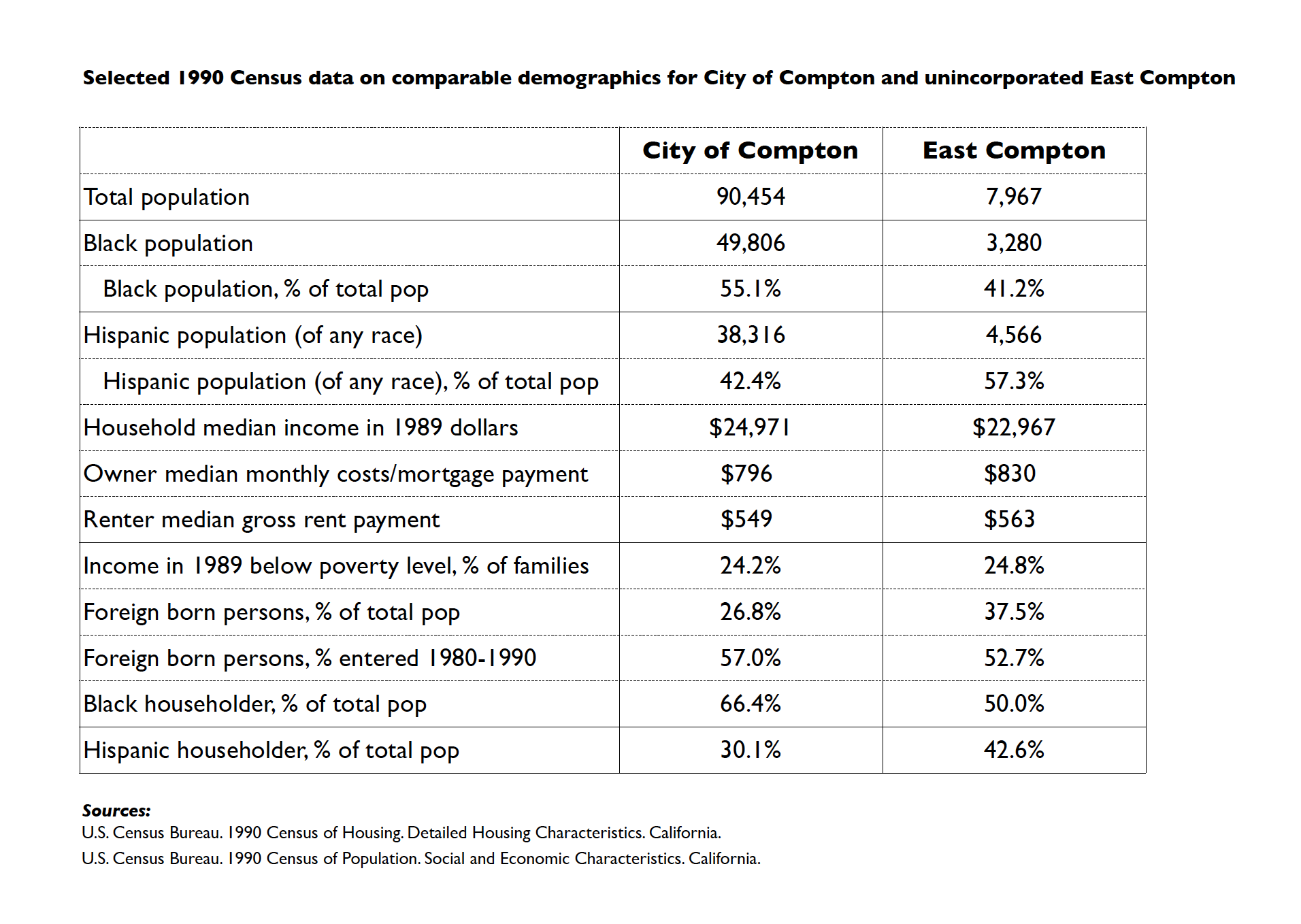
Sources:
U.S. Census Bureau. 1990 Census of Housing. Detailed Housing Characteristics. California. Retrieved from: https://www2.census.gov/library/publications/decennial/1990/ch-2/ch-2-6-1.pdf
U.S. Census Bureau. 1990 Census of Population. Social and Economic Characteristics. California. Retrieved from: https://www2.census.gov/library/publications/decennial/1990/cp-2/cp-2-6-1.pdf
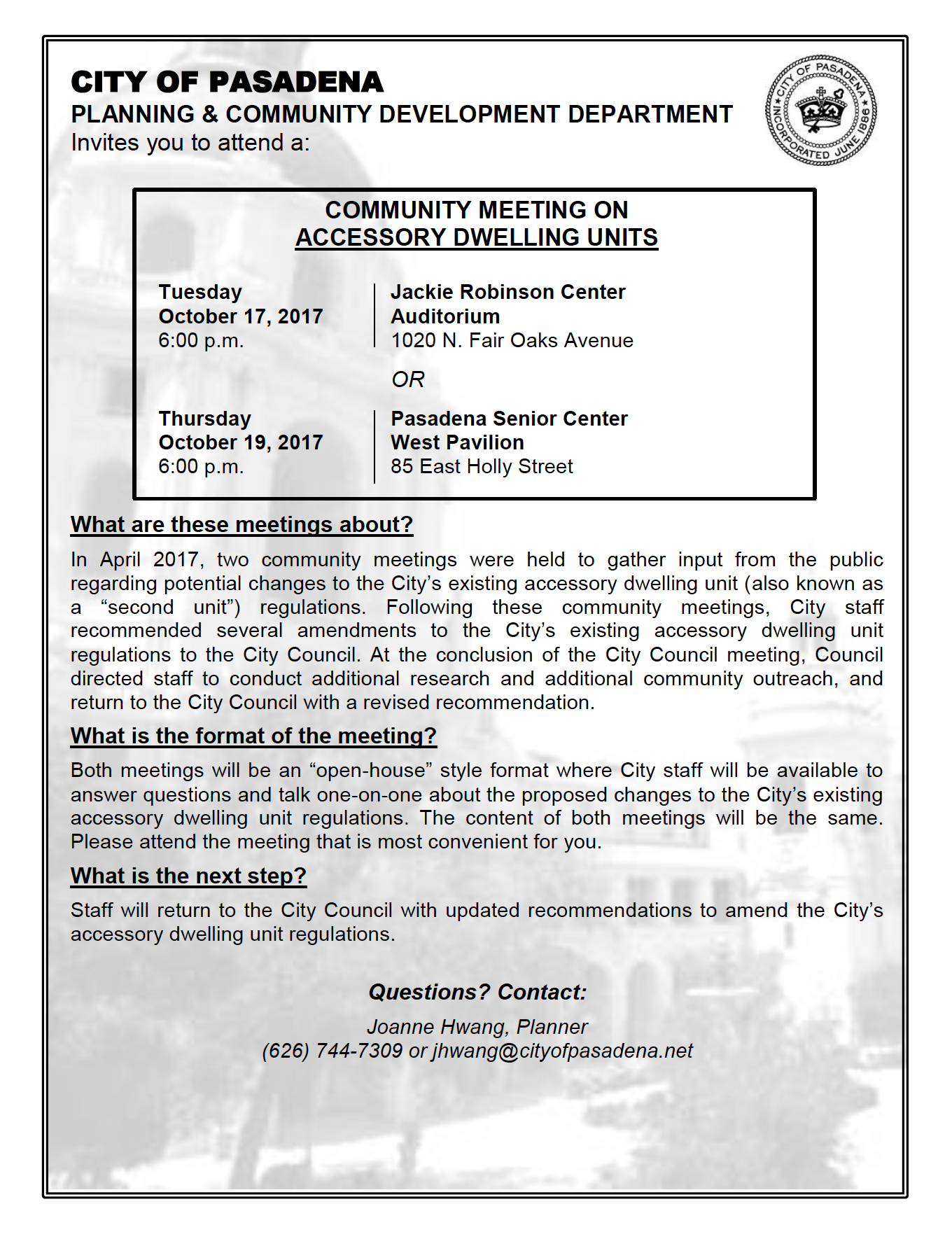
I was unable to attend tonight’s ADU ordinance community meeting hosted by Pasadena Planning Department. In lieu of in-person commentary, I emailed this public comment letter to staff.
My position hasn’t changed from June 19, 2017, when Pasadena City Council voted against a comprehensive ADU ordinance update advanced by our housing coalition.
As it stands today, Pasadena’s ADU ordinance remains broken. But we can fix it. The Pasadena City Council must drop its excessively-cautious, comfy-centrist, shortsighted, nostalgic, legally dubious, “I only wanna maintain votes in my SFR zones” mentality, and instead adopt a comprehensive ADU ordinance update that provides a safe and legal pathway for ADUs for working folks.

Consider this page 1 of my #manifesto nailed to the Planning Department’s door.
Read my op-ed, “We Cannot Plan From Our Desks”, in APA’s Planning Magazine #PlanMag October 2018 issue. Just in time for #PlanningMonth.
In this editorial I outline the tenets and benefits of #EmbeddedPlanning. This is my opening salvo to the planning field arguing for Embedded Planning praxis, what I describe as planning in the streets, over orthodox, desk-bound practice.
I ground Embedded Planning in the real life example of the Medina Family ADU Saga in the South Central Los Angeles community of Florence-Firestone. In my current speaking tour, “A Matter of Necessity:” Understanding Informal Housing through Embedded Planning, I’m sharing the family’s difficult first lesson in Planning and Zoning, and my inner conflict with the outcome. I can tell the Medinas’ story because I earned their trust, at their doorstep.