Category Archives: Planning
Embedded Planning Op-Ed Publishes in APA’s Planning Magazine, Oct 2018
Eureka moment for Embedded Planning

I’m writing an invited op-ed on Embedded Planning. It’s a challenging but rewarding exercise. This has been an amorphous idea swirling in my head for years. I knew what it was intuitively, but I hadn’t defined it. This op-ed is pushing me to define, outline, & explain the benefits of my #EmbeddedPlanning praxis.
The piece draws on my ideas developed over 12 years doing urban planning on-the-ground, from my #MLIS experience in which I regularly wrote about librarians breaking free from the reference desk to do LIS work out in the neighborhood, & from my speaking tour on the Medina Family #ADU saga.
My most fruitful thinking on this op-ed has been away from a desk. On Thursday morning, stuck in #LosAngeles traffic, I had a eureka! moment about the title of my public talk, “A Matter of Necessity”: Understanding Informal Housing through Storytelling. The reason I can tell the Medina Family story is because I earned their trust, at their doorstep, through my Embedded Planning praxis.
Thus far I’ve delivered the Medina Family ADU talk at CSUN, Woodbury University, Cal Poly Pomona, UCLA Luskin, & the American Planning Association #NPC18 Conference in New Orleans under the “Storytelling” title. It’s high time for an update. It’s time to revise my title to underscore that the lessons learned result from Embedded Planning.
Henceforth the title of my talk on the Medina Family ADU story is:
“A Matter of Necessity”: Understanding Informal Housing through Embedded Planning
Only through Embedded Planning do we arrive at my thesis: “Behind every informal unit there’s a story to tell, a human dimension that needs light.”
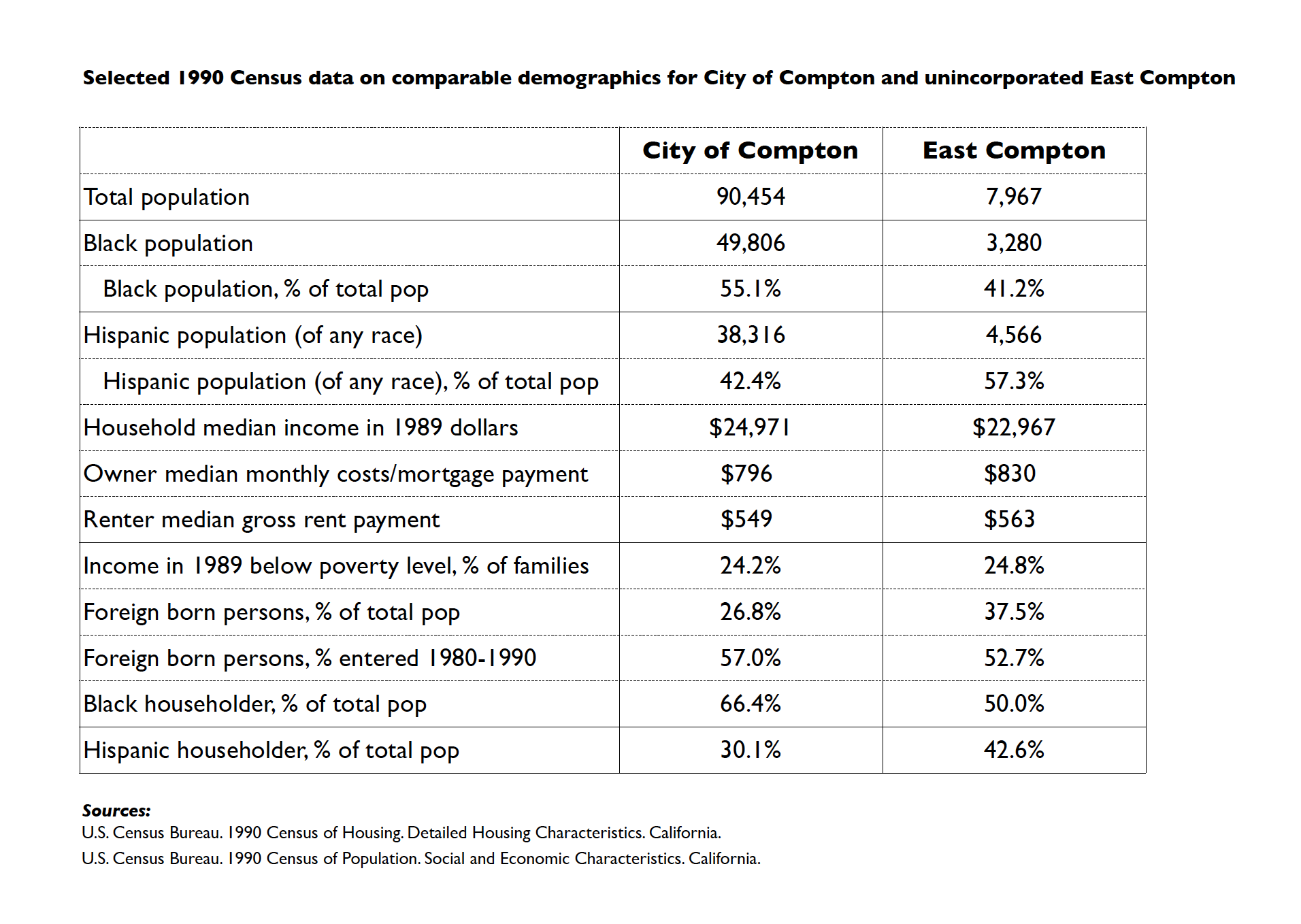
Selected 1990 Census data on comparable demographics for the City of Compton and unincorporated East Compton—now called East Rancho Dominguez
The present post serves as a hyperlinked footnote (“comparable demographics”) from this paragraph in my article titled, “My Afternoon Doing Urban Planning on the Ground in South Central Los Angeles,” to be published shortly in UrbDeZine:
Yet despite familiar appearances, ERD’s renaming was less a matter of “Compton stigma” and more about autonomy. Unlike the five cities who’d whitewashed Compton Boulevard from their maps, ERD reflected comparable demographics for African-American and Latino residents as the City of Compton. ERD wasn’t dissociating from the local populations; rather, it embraced them under a new, shared ethos within its borders. And while some stakeholders saw better economic development potential with the new name, backers argued that the rebrand would establish the autonomous identity rightly owed to this community. “I think we deserve it,” declared ERD leader Margaret Comer. These days, any definitive motivation for the name change remains up for debate – but what’s irrefutable is that this episode in local politics rendered publicly the fiercely independent spirit that defines East Rancho Dominguez.
The below chart includes selected 1990 Census data on those comparable demographics for the City of Compton and unincorporated East Compton—now called East Rancho Dominguez. The data are drawn from social, economic, population, and housing characteristics with the base geographic area of Place and County subdivision, 2,500 person or more.

Sources:
U.S. Census Bureau. 1990 Census of Housing. Detailed Housing Characteristics. California. Retrieved from: https://www2.census.gov/library/publications/decennial/1990/ch-2/ch-2-6-1.pdf
U.S. Census Bureau. 1990 Census of Population. Social and Economic Characteristics. California. Retrieved from: https://www2.census.gov/library/publications/decennial/1990/cp-2/cp-2-6-1.pdf
MUTUAL AID AT LUNCHTIME
Read my latest piece, “Mutual Aid at Lunchtime,” published Dec. 6, 2017 in Cultural Weekly.
It’s a concise but expository look at my unorthodox urban planning outreach tactics. I cover planning in plain language, burritos, and the anarchist philosopher Peter Kropotkin in less than 1000 words!
Pasadena’s ADU Ordinance Remains Broken. Here’s How to Fix it.

I was unable to attend tonight’s ADU ordinance community meeting hosted by Pasadena Planning Department. In lieu of in-person commentary, I emailed this public comment letter to staff.
My position hasn’t changed from June 19, 2017, when Pasadena City Council voted against a comprehensive ADU ordinance update advanced by our housing coalition.
As it stands today, Pasadena’s ADU ordinance remains broken. But we can fix it. The Pasadena City Council must drop its excessively-cautious, comfy-centrist, shortsighted, nostalgic, legally dubious, “I only wanna maintain votes in my SFR zones” mentality, and instead adopt a comprehensive ADU ordinance update that provides a safe and legal pathway for ADUs for working folks.
We Cannot Plan From Our Desks!
Designing Housing Solutions workshop @ #APACA2017
California’s housing crisis is at a breaking point. We need new ideas and strategies — now! Planners, urbanists, policymakers, designers, students: you’re invited to this innovative workshop where we’ll tap into your memories and experiences to design new housing solutions.
Designing Housing Solutions
2017 APA CA Conference Sacramento
Tuesday, Sept 26, 2017
8:30 a.m. – 10:00 a.m.
RSVP: https://www.facebook.com/events/311978272598475
OVERVIEW: The workshop will tap into the diverse experience and expertise of attending planners to collaborate and design comprehensive housing solutions. The facilitated exercise will bring together a diversity of perspectives to explore new housing typologies that expand choice, encourage affordability, and specifically address the risk of informal dwelling units.
ABSTRACT: The lack of affordable housing in California has reached crisis levels. Among the many consequences is the rash of hazardous incidents happening in unpermitted dwellings. As the tragic warehouse fire in Oakland recently illustrated, unpermitted housing happens across the State at various scales. With no sign of housing demand softening, there is an urgent need to investigate housing supply. While Los Angeles’ recent Proposition JJJ creates a de facto inclusionary zoning policy, no blanket approach exists to address the regulatory, cultural, design, and financing issues associated with housing policy.
The Designing Housing Solutions workshop will facilitate two interactive engagement activities where professionals design and prototype new and diverse housing typologies (co-housing, farm worker housing, artist housing, garage conversions, senior housing, ADUs, etc). The workshop creates a safe space for attending planners to nurture ideas, communicate through storytelling and collaborate. Participants will engage through memory, art and play to better understand themselves and the State’s housing assets, needs and challenges.
This input will launch a conversation that will inform future research, as well as generate ideas that address spatial values impacting housing’s urban design, zoning and planning. The workshop will consider how shared ideas can help create more inclusive spaces.
FACILITATORS:
◦ Gunnar Hand, Skidmore, Owings, & Merrill, LLP
◦ Jonathan P. Bell, County of Los Angeles, Dept. of Regional Planning
◦ James Rojas, Place It! & Latino Urban Forum
◦ Fay Darmawi, Affordable Housing Finance and Consulting
◦ Connie Chung, County of Los Angeles, Dept. of Regional Planning
◦ Cathy E. Creswell, Creswell Consulting
#APACA2017
How to fix Pasadena’s Accessory Dwelling Unit ordinance

Read my latest public comment letter to Pasadena City Council on the proposed amendments to the ADU ordinance.
The Council caved to NIMBY pressure and rejected the Pasadena Planning Department’s proposal for a more equitable ordinance.
More to come.
ADU Ordinance Update-Public Comment 19 June 2017-Jonathan P Bell
The invisibility of code enforcement in planning praxis: The case of informal housing in Southern California
Pretty cool to be published old school style: in print!
Read the latest from me and Jake Wegmann on #InformalHousing in Los Angeles: “The Invisibility of Code Enforcement in Planning Praxis: The Case of Informal Housing in Southern California,” (2016) FOCUS Journal, Cal Poly San Luis Obispo, Dept of City & Regional Planning
Abstract: More and better engagement with working class neighborhoods and communities of color are urgent imperatives for the planning profession as the United States transitions to a “majority minority” population. Code enforcement personnel are already doing much of this work, normally in a much more collaborative and less heavy-handed manner than the name of their profession would suggest. However, at present the planning profession largely holds code enforcement at arms’ length. Using the example of the informal housing market in Southern California—managed on a daily basis by code enforcement officers, yet largely unaddressed by planners—we draw on survey and interview data and our own professional experiences to make four propositions about code enforcement work. These are that code enforcement work is unusually cumbersome; it is chronically understaffed; its personnel cope by working reactively rather than proactively; and the profession suffers low prestige as a result. We argue that ending the estrangement between code enforcement and planning would offer numerous benefits to the latter, including inculcating cultural competence in planners through “learning by doing” and working at street level, and injecting sorely needed “community data” into efforts to address vexing issues such as housing unaffordability.
An Open Letter to the Pasadena City Council Urging a Comprehensive Overhaul of the Second Dwelling Unit Ordinance
Read my “Open Letter to the Pasadena City Council Urging a Comprehensive Overhaul of the Second Dwelling Unit Ordinance,” published on UrbDeZine.
The Pasadena City Council will consider an amended ordinance tomorrow, Monday, Jan 30th at a 7pm public hearing. The amendment does the bare minimum to comply with the state’s relaxed standards for building an Accessory Dwelling Unit (ADU) in your backyard. While the Pasadena Planning Commission removed some of the problematic standards, many “poison pills,” as I call them, remain in place.
Among the many ridiculous hurdles codified into the ordinance is a minimum lot size of 15,000 square feet to build an ADU in a backyard. So unless you’re a wealthy estate owner, no granny flats here. The inequality is real af.
The original Second Dwelling Unit Ordinance was broken from the start. The amended ordinance remains unfair and unfeasible. There’s no date for the “anticipated comprehensive review” of the ordinance as part of Pasadena’s Housing Element Implementation Program. So my call for a comprehensive overhaul of the ADU ordinance remains unfulfilled.
http://losangeles.urbdezine.com/2017/01/29/pasadena-overhaul-second-dwelling-unit-ordinance/

Latino Informal Housing session featured in APA Latinos & Planning December 2016 newsletter
After many years of ignoring unpermitted housing in the U.S., the planning field is finally coming around. The *unaffordable* housing crisis and rising incidents of fires in unpermitted dwellings pushed this issue into the spotlight. California found the audacity to pass AB 2299 and SB 1069 facilitating construction of safe and legal accessory dwelling units in all local jurisdictions. At long last, even the strictest Second Unit Ordinance laws are getting overhauled.
And over at the American Planning Association, I’m finally seeing a genuine interest in understanding the on the ground realities of informal housing. Not only did APA CA host my group’s Latino informal housing session at the 2016 conference in Pasadena, APA’s Latinos and Planning Division invited us to write a “Conference Spotlight” piece summarizing the session and its outcomes. My resulting article is published in the APA Latinos and Planning December 2016 newsletter. It’ll be of interest to planners, housing advocates, code enforcement inspectors, academics, and others working in the realm of housing and planning.
We’ll continue to elevate the informal housing debate going forward.
An Open Letter to the Pasadena Planning Commission Urging a Comprehensive Overhaul of the Second Dwelling Unit Ordinance

On December 14, 2016, the Pasadena Planning Commission will hold a public hearing to consider an amendment to the Second Dwelling Unit Ordinance. The update is required to comply with the relaxed standards in AB 2299 and SB 1069.
As proposed, the revised Ordinance achieves only minimum compliance with the new housing laws while leaving in place several “poison pill” criteria that discourage new accessory units. This is unacceptable.
Read my Open Letter to the Pasadena Planning Commission urging an overhaul of the Second Dwelling Unit Ordinance [published at UrbDeZine.com]
http://losangeles.urbdezine.com/2016/12/12/an-open-letter-to-the-pasadena-planning-commission-and-city-planning-staff-demanding-a-comprehensive-update-to-the-second-dwelling-unit-ordinance/
South Central Los Angeles: History and meaning in the historically proper place name
By: Jonathan P. Bell, @c1typlann3r
Decades ago the @latimes uncritically accepted L.A. City’s “South LA” rebranding. Recall that L.A. City’s elected officials wanted to sanitize images of “unrest” that they claimed were associated with “South Central.” So they dropped “Central”… brilliant 🙄. The L.A. Times went along with it wholesale.
We hadn’t seen “South Central L.A.” in an L.A. Times headline for many years until Angel Jennings’s Nov. 22nd story on #TheReef. While it’s in reference to the Historic South-Central district within L.A. City, seeing the historically proper place name was still exciting for many South Central Los Angeles advocates. It was one long overdue step away from revisionist history.
#SouthCentral #LosAngeles #OccasionalCritique #InstaEssay#MicroEssay
https://www.instagram.com/p/BNh-XSihMg7/?taken-by=c1typlann3r
South Central Los Angeles: Embrace, don’t erase, local history


Consider this page 1 of my #manifesto nailed to the Planning Department’s door.
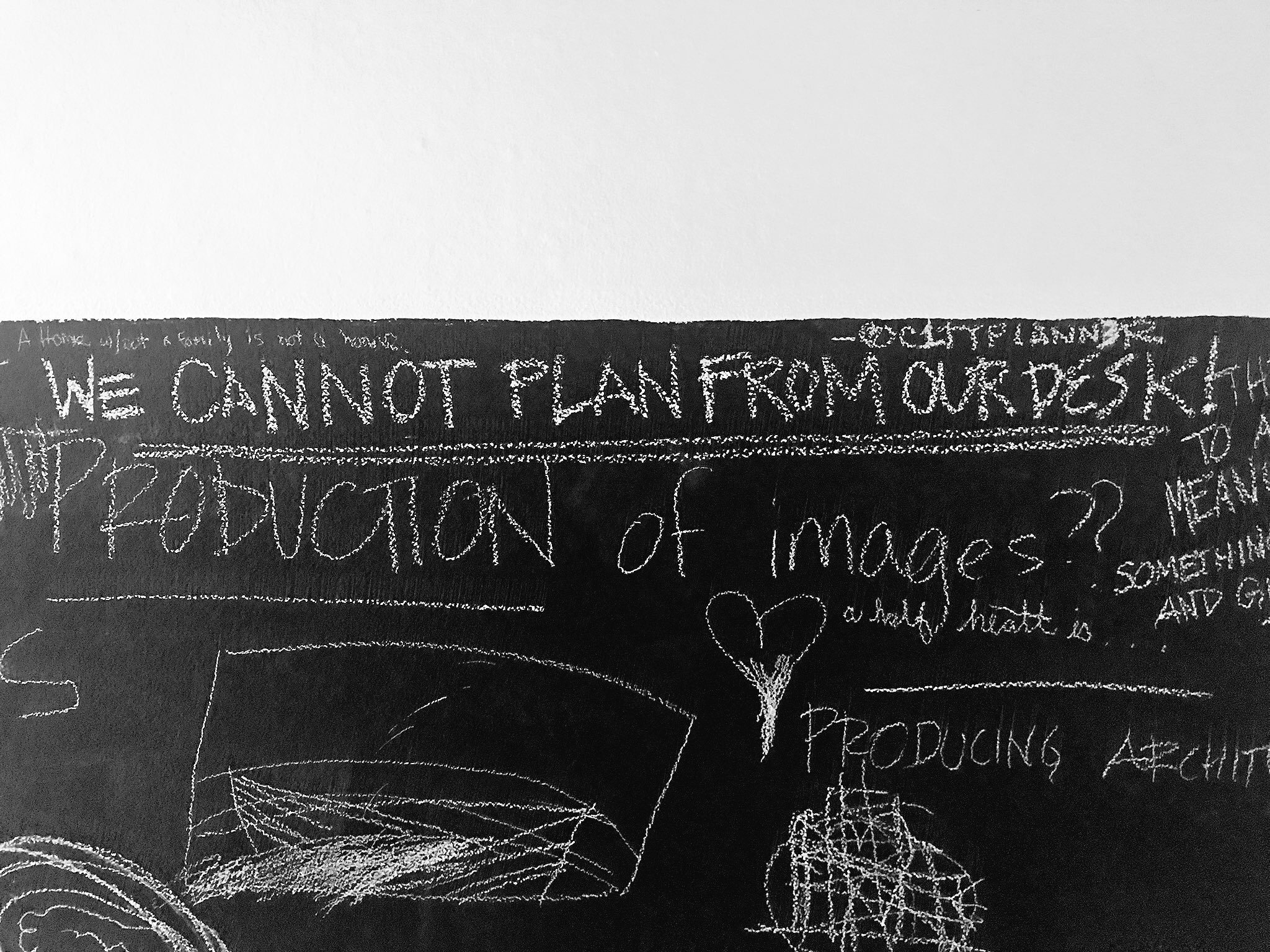
Read my op-ed, “We Cannot Plan From Our Desks”, in APA’s Planning Magazine #PlanMag October 2018 issue. Just in time for #PlanningMonth.
In this editorial I outline the tenets and benefits of #EmbeddedPlanning. This is my opening salvo to the planning field arguing for Embedded Planning praxis, what I describe as planning in the streets, over orthodox, desk-bound practice.
I ground Embedded Planning in the real life example of the Medina Family ADU Saga in the South Central Los Angeles community of Florence-Firestone. In my current speaking tour, “A Matter of Necessity:” Understanding Informal Housing through Embedded Planning, I’m sharing the family’s difficult first lesson in Planning and Zoning, and my inner conflict with the outcome. I can tell the Medinas’ story because I earned their trust, at their doorstep.