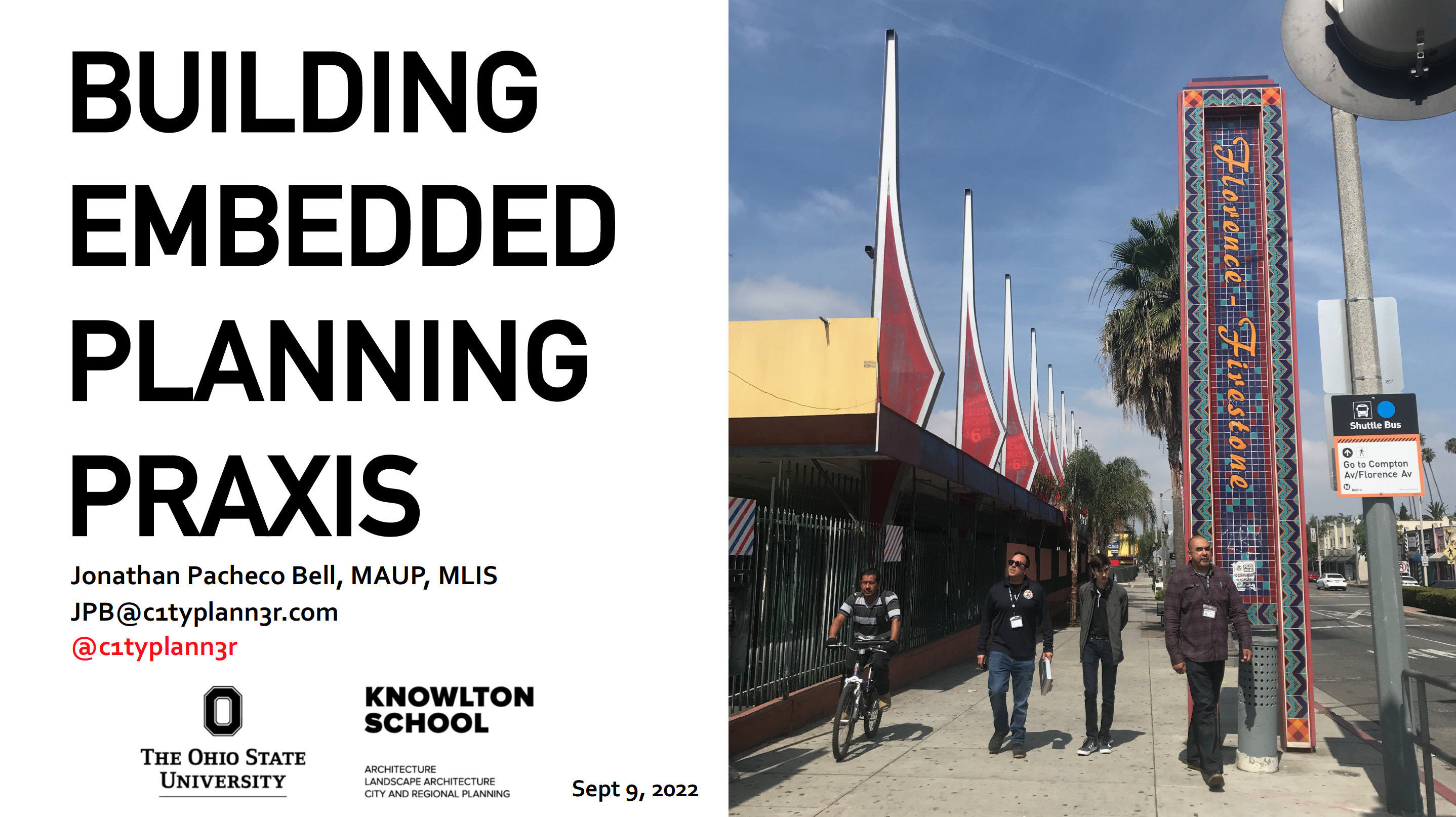
Today I presented virtually on the origins of #EmbeddedPlanning praxis in Gala Korniyenko’s course, “Reading the City Through History & Law” at The Ohio State University, Knowlton School City & Regional Planning.
We Cannot Plan From Our Desks.
Today I presented virtually on the origins of #EmbeddedPlanning praxis in Gala Korniyenko’s course, “Reading the City Through History & Law” at The Ohio State University, Knowlton School City & Regional Planning.
We Cannot Plan From Our Desks.
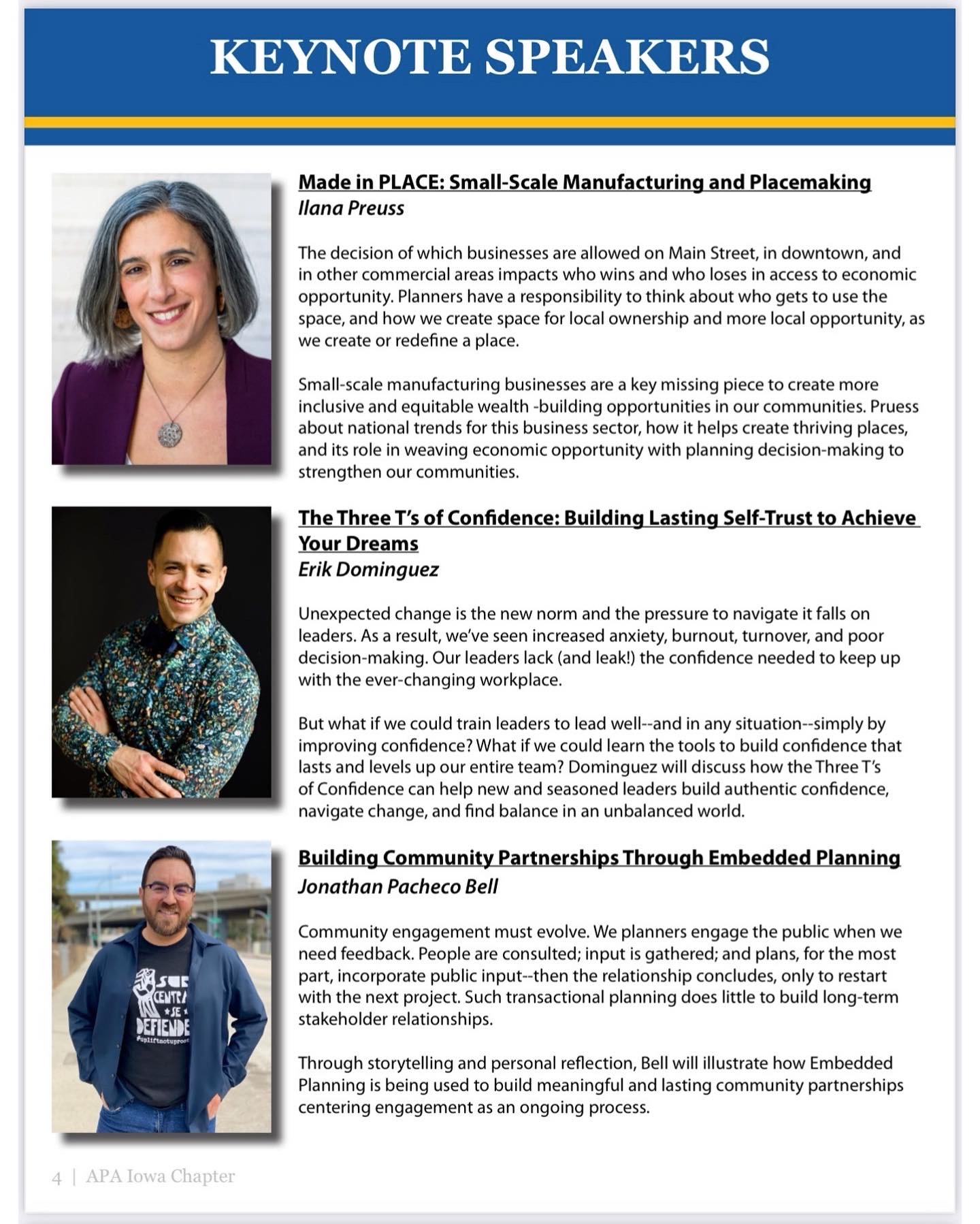
Honored to deliver the Friday, Oct 14 keynote at the APA Iowa Chapter Conference
Building Community Partnerships Through Embedded Planning
Community engagement must evolve. We planners engage the public when we need feedback. People are consulted; input is gathered; and plans, for the most part, incorporate public input — then the relationship concludes, only to restart with the next project. Such transactional planning does little to build long-term stakeholder relationships.
In a time of increasing interrogation of planning and its legacies of inequity, planners today are seeking better ways to build and sustain meaningful partnerships. Urban planner Jonathan Pacheco Bell (@c1typlann3r) proposes Embedded Planning as a way to fundamentally restructure community engagement and practice. Embedded Planning means planning from the street, not from a desk. Embedded Planners work in the spaces and places of community members. Embedded Planners build bridges with marginalized communities harmed by past planning practices. Embedded Planning is a praxis that puts theory into action to better this world. Since Bell declared Embedded Planning exists in 2018, it has grown into an international movement embraced by emerging planners.
Through storytelling and personal reflection, Bell will illustrate how #EmbeddedPlanning is being used to build lasting community partnerships that center engagement as an ongoing process. Attendees will learn the benefits and challenges of Embedded Planning, including takeaways for implementation, and understand why this #praxis is the future of planning.

This week I joined Youth Leaders Empowered Active & Diverse (YLEAD) at CDTech for a conversation on urban planning and gentrification in South Central LA. I shared my story of working on the ground supporting the community with tools and knowledge to preserve South Central history. We shed light on the importance of urban planning for a South Central future without displacement.
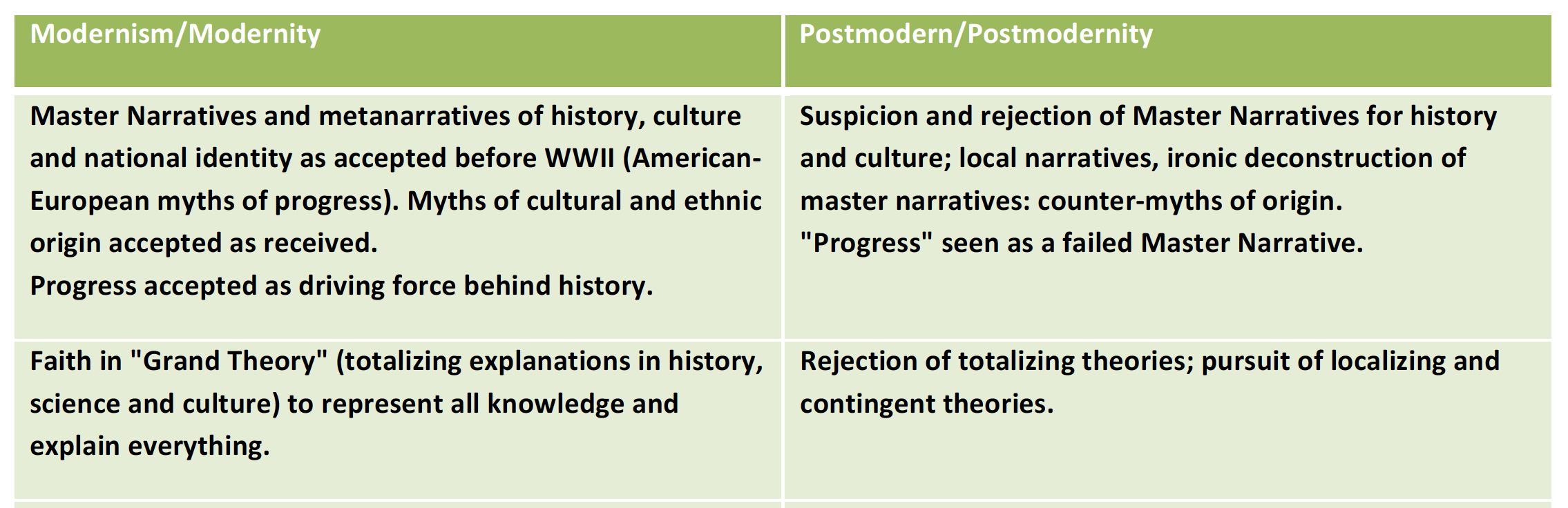
I’m revising an early essay I wrote interrogating planning theory in practice. It’ll be the first entry in my Student Papers Archive. I needed to do some background research on the two theories under scrutiny: Rational Planning and Postmodern Planning. In addition to peer reviewed journals from the planning realm, I found this exceptionally helpful chart comparing Modernism and Postmodernism.
From the URL cited on page 2, I noted the author is Professor Martin Irvine at Georgetown. But a copy-paste of the URL didn’t take me to the chart; instead it forwarded me to the professor’s homepage. And I couldn’t find the chart there. The last revision is dated 2012, but this side-by-side certainly is relevant 10 years later — and will remain so.
I want this chart to live on. I don’t know if the host site’s future update(s) will retain it. So much web ephemera is lost without us knowing. So, I’m doing my part by sharing Professor Irvine’s Modernism vs Postmodernism resource here. Researchers, check it out and please be sure to cite the original author if using the chart.
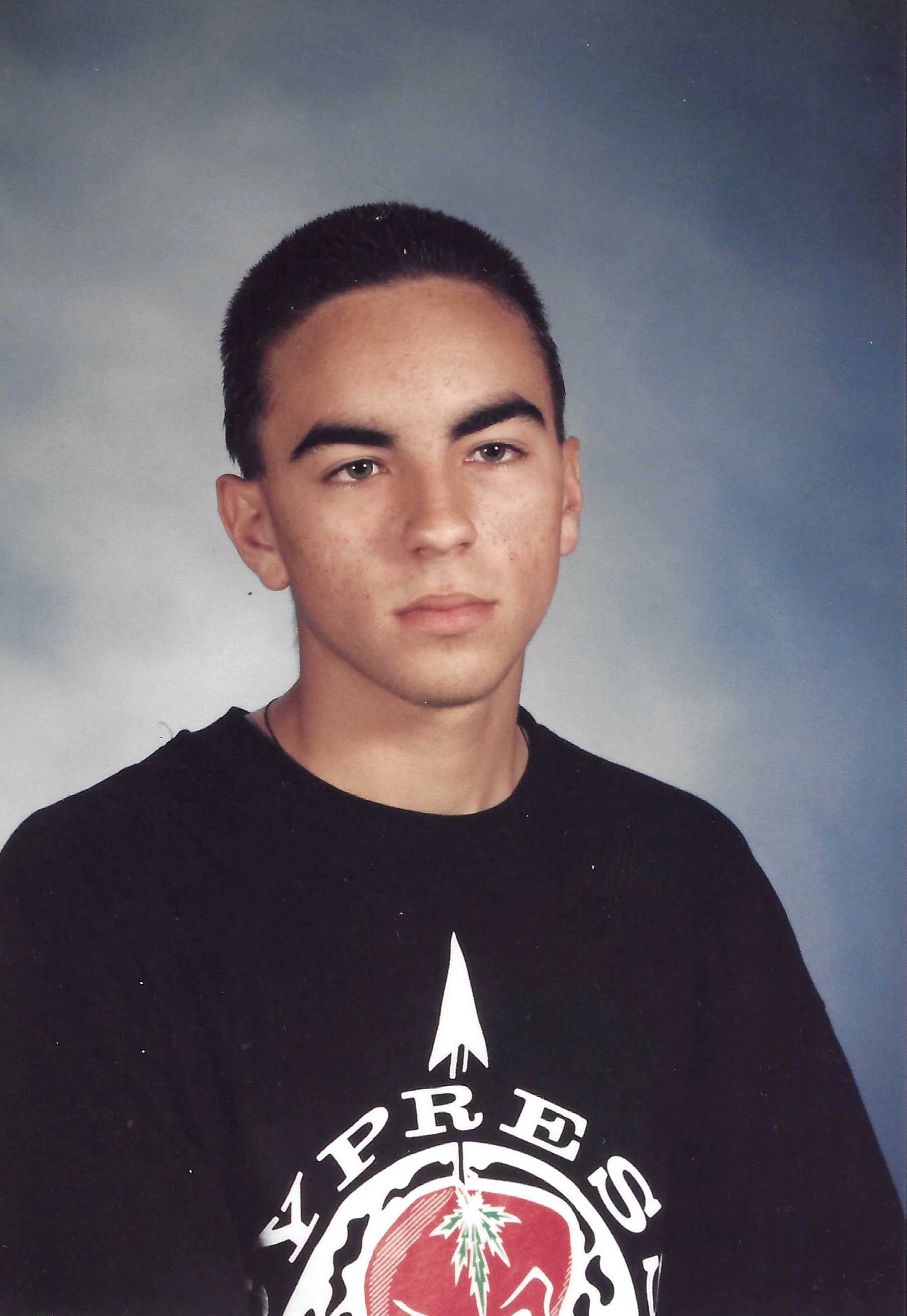
I wrote about the impact of Cypress Hill’s trailblazing self-titled debut album that dropped 31 years ago today, and explained why I represented them to the fullest in my 1992 yearbook photo at Montebello High School.
The #HipHopHistory microessay is on my Instagram (private but I add): https://www.instagram.com/c1typlann3r/
Excerpt:
“We saw ourselves in Cypress. They talked like us. We looked like them. Or tried, if you could grow a goatee.
This foolio went all in. I wore out that cassette tape. I grew a whiskery #brocha. I joined the Cypress Hill fan club, scoring stickers, newsletters, and the OG Cypress Hill t-shirt with the skull, weed, & globe in compass album cover on the front, and on the back it read: “The Phuncky Cypress Hill Shit.” The iconic gear got me suspended from Montebello High and gaffeled up by Magic Mountain security —“harassed by a pig real fast,” to quote B-Real.
When it came time for my 1992 yearbook photo, I had to represent. Vatos don’t smile ey. But I was moody too. The night before I’d phucked up my mustache trim. I cut it all off rather than leave it #chueco in the yearbook. I told myself that I was still down for mine. That’s not Johnny, it’s SKUZ ONE.”

I’m interviewed about the history of student debt in this excellent long form reporting by Julia Barajas at LAist. I thought about my urban planning students at Cal Poly Pomona and Pitzer College for this one.
Excerpt:
In May 2022, the Washington Post reported that White House officials were exploring the promised cancellation of $10,000 in student debt per borrower, but limiting efforts to people who earned less than $150,000 last year.
Opponents to this proposal can be found across the political spectrum.
Jonathan Pacheco Bell, an urban planner and adjunct professor at Cal Poly Pomona and Pitzer College, said he appreciates that Biden has not forgotten his campaign promise, but $10,000 is insufficient.
“It’s a way to split the difference so that you make some people happy and some people mad, but you’re not going to piss off the other side of the aisle, because you didn’t wipe away all the debt. It’s a very comfortable and extremely safe position,” he said.
Some of his students have taken on tens of thousands of dollars in debt, he added. “Meanwhile, the U.S. seems to be endlessly funding wars and other priorities with almost no hesitation, but it hesitates to invest in its own workforce.”

Eight months after announcement, I’m ready to launch my #StudentPapersArchive series on Medium: c1typlann3r.medium.com.
Coming very soon, the first publication is titled, “What’s Theory Got to Do With It? An Examination of the Utility of Planning Theory in Planning Practice.”
I wrote the original in March 2004 for Professor Evelyn Blumenberg’s course UP 222A Introduction to Planning History and Theory at UCLA Luskin School of Public Affairs.
Stay tuned.

I appreciate UC Irvine Professor Michael Mendez citing me and Embedded Planning in his article, “The Reflective Practitioner in the Context of Racial and Environmental Justice” in Planning Theory & Practice 2022. This is the Repair and Healing issue co-edited by Professor Courtney Knapp.
This is the first mention of Embedded Planning praxis in a peer-reviewed journal! The entire issue is Open Access. Read Dr Méndez and all the insightful articles.
Here’s the excerpt:
“Allowing time for critical reflective practice can be a powerful tool for planners to think purposively about their prior actions and to learn how in the future they can better challenge multiple forms of inequality embedded in the urban planning profession. Such an approach has led one county planner, Jonathan Pacheco Bell, to advocate broadly for planners to step away from their office desks and embed themselves in local communities, in what he calls, “Embedded Planning.” He believes that “for planning to achieve equity in communities, planners need to see the realities of community life…[and] connect with the people we serve” (Pacheco Bell, 2018). While he still works in an office and attends community meetings, he argues for prioritizing street-level engagement. Pacheco Bell often goes directly to constituents’ localized spaces: homes, churches, businesses, and bus stops to perform plain language outreach, conduct neighborhood organizing, give walking tours, mentor students, do empathetic code enforcement, and more. Pacheco Bell argues that working in such a manner helps produce more equitable plans, policies, and ordinances.
This type of emerging embedded planning offers a multidimensional view of the interactions between people’s well-being and the varying contexts of climate or environment or community shaped by wider political, institutional, economic, and social structures (Goldsmith et al., 2021; Mendez et al., 2020). For practitioners, in particular, such an approach can provide valuable contextual analysis and reflection on what hinders racial and environmental justice reform within the planning and regulatory institutions.”

I recently stumbled upon the fact that my SJSU bepress page was deleted along with the link to my 2012 MLIS thesis proposal, “Libraries in the ‘Hood: A Social History of the Florence and Graham Branch Libraries in the Community of Florence-Firestone, 1912-2012.”
That’s a damn shame.
This work served as the basis for my 2015 chapter “Library History as Community History: Florence and Graham” in the book, A Paseo Through Time in Florence-Firestone, and it remains a local history resource for those who have it.
But it should be an accessible resource for any community member who goes looking for it. They shouldn’t hit a 404 error.
This was the impetus I needed.
I’ve added my Florence-Firestone MLIS thesis proposal to my Writings section on here.
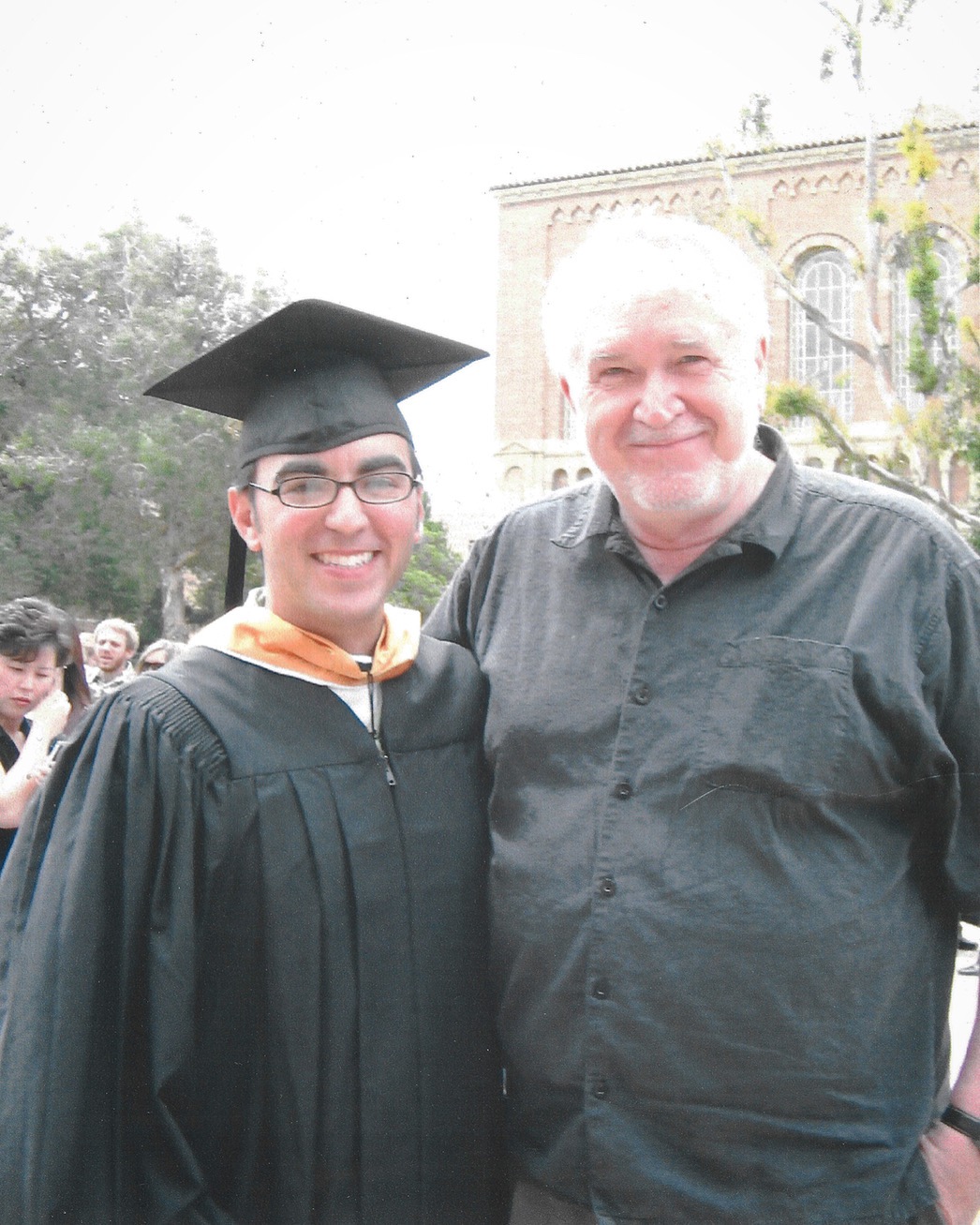
Edward Soja and me on graduation day 17 years ago today. Grad school was tough. I felt the weight of the neighborhood on my shoulders. I nearly dropped out 5 times, but Ed inspired me to stay and keep at it. My work with Soja would help me create Embedded Planning years later. The moral of the story: Find mentors who inspire you.

Congratulations to my fellow UCLA Bruin planners graduating today 👏🏽 You’re the next generation of planning. We’re in good hands.
Draw on our past to inform (y)our future. See the work of Edward W. Soja, Jackie Leavitt, Leo Estrada, VC Powe, Marty Wachs, John Friedmann and many others who rest in power.
Keep the flame lit.
In solidarity,
JPB @c1typlann3r

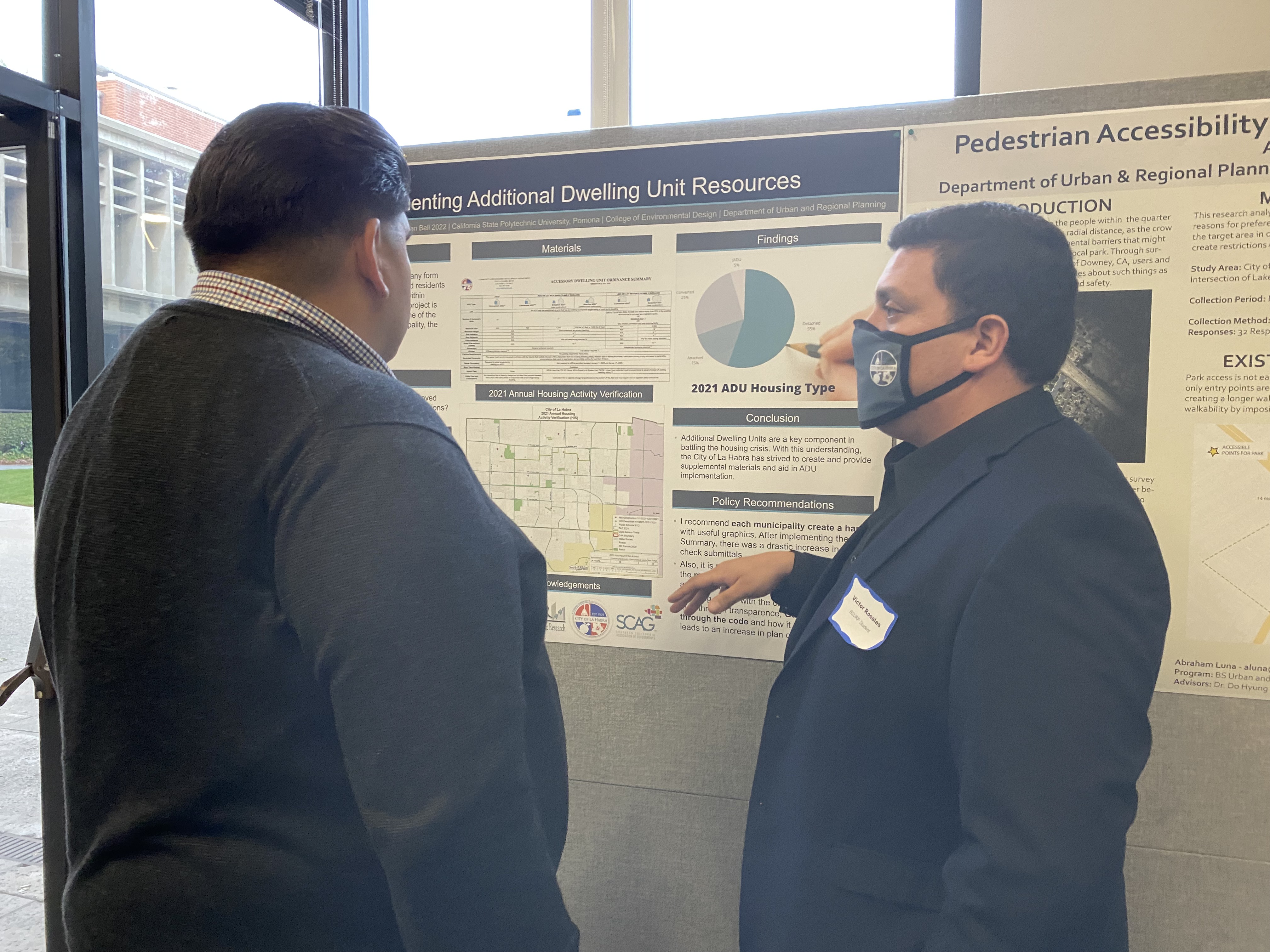
I’m celebrating the graduates in my Senior Projects class at Cal Poly Pomona Department of Urban & Regional Planning! Today we big up this researcher:
Will ADU Resources Expedite Implementation?
By: Victor Rosales
Abstract: In the City of La Habra, California, there was not enough Accessory Dwelling Units (ADUs) being built to address the housing crisis. One of the main obstacles was a lack of ADU resources and materials available to the public. While the city’s municipal code is accessible for public review, a large portion of the community does not understand how to interpret zoning codes or how codes apply to individual projects.
With this understanding of the problem, I worked with city staff on creating supplemental ADU materials, with the intended goal of increasing the amount of ADUs built within city limits. In 2021, the city’s Senior Building Official created an ADU Summary handout with basic outlines of development standards and simple graphic aides. This newly introduced resource, along with the assistance and communication from staff to the community, resulted in an upsurge in ADU plan check submittals and new construction. City staff tracked the progression of these newly built ADUs though paid plan checks, Certificate of Occupancy, surveys, and California Department of Housing credit logs. The data showed an increased number of ADUs constructed in the last 6 months of 2021, which correlated with the timing of the implementation of the ADU Summary. By providing supplemental materials for ADUs, the City of La Habra was able to increase the amount of ADUs built in their community in 2021. Additionally, staff revised and enhanced these readily available resources to support ADU development. As a result, the amount of plan check submissions has nearly tripled in the first six months of 2022.
Upon studying the City of La Habra’s approach to ADUs, I offer several policy recommendations for resources and information that support expediting ADU implementation in cities.

I’m celebrating the graduates in my Senior Projects class at Cal Poly Pomona Department of Urban & Regional Planning! Today we big up this team:
Wildfire Mitigation & Resilience Strategies: Best Planning Practices across Local Jurisdictions in Southern California
By: Stacy Lee & Eric Ji
Abstract: Increasing forecasts of prolonged and more severe fire seasons can be attributed to several factors: urban density growth; fire suppression and fuel buildup; and climate change. Many of these issues are amplified in Southern California, especially in the wildland-urban interface (WUI). Land-use policies must begin to proactively strategize around the immutable outbreaks of future wildfires as expanding boundaries of development and very high fire severity zones cross onto each other.
This qualitative research empirically analyzes the survey response consisting of a list of 19 planning strategies for wildfire mitigation on a Likert scale on compatibility, feasibility, and necessity of each local jurisdiction across four counties. The Counties of Los Angeles, Orange, Riverside, and San Bernardino with areas of very high fire severity zones identified by CAL FIRE were contacted with the survey request. The 18 responding jurisdiction responses scored each strategy to display the compatibility, feasibility, and necessity on a scale from 0 to 4, and cross analyzed by any implemented strategies in the corresponding jurisdictions or alternative policies in lieu of the strategies presented in the survey.
These findings are used to develop a scale of adoptable strategies based on the context of each jurisdiction as well as possible alternatives and narratives to adopting feasible strategies.


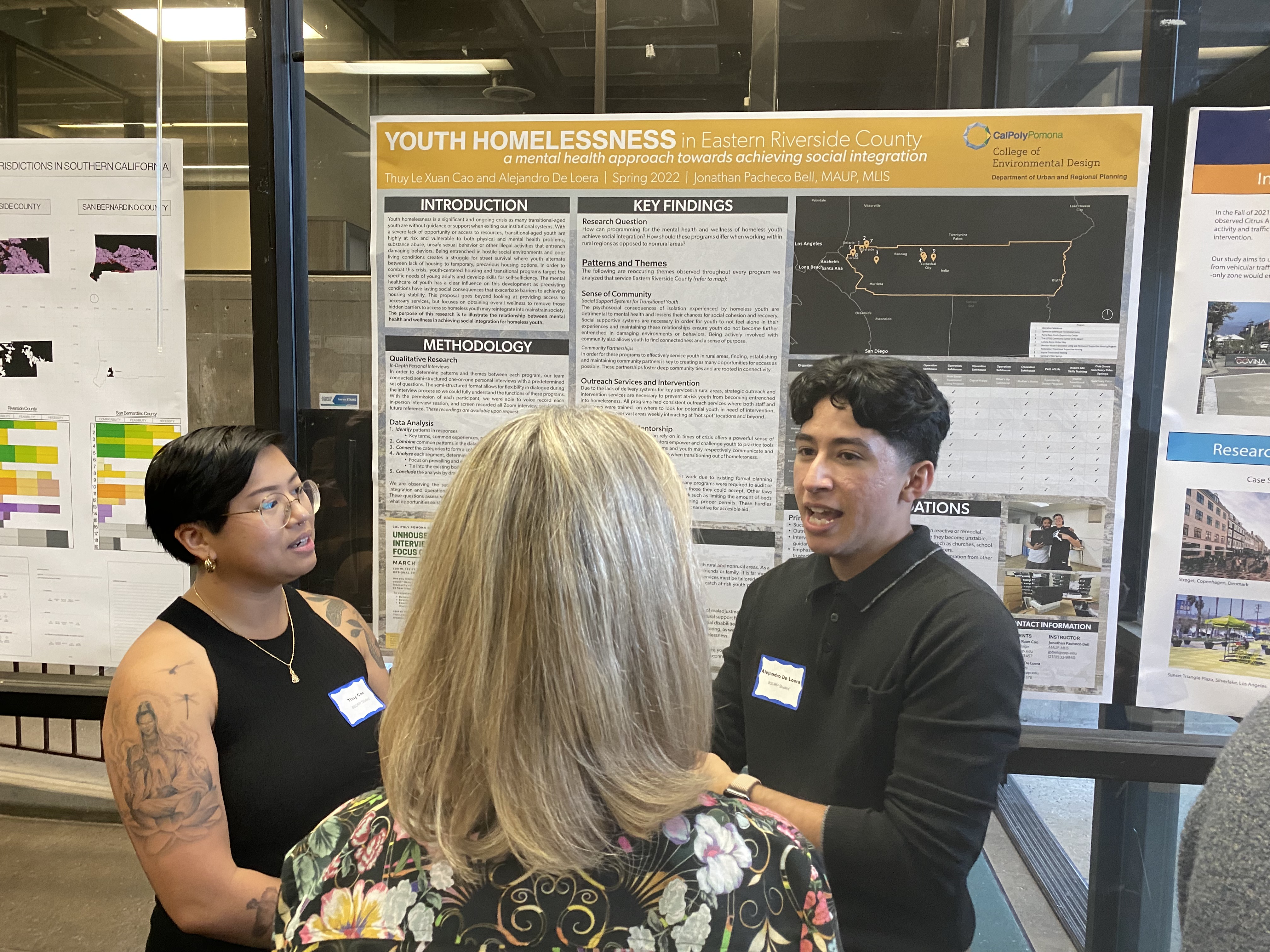
I’m celebrating the graduates in my Senior Projects class at Cal Poly Pomona Department of Urban & Regional Planning! Today we big up this team:
Youth Homelessness in Eastern Riverside County: A Mental Health Approach Towards Achieving Social Integration
By: Thuy Le Xuan Cao & Alejandro De Loera
Abstract: Youth homelessness is an ongoing crisis. Transitional-aged youth need support when exiting institutional systems. Without access to stable living environments, youth are exposed to trauma. Without coping strategies for stress, they’re vulnerable to chronic or cyclical homelessness. Hostile environments and poor living conditions create struggles for street survival. To combat this crisis, youth-centered housing and transitional programs target their unique needs. Youth mental healthcare influences this development as preexisting conditions including housing insecurity, mental health issues, substance use and family dysfunction have psychosocial consequences exacerbating barriers to housing stability. This project examines access to services for wellness and removal of hidden access barriers so unhoused youth can integrate into society.
Youth homelessness is prevalent in rural and nonrural areas and correlates to mental health issues magnified by rural conditions. Supportive services must be tailored to rural homeless youth needs. Beyond skill building, homeless youth require tailored interventions including non-housing case management, mentorship, counseling and mental health treatment. The creation of safe communal spaces promotes social cohesion where youth may interact and gain social capital from peer mentorship. Notably, planning itself creates a barrier to collective action due to formalities required for programs to exist legally.
We’ve created recommendations for 3 stages of intervention: Primary interventions include successful outreach focusing on preventative services for at-risk youth. Secondary programming offers local and short-term supportive programs with flexible hours for youth in crisis. Tertiary support prioritizes community partnerships to offer continuous, long-term services where homelessness occurs.
*Abbreviated from original

Kenny Uong, the future CEO of Los Angeles Metro, quoted me on his graduation cap at CSUN 🎓😭✊🏽 WE CANNOT PLAN FROM OUR DESKS 📢
Congratulations, Kenny 👏🏽

You must be logged in to post a comment.