Among the many excellent urban planning programs in the Los Angeles region, UCI MURP has been one of the strongest supporters of advancing #EmbeddedPlanning praxis. To the students, faculty, and staff: THANK YOU!
Looking forward to growing our partnership and developing future critical planners & Embedded Planners.
I was not raised speaking Spanish. When Nana Josephine Pacheco née Ontiveros came to #LosAngeles from #Texas, the school teachers struck her with rulers por hablando Español en clase. So Nana didn’t teach my mom. And nobody taught me. I learned Español in earnest in the last 8 years working as an Embedded Planner on the ground in Florence-Firestone. For real I’m at like 6th grade level, pero sabes que, es mejor que nada!
On arrival Friday in #CDMX, I quickly had to adjust to Español. It was thrilling. I found myself absorbing the spoken word, the unique rhythm, cadence, & dialect of #Chilango, the Spanish of Mexico City. Immediately I found myself translating signs, speech, & writing intuitively. Dormant neurotransmitters began firing. Parts of my brain were trabajando overtime to help situate myself in this new space & culture.
I recognized this feeling. It had been awhile but I’d felt it long before. I told mi esposita that this exhilaration must have been the same stimulating experience of learning Inglés as a child con mi familia on the streets of East Los Angeles y Montebello 40+ years ago.
We’re working on a new way to advance #EmbeddedPlanning praxis. It’s an act of mutual aid by our friends at South Central Shirt Printing.
Embedded Planning was born on the streets of Florence-Firestone in South Central Los Angeles. The founders of South Central Shirt Printing grew up in #FlorenceFirestone. We take care of each other. They help me build community power. I rep their gear at public talks. This is how we do.
Stay tuned for more on this project. Meantime, follow @south_central_shirt_printing on Instagram 👊
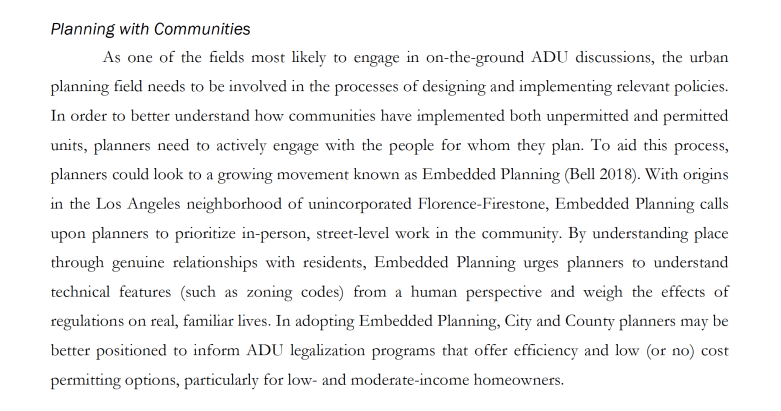
Embedded Planning in Hannah Diaz’s MCP thesis Recommendations, MIT 2019
#EmbeddedPlanning has spread into urban planning student projects. One among many examples is Hannah Diaz’s MIT master’s thesis on Accessory Dwelling Unit (#ADU) pilot programs in Los Angeles, titled “Bidding AD(ie)U to Homelessness?”
Originally from California, Hannah wanted to write a thesis addressing the highly personal issue of homelessness back home. Affordable ADUs are part of the solution. Hannah interviewed me and several L.A. planning colleagues for this project. I shared my street-level experience with regulation and legalization of informal ADUs. I was honored to see Embedded Planning mentioned in Hannah’s Recommendations, as it implores planners to understand planning’s technocratic work from a “human perspective and weigh the effects of regulations on real, familiar lives.”
YES!
Congratulations Hannah Diaz on completing your Master in City Planning at MIT Urban Planning#MITDUSP! Onward to professional praxis 🙌
You know you’ve made an impact on the culture when your work becomes a meme 😄
This meme was posted today in the Planning Peeps group on #facebook! It references the #EmbeddedPlanning rallying cry: WE CANNOT PLAN FROM OUR DESKS!
Shout out to the meme creator and colleagues who sent this over today 🙌 Please head over to Planning Peeps on fb, like the meme, and post a comment on Embedded Planning.
The American Planning Association just published the Planning for Equity Policy Guide and #EmbeddedPlanning praxis is featured in the Further Reading section.
Thank you Miguel Angel Vazquez, AICP for your ongoing support and all committee authors for including the #PlanMag op-ed in this important resource for planners.
It’s incredibly humbling to be listed alongside planning luminaries Paul Davidoff, Norm Krumholz, John Forester, and Ruth Glass, who created the term #gentrification.
From Los Angeles to Seattle to Detriot to Boston to Norfolk, VA and back: “WE ARE A MOVEMENT” 📢
TODAY—I’m at @ucimurp delivering the Medina Family ADU Story in Prof. Lynda Hikichi’s class UPPP 275: Site Development. This is the 9th rendition of this public talk and the 2nd time UCI Urban Planning & Public Policy hosts it, thank you! If you’re on campus or nearby, come through: Room 3240 in the SBSG-Social & Behavioral Sciences Gateway building, 11:30am—12:30pm.
ABSTRACT: This presentation puts a human face on California’s housing crisis. Through storytelling, reflection and #EmbeddedPlanning praxis, presenter Jonathan Pacheco Bell @c1typlann3r, a zoning enforcement planner in South Central #LosAngeles, presents the story of the Medina Family from the #SouthCentralLA community of @FlorenceFirestone, who built an informal backyard Accessory Dwelling Unit #ADU for extra income after the sudden passing of their head of household. An anonymous complaint triggered inspection and eventual demolition of the dwelling for code violations. Jonathan himself ordered its removal. Attendees will understand the emotional roller coaster the family endured while embroiled in this regulatory process, and Jonathan’s inner conflict with the outcome. To help himself cope emotionally and to spotlight this family’s housing struggle, Jonathan has turned the experience into a speaking tour offering takeaways for planning policy, practice, and pedagogy. Jonathan will explain the @EmbeddedPlanning approach at the story’s core. This talk will inspire emerging planners to adapt and respond to the problem of housing insecurity with empathetic, activist, street-level planning #praxis.
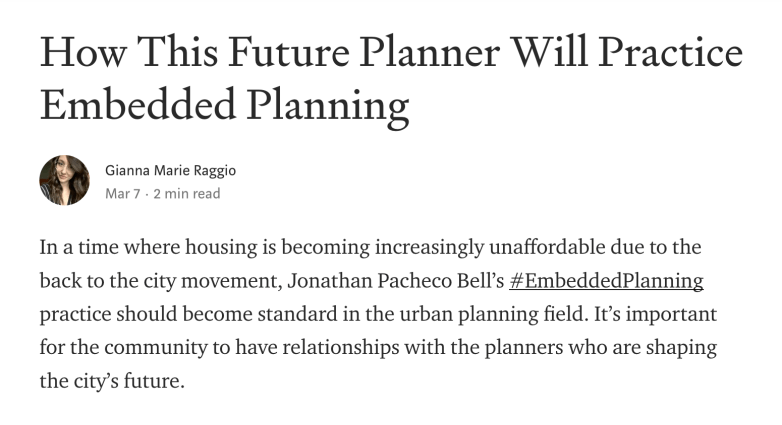
In a recent op-ed, Virginia urban planning student Gianna Raggio declared that she will lead Embedded Planning praxis in her community when she’s a practitioner.
As Gianna observed:
“Once I become a planner, I don’t want to be glued to a desk. Nor should I be. In order to make a positive impact on my community, I need to be present. To be an embedded planner, I need to be constantly interacting with residents in the community in which I work. Yes, that means attending community meetings. But it also goes above that. Embedded planners should go beyond what the job requires. Be present at community events, and contribute to neighborhood relationship building. Be a familiar face in the community.”
From #LosAngeles to #Norfolk and beyond, #EmbeddedPlanning is the future.
We brought the Medina Family ADU Story to Stanford Engineering on November 15, 2018. The Medina Family experience happens across all spaces, places, geographies, and jurisdictions. We need new audiences and new advocates. Photo courtesy of Derek Ouyang at Stanford SUS.
If you’ve been to my Medina Family ADU Story, or plan to attend an upcoming talk, you’ll see I get choked up. Happens every time. I don’t even try to suppress it anymore. This was a harrowing experience for the Medinas, and for me. My #EmbeddedPlanning praxis rejects the technocratic detachment of Rational Planning orthodoxy. When we shed tears, those tears are earned.
For the Medinas, removing the backyard dwelling built to generate income after the passing of their head of household worsened the stress that started it all. Ordering the removal after knowing the Medinas’ story made me question strict enforcement of #InformalHousing. The dwelling was not substandard—it was simply out of zoning compliance. All of this predated California’s relaxed State ADU Laws, so the only option was to demolish it. This was in 2016. After 10 years on the job, I’d finally realized that “Penalties or Demolition” was a false dilemma fallacy in #ADU enforcement. We’re trying to change this outcome for other folx.
The ending part is emotional for me. I conclude with slides featuring each member of the Medina Fam. I wanted audience members to understand the impact of rigid zoning on real people. I wanted to evoke an emotional response. And every time it works . . . on ME.
The final slide is of little Janelle. Janelle represents the future of #LosAngeles.
Janelle represents the future of Los Angeles. This effort is for her. Photo courtesy of Amy Thomson at SPUR
People’s lives are at the heart of Planning. Planners: befriend the community, get to know constituents personally, invest your heart into bettering THEIR lives and you’ll always have a righteous mission.
I could not do this series of public talks on #InformalHousing without permission & support of the Medina Family. My regulatory responsibility resulted in the removal of their informal #ADU but ironically brought us closer together. Theirs was a hard first lesson in Planning & Zoning. They knew others endure the same struggle. The Medinas permitted my public talks because they knew sharing their experience would help other residents & Other Planners understand the street realities of informal housing in working-class communities of color. They entrusted me to tell their story. They granted me a righteous mission.
Planners! We must draw inspiration from The People we serve.
The Medina Family—Flora, Josefina, Maria, and Janelle—they inspire me. Janelle represents the future of #LosAngeles. THIS IS FOR HER ♥️
Gracias Fay Darmawi for including us in the 2018 SF Urban Film Fest, SPUR Urbanist for hosting us, & SPUR’s Amy Thomson for photographing this moment.
“A Matter of Necessity”: Understanding Informal Housing through Embedded Planning at UCI School of Social Ecology, Department of Urban Planning and Public Policy, 25 October 2018
I’m honored to serve as UCI MURP Planning Visions Guest Speaker delivering my public talk, “A Matter of Necessity:” Understanding Informal Housing through Embedded Planning, at UC Irvine School of Social Ecology, Department of Urban Planning & Public Policy, Thursday, Oct 25th, 11:30a-1:00p. The event is made possible through the initiative of 2nd year MURP candidate Irene Aceituno. She will introduce me as speaker, discuss UCI’s Diversity in Planning Fellows program, & emphasize the value of mentorships in planning. The talk is Free & Open To All. RSVP at Eventbrite.
SUMMARY: This presentation puts a human face on California’s housing crisis. Jonathan Pacheco Bell, a zoning enforcement planner in Los Angeles County, will tell the story of the Medina Family from the South Central L.A. community of Florence-Firestone, who built an informal backyard dwelling for extra income after the sudden passing of their head of household. An anonymous complaint triggered an inspection & eventual demolition of the dwelling for code violations. It was Jonathan himself who ordered its removal. Audience members will understand the emotional roller coaster the family endured while embroiled in this regulatory process, & Jonathan’s inner conflict with the outcome. Key takeaways for planning policy, practice & pedagogy will be offered. This talk demonstrates that the rules we enforce can have unintended consequences, especially in working class communities of color.
BIO: Jonathan Pacheco Bell (@c1typlann3r) is a public sector Urban Planner in Los Angeles County with over 12 years of experience in zoning enforcement. He is a fierce advocate for the unincorporated areas of South Central Los Angeles. On any given day you will find him in the unincorporated community of Florence-Firestone partnering with stakeholders to improve quality of life.
A field-based planner, Bell researches, writes, & speaks about informal housing, unorthodox community outreach, and South Central L.A. history from his unique, on the ground perspective. He calls his praxis Embedded Planning.
A product of the California public school system from kindergarten to graduate school, Bell holds an MAUP from UCLA Luskin & an MLIS from SJSU iSchool.
Consider this page 1 of my #manifesto nailed to the Planning Department’s door.
Read my op-ed, “We Cannot Plan From Our Desks”, in APA’s Planning Magazine #PlanMag October 2018 issue. Just in time for #PlanningMonth.
In this editorial I outline the tenets and benefits of #EmbeddedPlanning. This is my opening salvo to the planning field arguing for Embedded Planning praxis, what I describe as planning in the streets, over orthodox, desk-bound practice.
I ground Embedded Planning in the real life example of the Medina Family ADU Saga in the South Central Los Angeles community of Florence-Firestone. In my current speaking tour, “A Matter of Necessity:” Understanding Informal Housing through Embedded Planning, I’m sharing the family’s difficult first lesson in Planning and Zoning, and my inner conflict with the outcome. I can tell the Medinas’ story because I earned their trust, at their doorstep.
“We Cannot Plan From Our Desks.” My op-ed on Embedded Planning praxis published in APA’s Planning Magazine, October 2018.
Planning practioners, students, and professors: WE CANNOT PLAN FROM OUR DESKS.
We need to get out there and connect.
#EmbeddedPlanning praxis means planning in streets, not from the comfort of your desk.
My op-ed publishes in APA’s Planning Magazine #PlanMag October 2018, just in time for #PlanningMonth.
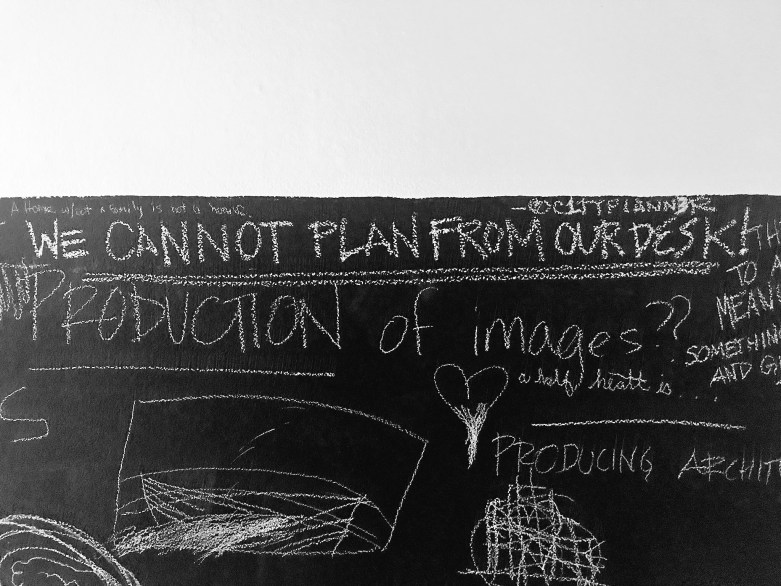
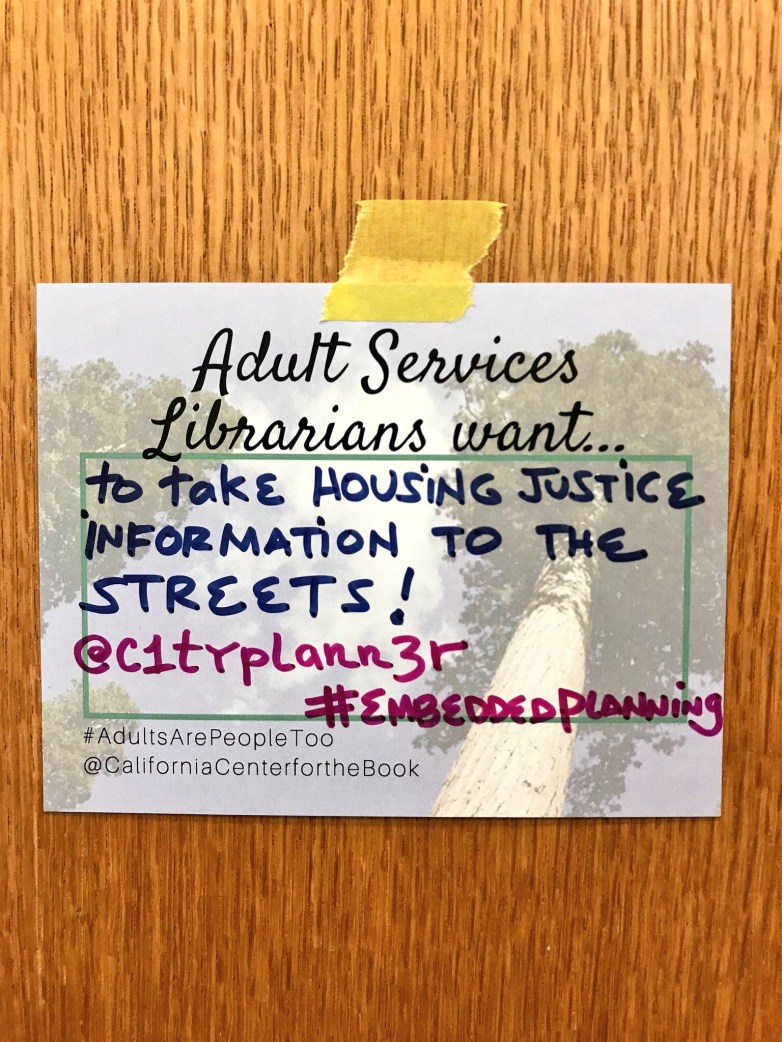
We Cannot Plan From Our Desks! at the 2018 APA National Planning Conference New Orleans #NPC18 via Jonathan Pacheco Bell @c1typlann3rWe Cannot Plan From Our Desks! at the Free School of Architecture closing night 2018 WUHO Gallery in Hollywood, CA via Jonathan Pacheco Bell @c1typlann3rWe Cannot Plan From Our Desks! at UCLA Luskin School of Public Affairs “The Informal City” seminar May 2018 via Jonathan Pacheco Bell @c1typlann3r#EmbeddedPlanning and Embedded Librarianship come together in taking housing justice information to the streets! at the CLA 2018 Adult Services Symposium, Sacramento Public Library via Jonathan Pacheco Bell @c1typlann3r
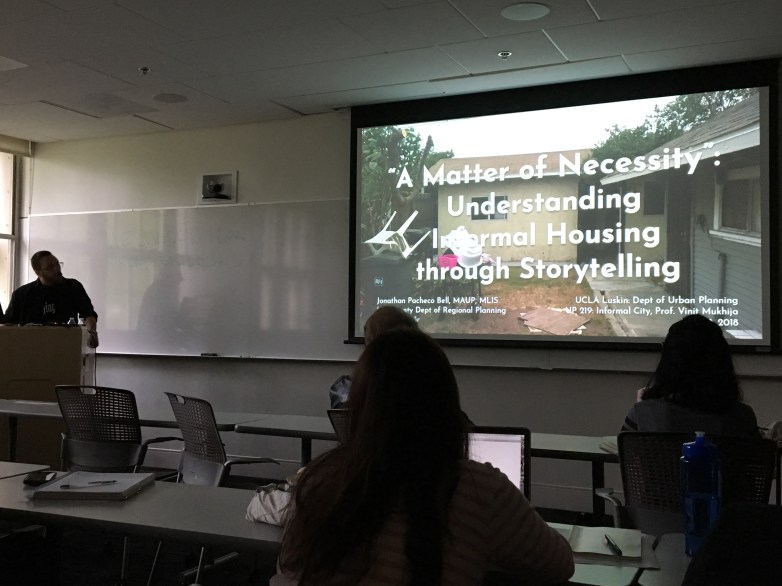
Delivering the Medina Family ADU talk in the “Informal Cities” seminar at UCLA Luskin School of Public Affairs, May 2018. Photo courtesy of Joshua Baum, MURP ’18
I’m writing an invited op-ed on Embedded Planning. It’s a challenging but rewarding exercise. This has been an amorphous idea swirling in my head for years. I knew what it was intuitively, but I hadn’t defined it. This op-ed is pushing me to define, outline, & explain the benefits of my #EmbeddedPlanning praxis.
The piece draws on my ideas developed over 12 years doing urban planning on-the-ground, from my #MLIS experience in which I regularly wrote about librarians breaking free from the reference desk to do LIS work out in the neighborhood, & from my speaking tour on the Medina Family #ADU saga.
My most fruitful thinking on this op-ed has been away from a desk. On Thursday morning, stuck in #LosAngeles traffic, I had a eureka! moment about the title of my public talk, “A Matter of Necessity”: Understanding Informal Housing through Storytelling. The reason I can tell the Medina Family story is because I earned their trust, at their doorstep, through my Embedded Planning praxis.
Thus far I’ve delivered the Medina Family ADU talk at CSUN, Woodbury University, Cal Poly Pomona, UCLA Luskin, & the American Planning Association #NPC18 Conference in New Orleans under the “Storytelling” title. It’s high time for an update. It’s time to revise my title to underscore that the lessons learned result from Embedded Planning.
Henceforth the title of my talk on the Medina Family ADU story is:
“A Matter of Necessity”: Understanding Informal Housing through Embedded Planning
Only through Embedded Planning do we arrive at my thesis: “Behind every informal unit there’s a story to tell, a human dimension that needs light.”









Consider this page 1 of my #manifesto nailed to the Planning Department’s door.
Read my op-ed, “We Cannot Plan From Our Desks”, in APA’s Planning Magazine #PlanMag October 2018 issue. Just in time for #PlanningMonth.
In this editorial I outline the tenets and benefits of #EmbeddedPlanning. This is my opening salvo to the planning field arguing for Embedded Planning praxis, what I describe as planning in the streets, over orthodox, desk-bound practice.
I ground Embedded Planning in the real life example of the Medina Family ADU Saga in the South Central Los Angeles community of Florence-Firestone. In my current speaking tour, “A Matter of Necessity:” Understanding Informal Housing through Embedded Planning, I’m sharing the family’s difficult first lesson in Planning and Zoning, and my inner conflict with the outcome. I can tell the Medinas’ story because I earned their trust, at their doorstep.