Voices of the Streets: The Lived Experiences of Street Vendors in the Community of Florence-Firestone. By: Sergio Saldana
Celebrating the graduates in my 2023 Senior Projects class at Cal Poly Pomona Department of Urban & Regional Planning. Today we big up this researcher:
Voices of the Streets: The Lived Experiences of Street Vendors in the Community of Florence-Firestone
By: Sergio Saldaña
Abstract: The street vendors in Florence-Firestone, an unincorporated community in Los Angeles County, have been left alone by County entities and enjoyed a certain degree of autonomy. However, this has also led to neglect on the part of the County towards the street vending community. Despite the existence of resources to help street vendors with issues such as rent relief, food, and public safety, the County has failed to address these concerns. Qualitative research in the form of in-person surveys was conducted with street vendors and sheds light on this community’s lived experiences. While street vendors appreciate the County’s hands-off approach, the lack of attention from the County has resulted in many problems for street vendors. Many of them struggle to make ends meet and need assistance. They also face public safety concerns, such as the risk of theft or harassment while working on the street.
Based on interview data from street vendors in Florence-Firestone, the County should take a more proactive role in addressing the concerns of the street vendors. The data derived from this study can play an essential part in helping County officials understand the needs and desires of street vendors by knowing their struggles. To give insight into challenges faced by street vendors as well as areas where they may require additional support, County officials can create an actionable plan to support street vending activity more effectively in future. This data can be used to assist officials with addressing regulatory issues preventing street vendors from succeeding. Officials can take measures such as providing education and guidance on compliance or revising regulations to be more vendor friendly. In the culmination of this paper, it is recommended that the County update the Florence-Firestone Community Plan with a new section addressing the concerns of street vendors and direct them towards available resources that may help.
Researcher presenting at the 2023 Cal Poly Pomona Urban & Regional Planning Senior Projects Day. Photo: Jonathan Pacheco Bell
Female Perceptions of Parking Safety at the First/Last Mile: An Analysis of Cal Poly Pomona. By: Nikole J. Sanchez & Jaden R. Oloresisimo
Celebrating the graduates in my 2023 Senior Projects class at Cal Poly Pomona Department of Urban & Regional Planning. Today we big up this team:
Female Perceptions of Parking Safety at the First/Last Mile: An Analysis of Cal Poly Pomona
By: Nikole J. Sanchez & Jaden R. Oloresisimo
Abstract: This research studies women’s perspective of safety by analyzing women’s fear of victimization at the first/last mile. The first/last mile refers to the very first and last distance of a traveler’s journey such as an automobile driver’s distance from their car to their building and their building back to their car. Research has found that women endure greater fear of victimization than men at the first/last mile due to varying levels of vulnerability, the continuity of violence, and perceived risk caused by the physical conditions of transportation infrastructure. The greater opportunity there is for hidden danger, the greater the perception of lack of safety, the perception of vulnerability, and the fear of victimization.
This research focuses on learning and engaging with women’s perceptions of safety (compared to men’s) in college campus parking. Using Cal Poly Pomona as a case study, this research follows a quantitative methodology through surveys addressing physical and non-physical variables known to impact women’s fear of victimization. The overall goal of this research is to recognize which variables are most impactful to women’s fear of victimization and to create women-endorsed solutions that negate women’s fear.
Research team presenting at the 2023 Cal Poly Pomona Urban & Regional Planning Senior Projects Day. Photo: Jonathan Pacheco Bell
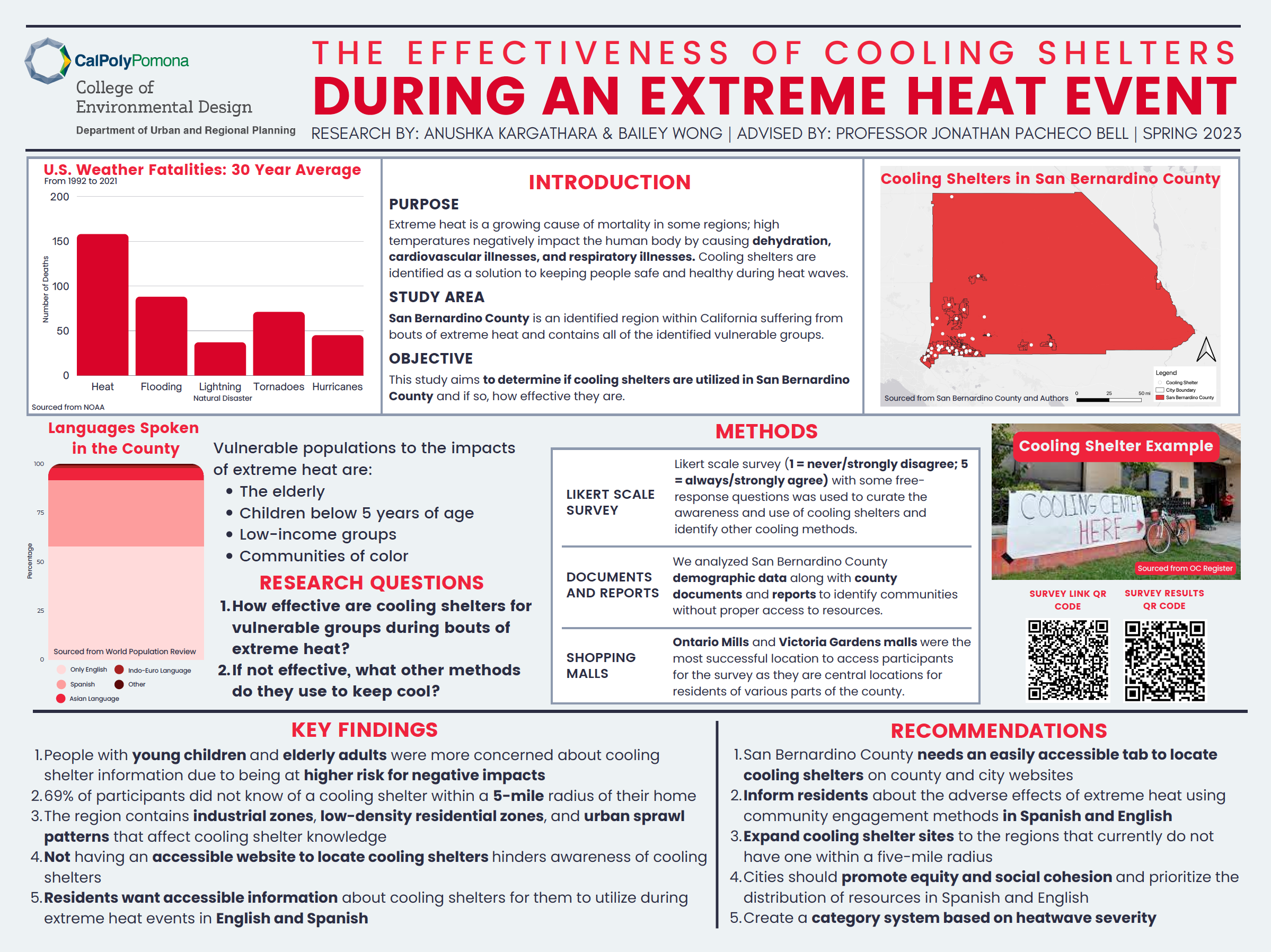
The Effectiveness of Cooling Shelters During an Extreme Heat Event. By: Anushka Kargathara & Bailey Wong
Celebrating the graduates in my 2023 Senior Projects class at Cal Poly Pomona Department of Urban & Regional Planning 🎉 Today we big up this team:
The Effectiveness of Cooling Shelters During an Extreme Heat Event (Winner of the First Place Award 🥇 for Senior Project Poster!)
By: Anushka Kargathara & Bailey Wong
Abstract: Extreme heat is one of the growing causes of mortality in the nation with temperatures surpassing 120˚F. Extreme heat (temperatures above 90 degrees Fahrenheit and 32 degrees Celsius) links an inequitable distribution of heat resources. During hot summer months, specifically June through August, heat negatively affects lower-income and communities of color and causes fatigue, dehydration, and respiratory illnesses due to environmental changes in air quality.
This research aims to analyze how heat impacts vulnerable populations in San Bernardino County, California, that do not have access to proper cooling methods, and what methods, if any, they use to keep cool. Knowledge of cooling shelters was tested through voluntary survey participation at San Bernardino County shopping malls to help local city governments broaden cooling shelter resources and gauge residential knowledge about their existence. Data collected showed an urgent need for improvement in the accessibility and promotion of local resources and equitable distribution focusing on lower-income communities.
Currently, resources are not readily available to residents and need to be accessible in both English and Spanish to ensure health communication equity to all population groups in San Bernardino County. Creating heat intensity awareness to prepare cities and planners to dispense correct and adequate resources is recommended to promote social cohesion and resident well-being during bouts of extreme heat.
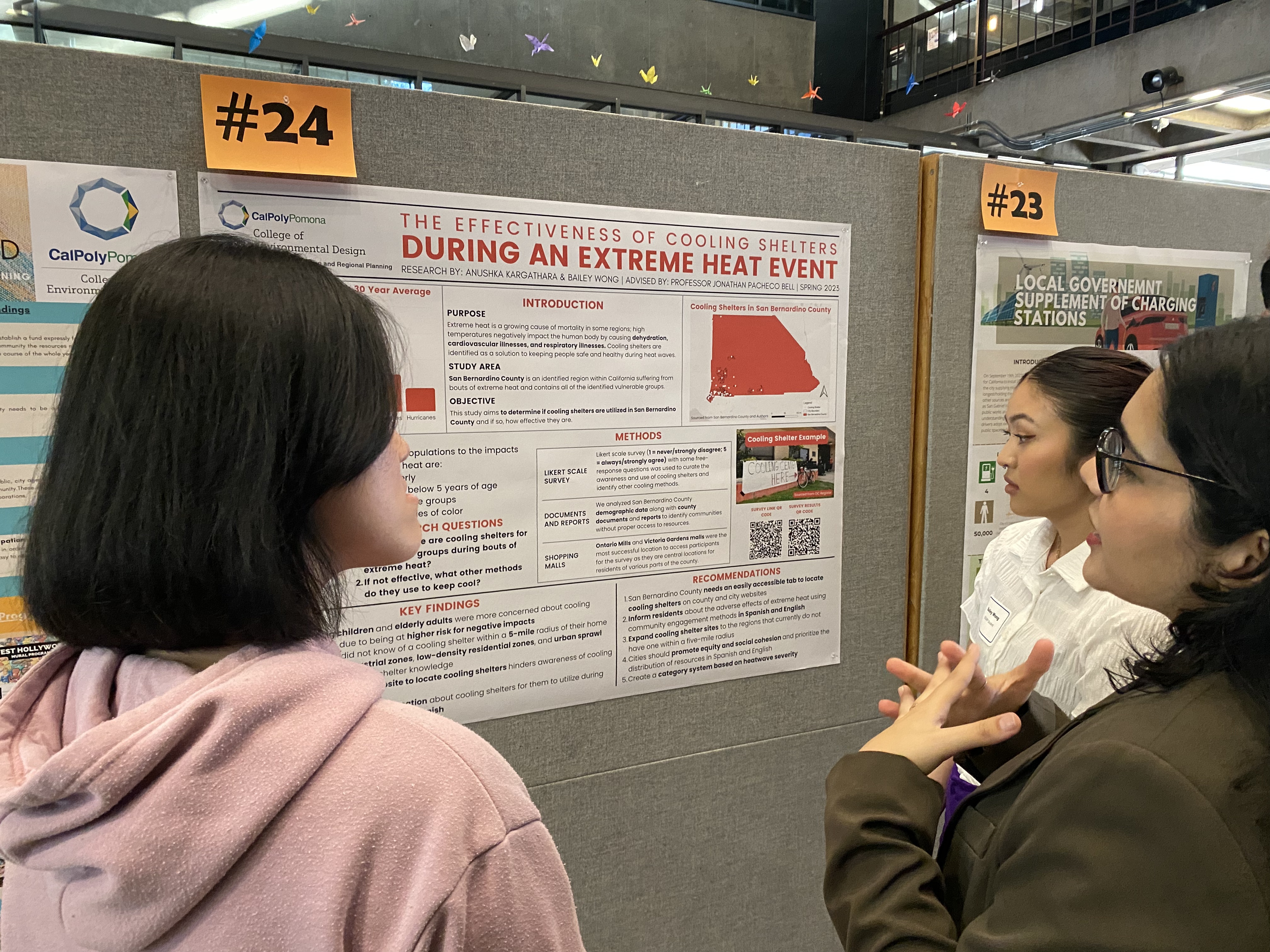
Research team presenting at the 2023 Cal Poly Pomona Urban & Regional Planning Senior Projects Day. Photo: Jonathan Pacheco Bell
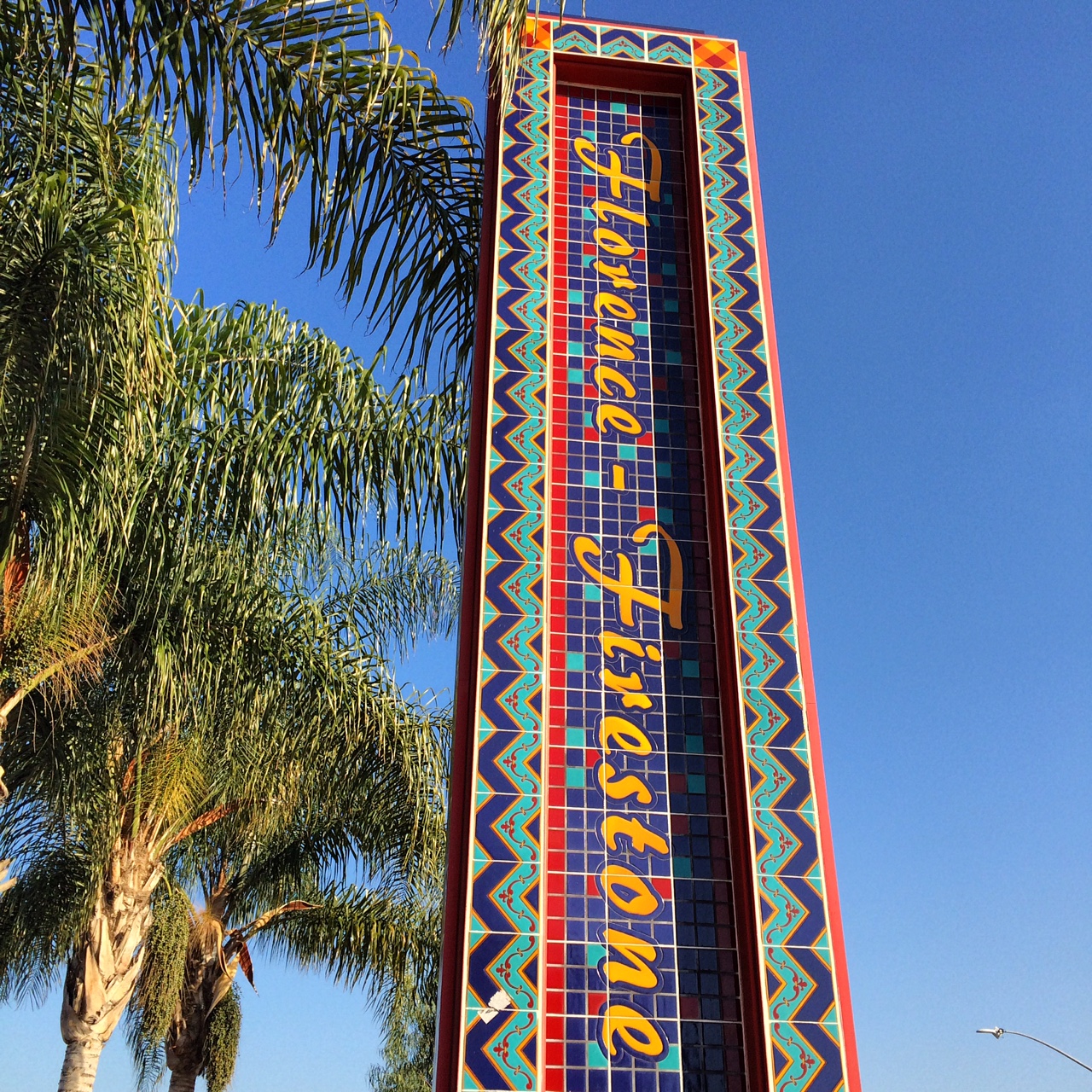
Florence-Firestone monument sign on Florence Avenue. Photo by Jonathan Pacheco Bell
I’m excited to work with Cal Poly Pomona students in Professor Shannon Heffernan’s course URP 4040: Placemaking: Theories, Methods, and Practices. For the Fall 2023 semester, the course will be studying the community of Florence-Firestone in South Central LA (sometimes called “Florence-Graham” using the federal Census designation). The course “client” and contact is the Florence-Firestone Community Organization (501c3), where I proudly serve as Vice President. Florence-Firestone is where I created Embedded Planning praxis as a street-level LA county planner.
Local news coverage of Florence-Firestone lamentably focuses on social ills. The community endures challenges and struggle — as many others do — but there is more to it than clickbait headlines. Our decades-long community-driven work proves it. Florence-Firestone is a vibrant and historic community. CPP students will see it this semester.
Below is a variety of key sources on Florence-Firestone. I’m proud to have worked on most of these projects. These help reframe the narrative about our community. They tell a fuller story of partnerships, solidarity, and hope.
Note: This is a living document for URP 4040. I’ll update it as needed throughout the semester. The revision history is at the bottom of this page.
Florence-Firestone Community Organization and SELA Collaborative interview, including Embedded Planning origins in Florence-Firestone (starts at 5:25 min mark):
How a Tire Shop in South L.A. Became a Community Hub for Locals:
This webpage was originally published on August 25, 2023.
Revised to add Pat Brown Institute article on September 30, 2023.
My upcoming first semester MURP course at Cal Poly Pomona College of Environmental Design 📍
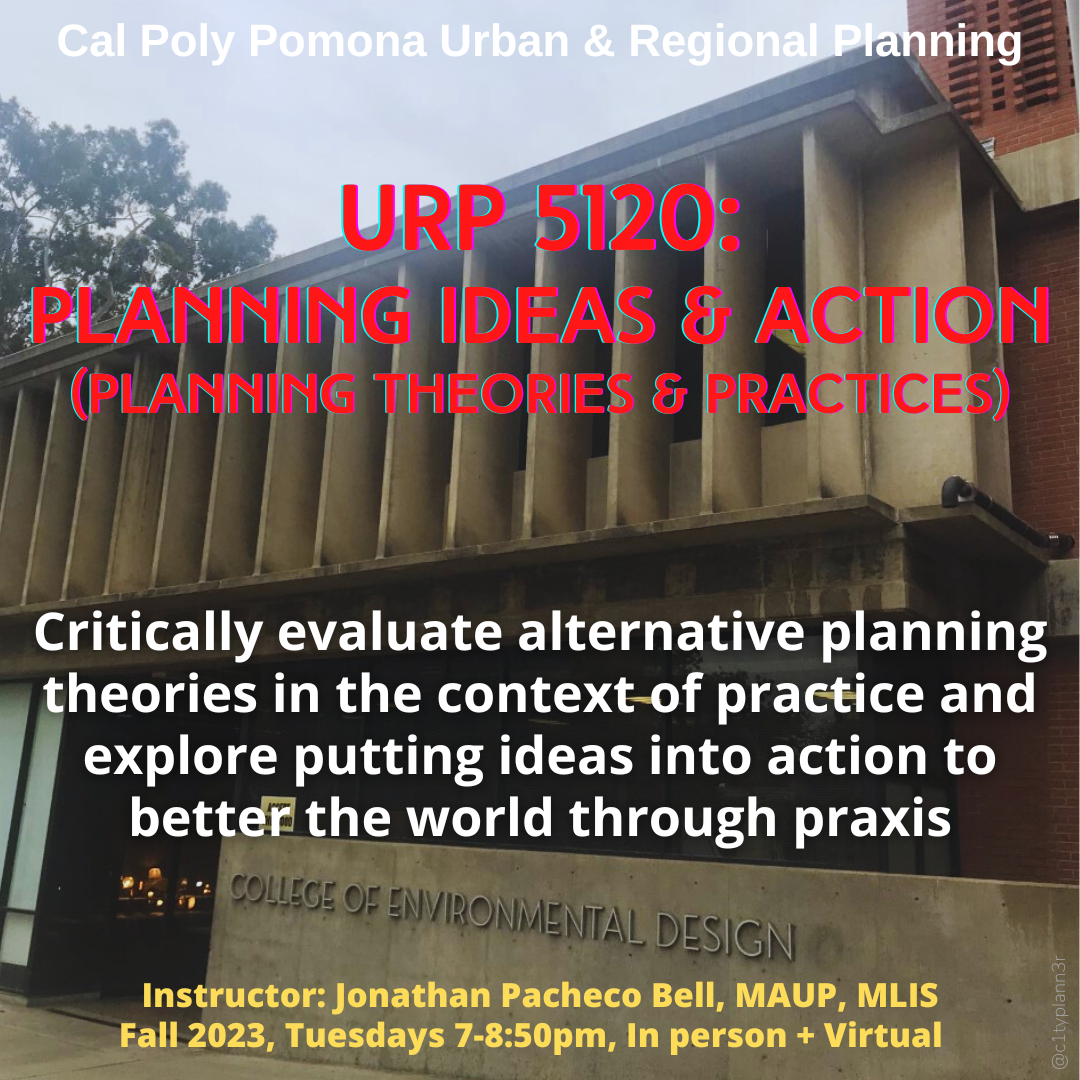
URP 5120: Planning Ideas and Action, aka Planning Theories and Practices
Course Description: There are competing views about what planning is and what processes planners should use to carry out their work, including arguments for technocratic, communicative, advocacy, and radical approaches. These views stem from differing understandings in philosophy, political economy, and justice. The course asks you to learn about and critically evaluate alternative planning approaches in the context of planning practice. You will be challenged to explore how to put complex ideas into action as part of planning #praxis – putting theories into practice to better the world. By the end of the course, you should be able to recommend planning processes that are appropriate to a given planning problem. You should also be able to articulate the relationship of your recommendations to your own values and those of the profession. Fundamentally, the course is about how to plan. We emphasize processes by which planners can add reason and judgment to planning “messes,” recognizing the rarity of well-defined, purely technical problems.
Cal Poly Pomona Communications is recording a short video about my creation ofEmbedded Planning praxis. Students and community members are invited to join! It’s in South Central LA’s Florence-Firestone community, where this street-level praxis was born.
In support of Vision Zero, join us for a community walk in Florence-Firestone Sunday, July 23rd from 10am to 1pm. FFCO’s Ramsey Nicholson and I will highlight landmarks, social history, and community issues on the route. No registration required! Just come through.
Route includes: Compton Avenue, Florence Avenue, Maie Avenue, Graham Avenue, Miramonte Boulevard, E. 66th Street
Florence-Firestone Community Organization in partnership with Estolano Advisors, BikeLA, Los Angeles County Department of Public Health, & California Office of Traffic Safety
Join me and APA Los Angeles Young & Emerging Planners on July 14th at 12pm Pacific to learn about Embedded Planning praxis in the contexts of planning education and practice.
“Like many other professions, planning deals with a theory/practice gap. What we’re taught in our urban planning classes frequently differs from what we do on the job. In the academy, planners learn about theories such as #AdvocacyPlanning and #InsurgentPlanning that were born as challenges to technocratic #RationalPlanning. But in practice, radical approaches require the planner to be political, take a stand, and challenge power structures. That makes some planning traditionalists uncomfortable.
Planning, by convention, is a desk-bound profession, and planners work separately from the communities they serve. #EmbeddedPlanning challenges planners to perform their work at the street-level. I use the phrase “move with intention.” This means you do as much as possible to relocate your work from behind a desk to the spaces and places of the community. Go to the people. Be part of daily community life. Plan in plain language. Make the neighborhood your office. This is how you build trust with community members. Embedded Planning makes traditional city planning more accessible.”
In May 2022, the Washington Post reported that White House officials were exploring the promised cancellation of $10,000 in student debt per borrower, but limiting efforts to people who earned less than $150,000 last year.
Opponents to this proposal can be found across the political spectrum.
Jonathan Pacheco Bell, an urban planner and adjunct professor at Cal Poly Pomona and Pitzer College, said he appreciates that Biden has not forgotten his campaign promise, but $10,000 is insufficient.
“It’s a way to split the difference so that you make some people happy and some people mad, but you’re not going to piss off the other side of the aisle, because you didn’t wipe away all the debt. It’s a very comfortable and extremely safe position,” he said.
Some of his students have taken on tens of thousands of dollars in debt, he added. “Meanwhile, the U.S. seems to be endlessly funding wars and other priorities with almost no hesitation, but it hesitates to invest in its own workforce.”
Senior Project poster by Stacy Lee and Eric Ji. Image credit: Stacy and Eric
I’m celebrating the graduates in my Senior Projects class at Cal Poly Pomona Department of Urban & Regional Planning! Today we big up this team:
Wildfire Mitigation & Resilience Strategies: Best Planning Practices across Local Jurisdictions in Southern California
By: Stacy Lee & Eric Ji
Abstract: Increasing forecasts of prolonged and more severe fire seasons can be attributed to several factors: urban density growth; fire suppression and fuel buildup; and climate change. Many of these issues are amplified in Southern California, especially in the wildland-urban interface (WUI). Land-use policies must begin to proactively strategize around the immutable outbreaks of future wildfires as expanding boundaries of development and very high fire severity zones cross onto each other.
This qualitative research empirically analyzes the survey response consisting of a list of 19 planning strategies for wildfire mitigation on a Likert scale on compatibility, feasibility, and necessity of each local jurisdiction across four counties. The Counties of Los Angeles, Orange, Riverside, and San Bernardino with areas of very high fire severity zones identified by CAL FIRE were contacted with the survey request. The 18 responding jurisdiction responses scored each strategy to display the compatibility, feasibility, and necessity on a scale from 0 to 4, and cross analyzed by any implemented strategies in the corresponding jurisdictions or alternative policies in lieu of the strategies presented in the survey.
These findings are used to develop a scale of adoptable strategies based on the context of each jurisdiction as well as possible alternatives and narratives to adopting feasible strategies.
Stacy and Eric at CPP Senior Projects Poster Session 2022. Photo: Jonathan Pacheco Bell
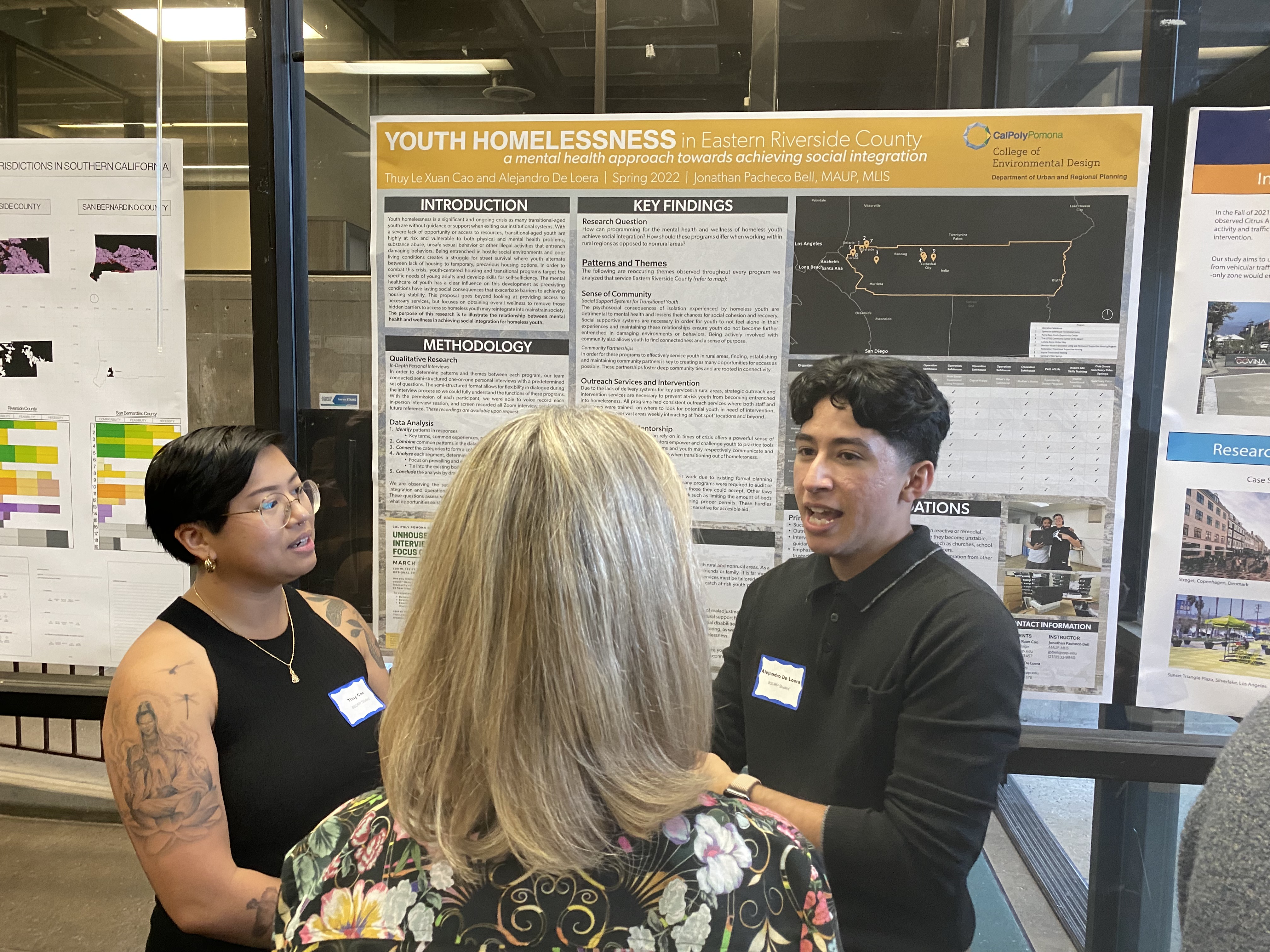
Senior Project poster by Thuy Le Xuan Cao and Alejandro De Loera. Image credit: Thuy and Alejandro
I’m celebrating the graduates in my Senior Projects class at Cal Poly Pomona Department of Urban & Regional Planning! Today we big up this team:
Youth Homelessness in Eastern Riverside County: A Mental Health Approach Towards Achieving Social Integration
By: Thuy Le Xuan Cao & Alejandro De Loera
Abstract: Youth homelessness is an ongoing crisis. Transitional-aged youth need support when exiting institutional systems. Without access to stable living environments, youth are exposed to trauma. Without coping strategies for stress, they’re vulnerable to chronic or cyclical homelessness. Hostile environments and poor living conditions create struggles for street survival. To combat this crisis, youth-centered housing and transitional programs target their unique needs. Youth mental healthcare influences this development as preexisting conditions including housing insecurity, mental health issues, substance use and family dysfunction have psychosocial consequences exacerbating barriers to housing stability. This project examines access to services for wellness and removal of hidden access barriers so unhoused youth can integrate into society.
Youth homelessness is prevalent in rural and nonrural areas and correlates to mental health issues magnified by rural conditions. Supportive services must be tailored to rural homeless youth needs. Beyond skill building, homeless youth require tailored interventions including non-housing case management, mentorship, counseling and mental health treatment. The creation of safe communal spaces promotes social cohesion where youth may interact and gain social capital from peer mentorship. Notably, planning itself creates a barrier to collective action due to formalities required for programs to exist legally.
We’ve created recommendations for 3 stages of intervention: Primary interventions include successful outreach focusing on preventative services for at-risk youth. Secondary programming offers local and short-term supportive programs with flexible hours for youth in crisis. Tertiary support prioritizes community partnerships to offer continuous, long-term services where homelessness occurs. *Abbreviated from original
Thuy and Alejandro at CPP Senior Projects Poster Session 2022. Photo: Jonathan Pacheco Bell
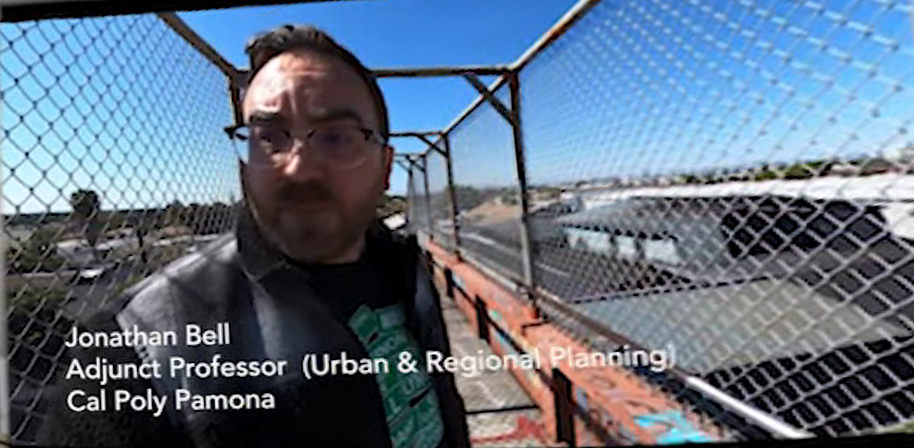
Still image from “Reflections of the LA Uprising” 30 Years Later
The 1992 Los Angeles Uprising began thirty years ago today — April 29, 1992.
I was interviewed for “Reflections of the LA Uprising”30 years later. This is a collaboration by JOVRNALISM, USC Annenberg, KCET, and LA Times.
I shared how the unrest led me on a path toward urban planning in/for South Central LA. And I testified this path would inspire me to create Embedded Planning as an LA County planner on the ground in Florence-Firestone.
Rightfully, this interview was done at the landmark Roosevelt Park pedestrian bridge over the Blue Line.
Many community voices are part of this project. Check out the immersive video “Echoes of the Uprising” where we share our memories and oral histories.






You must be logged in to post a comment.