Roles of Place Design Between Conventional and Student Housing in South Central Los Angeles. By: Osvaldo Martinez
Celebrating the graduates in my 2024 Senior Project class at Cal Poly Pomona Department of Urban and Regional Planning. Today we uplift this researcher:
Roles of Place Design in Creating a Sense of Community Between Conventional Homes and Student Housing in South Central Los Angeles
By: Osvaldo Martinez
Abstract:
For the last 4 to 5 years, the community around the University of Southern California in South Central LA has experienced an increase in student housing development where conventional, longtime residents live. This development wave not only introduces student housing in new neighborhoods but also implements unprecedented design that strays from existing neighborhood architectural styles and densities. This phenomenon raises the question of how these new forms of student housing affect residents’ perceptions of community identity, and how it affects community interactions with USC students.
Through qualitative research, I interviewed residents about new housing design and social interactions with USC students to understand the role of place design in creating a cohesive community. Residents agreed that the new forms of student housing should align with the community’s existing architectural styles, and that new student housing is being built to profit from the student market. Many residents felt that housing developers were intentional about creating a brand within the neighborhood rather than making developments that contribute to the neighborhood.
Osvaldo presenting at the 2024 Cal Poly Pomona Urban & Regional Planning Senior Projects Day. Photo: Jonathan Pacheco Bell
Planning For The Prestigious Poor. A Critical Analysis of Cal Poly Pomona’s Initiatives Addressing Student Homelessness and Housing Instability. By: Eileen Ramos
Celebrating the graduates in my 2024 Senior Project class at Cal Poly Pomona Department of Urban and Regional Planning. Today we uplift this researcher:
Planning for the Prestigious Poor: A Critical Analysis of Cal Poly Pomona’s Initiatives Addressing Student Homelessness and Housing Instability
By: Eileen Ramos
Excerpt:
This study assesses the ability of housing-insecure college students at Cal Poly Pomona to access support services to meet their needs. It identifies successes, limitations, and areas of improvement within the existing support system.
I will be coining the term the ‘prestigious poor’ in this research, which is in conversation with the concept of The Privileged Poor coined by Anthony Abraham Jack. Jack explores, “the experiences of those who live in poor, often segregated communities but enter college from elite boarding, day, and preparatory schools like Exeter, Choate, or Dalton those whom I call the Privileged Poor.” In contrast, I approach “The Prestigious Poor” from the lens of the most disadvantaged and vulnerable student populations in any university setting. I define the “Prestigious Poor” as college students who lack basic necessities like housing and food while simultaneously working towards a degree to better their socioeconomic status. While the concept of the ‘privileged poor’ portrays the struggles faced by low-income students in contrast to their Ivy League legacy wealthy students, the ‘prestigious poor’ encompasses all disadvantaged students facing critical disruptive instability like homelessness compared to secure students.
Questions driving this research are: “Do the resources provided by Cal Poly Pomona fulfill the needs of students facing housing instability?” and “How can Cal Poly Pomona make these resources more accessible to students in need?”
Eileen presenting at the 2024 Cal Poly Pomona Urban & Regional Planning Senior Projects Day. Photo: Jonathan Pacheco Bell
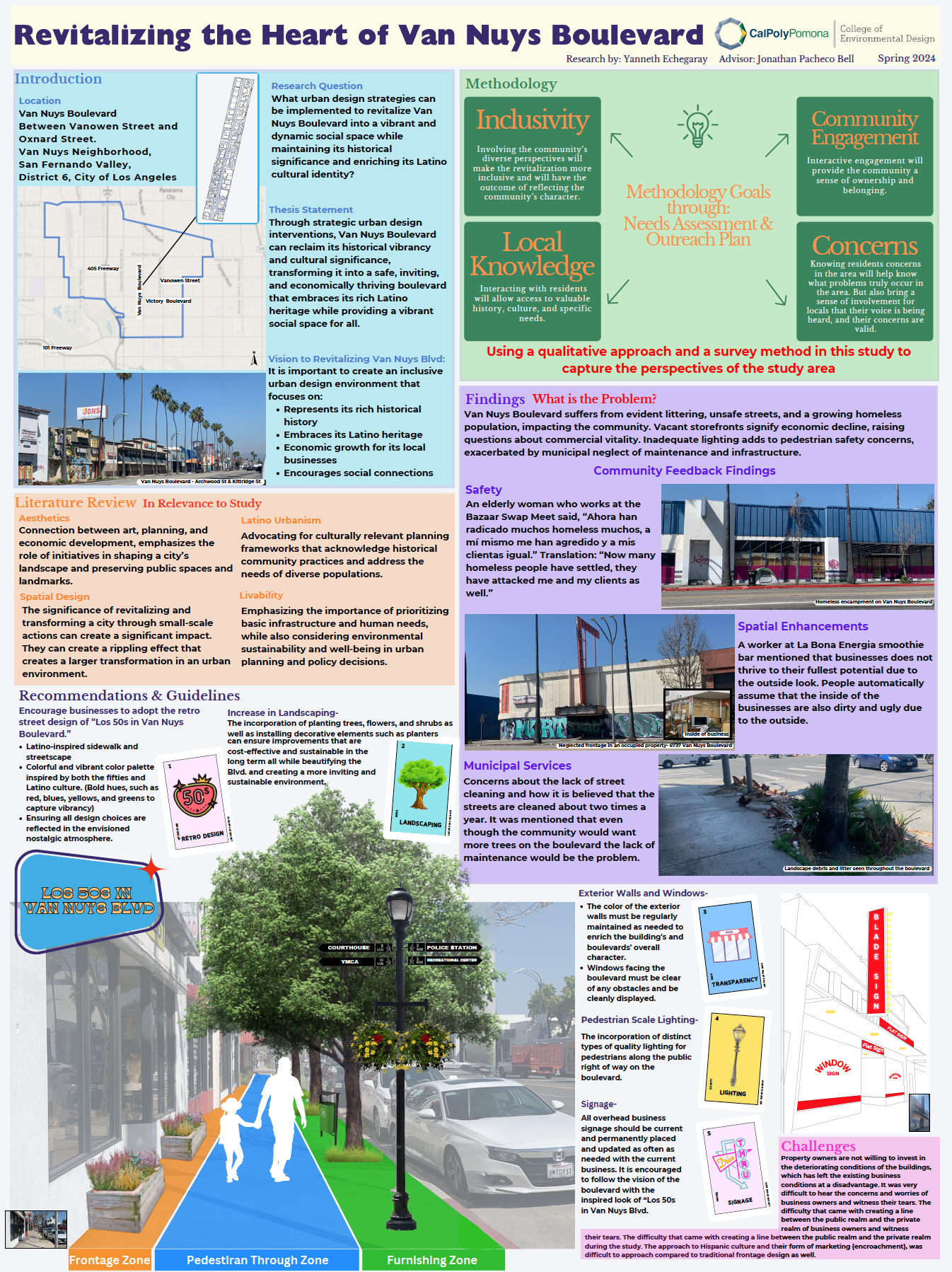
Revitalizing the Heart of Van Nuys Boulevard Through Urban Design. By: Yanneth Echegaray
Celebrating the graduates in my 2024 Senior Project class at Cal Poly Pomona Department of Urban and Regional Planning. Today we uplift this researcher:
Revitalizing the Heart of Van Nuys Boulevard Through Urban Design
By: Yanneth Echegaray (1st Place Poster Winner!)
Excerpt:
This study seeks to address the question, “What urban design strategies can be implemented to revitalize Van Nuys Boulevard into a vibrant and dynamic social space while maintaining its historical significance and enriching its Latino cultural identity?”
The proposed section of Van Nuys Blvd is between Vanowen and Oxnard St in the Van Nuys neighborhood in the San Fernando Valley in Los Angeles County in the State of California. Through strategic urban design interventions, Van Nuys Boulevard can reclaim its historical vibrancy and cultural significance, transforming it into a safe, inviting, and economically thriving boulevard that embraces its rich Latino heritage while providing a vibrant social space for all.
Revitalization Vision:
“To enhance the heart of Van Nuys Blvd, between Vanowen St and Oxnard St, it is important to create an inclusive urban design environment that focuses on its rich historical significance, embraces its Latino heritage, fosters economic growth for its local businesses, and encourages social connections. Through various design strategies, this study aims to revitalize this boulevard into a dynamic and vibrant public space for all.”
Specifications within this study will be Guidelines for redesigning store frontage to enhance the environment through cohesively connecting the public to the private realm. Redesigning the streetscape to capture vibrant and welcoming aspects, while prioritizing lighting and safety features, and embracing the rich and significant Latino culture that has organically been embedded on Van Nuys Boulevard – all of this is aimed at creating a suppositional nexus that will positively affect the economic development of the local businesses inhabiting the boulevard.
Yanneth presenting at the 2024 Cal Poly Pomona Urban & Regional Planning Senior Projects Day. Photo: Jonathan Pacheco Bell
Governor Gavin Newsom has signed AB 2533 expanding amnesty for unpermitted ADUs. I’m proudly part of this effort in partnership with Casita Coalition, and the community of Florence-Firestone plays a role in the story. Shout out to Assemblymember Carrillo for authoring the legislation. Check out my reflections on AB 2533 as a former Zoning Enforcement Planner in Casita Coalition’s article authored by Board Chair Rafael Perez: https://www.casitacoalition.org/casita-coalition-blog/bringing-californias-hidden-housing-out-of-the-shadows-adu-amnesty-reform
From Casita Coalition social media:
Exciting News! Governor Newsom has signed Casita-sponsored AB 2533 into law! This bill is a game changer for legalizing unpermitted ADUs, making it easier, more affordable, and predictable for homeowners. Now, more homeowners can bring their units up to safety standards without breaking the bank, helping to preserve a critical segment of California’s naturally affordable rental housing market. This is a huge win for renters, homeowners, and housing stability in our communities! We thank Asm. Carrillo for championing this effort and everyone who supported this vital step toward advancing housing equity and preserving much-needed affordable homes. Our Board Chair, Rafael Perez, has authored a blog on AB 2355, titled “Bringing California’s Hidden Housing Out of the Shadows: ADU Amnesty Reform.” It features powerful insights from urban planner Jonathan Pacheco Bell @c1typlann3r and remarks from Assemblymember Juan Carrillo, highlighting the positive benefits this reform will unlock for communities.
I’m moderating the panel session “We’re In This Together: Improving Communities Through Planning and Code Enforcement Collaboration” at the 2024 APA CA Conference in Riverside. Our session is on September 28th, Conference Day 1, at 2:45pm. Come through.
Session description:
Planning and code enforcement are highly specialized and frequently politicized municipal services. At times this results in competing priorities and differing work styles, but fundamentally planners and code enforcement inspectors share the goal of creating community wellness. We best achieve this through intentional collaboration.
This session brings together planners and code enforcement professionals for a candid conversation about collaborative practice. Panelists will draw from personal reflections, scenarios, and case studies, and respond to interactive audience questions, to illustrate code enforcement and planning collaboration opportunities that benefit the community. By working collaboratively, planners and code enforcement avoid conflicting outcomes and reduce costs while co-creating better plans, policies, and programs and advancing fairness in land use regulation.
The moderator will facilitate a discussion exploring how effective communication, desire for mutual learning, and partnerships among planners, code enforcement regulators, and the community can increase equitable and inclusive planning, leading to more successful outcomes. Using interactive digital and in-person engagement methods, the audience will be empowered to guide the conversation in this forum. Attendees will gain insights and tools that they can apply in a variety of organizational settings to build collaborative opportunities for code enforcement and planning professionals.
I’m moderating the panel session “Land Use Hot Topics and Code Enforcement” at the 2024 APA CA Conference in Riverside. Our session is on September 28th, Conference Day 1, at 1:30pm. Come through.
Session description:
In an era of evolving regulations and shifting political landscapes, code enforcement officers and planners face unique challenges when addressing land use issues related to cannabis operations, massage parlors, and sidewalk vending. This session will explore the delicate balance between upholding local regulations and navigating the complex web of state rights and political sensitivities.
Our expert panel will share insights and strategies from jurisdictions across Southern California that have successfully tackled these challenging enforcement areas. Attendees will gain valuable knowledge on:
– Developing effective communication strategies to educate stakeholders on local regulations while respecting state rights.
– Collaborating with code enforcement and other agencies to address illegal operations and ensure public safety.
– Implementing innovative approaches to code enforcement that prioritize community engagement and voluntary compliance.
– Navigating political pressures and maintaining professionalism in sensitive enforcement situations.
Through interactive discussions and real-world case studies, participants will leave equipped with practical tools and best practices to manage politically sensitive land use issues in their own jurisdictions. This session aligns with the conference theme by emphasizing the importance of adaptability, collaboration, and innovation in the face of evolving challenges in code enforcement.
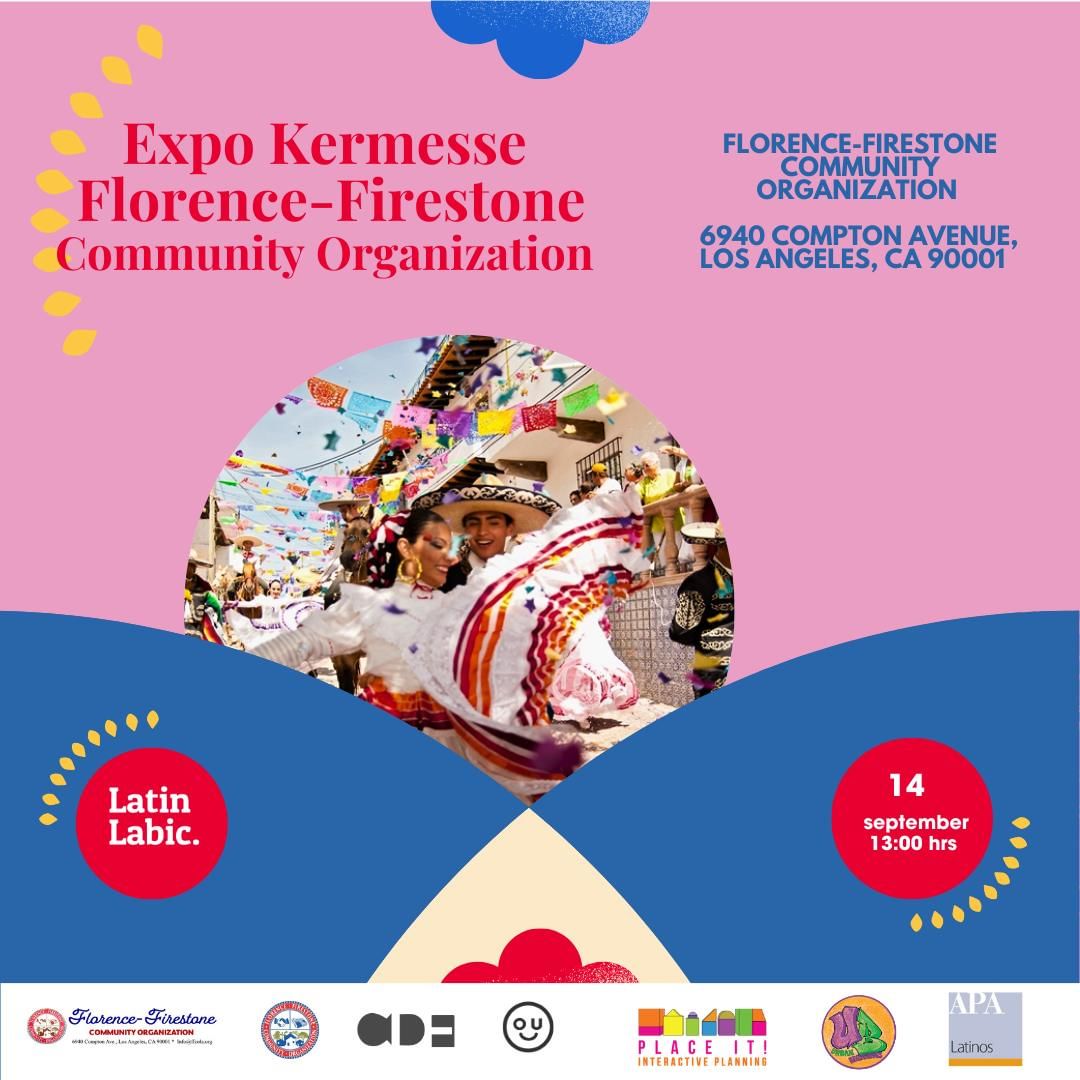
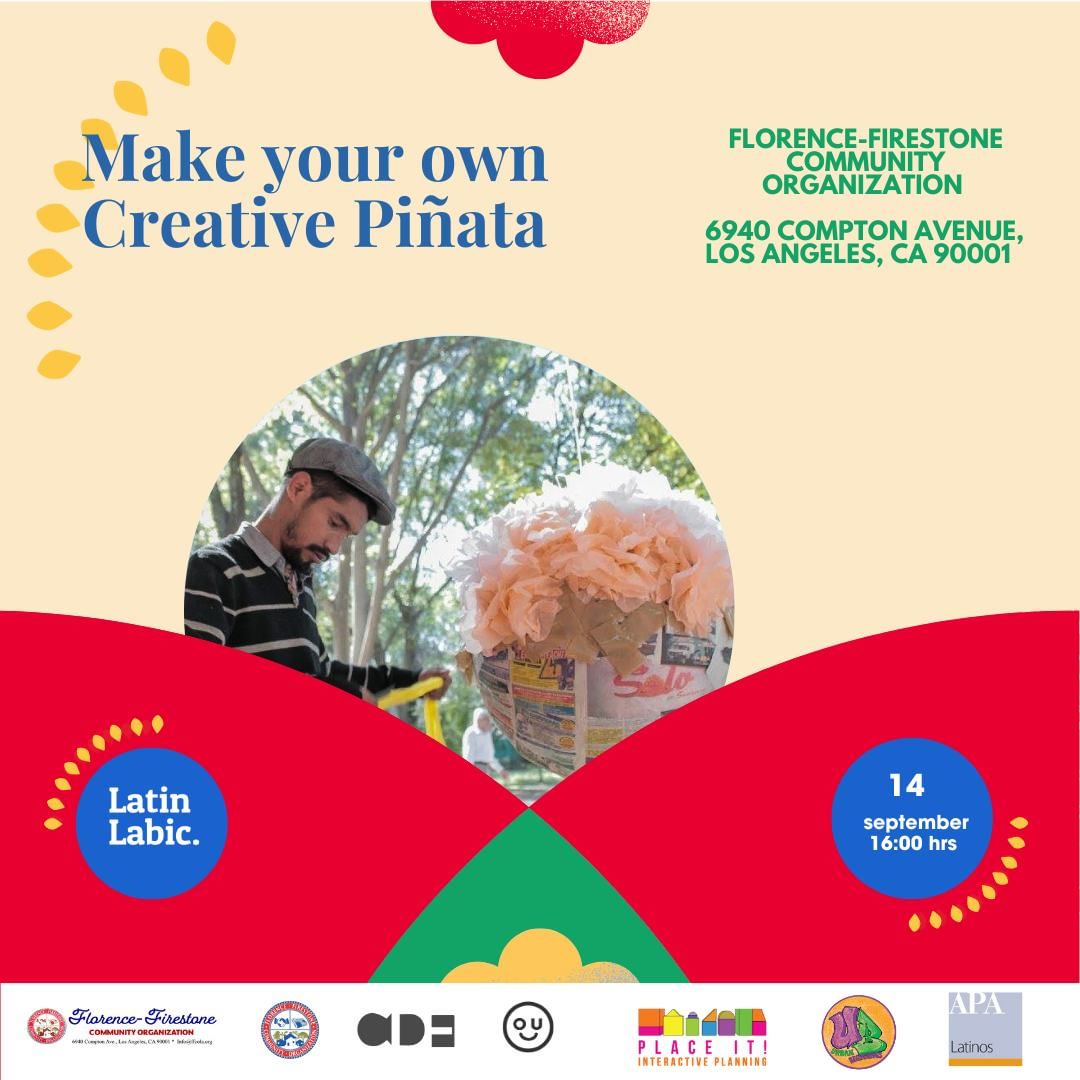
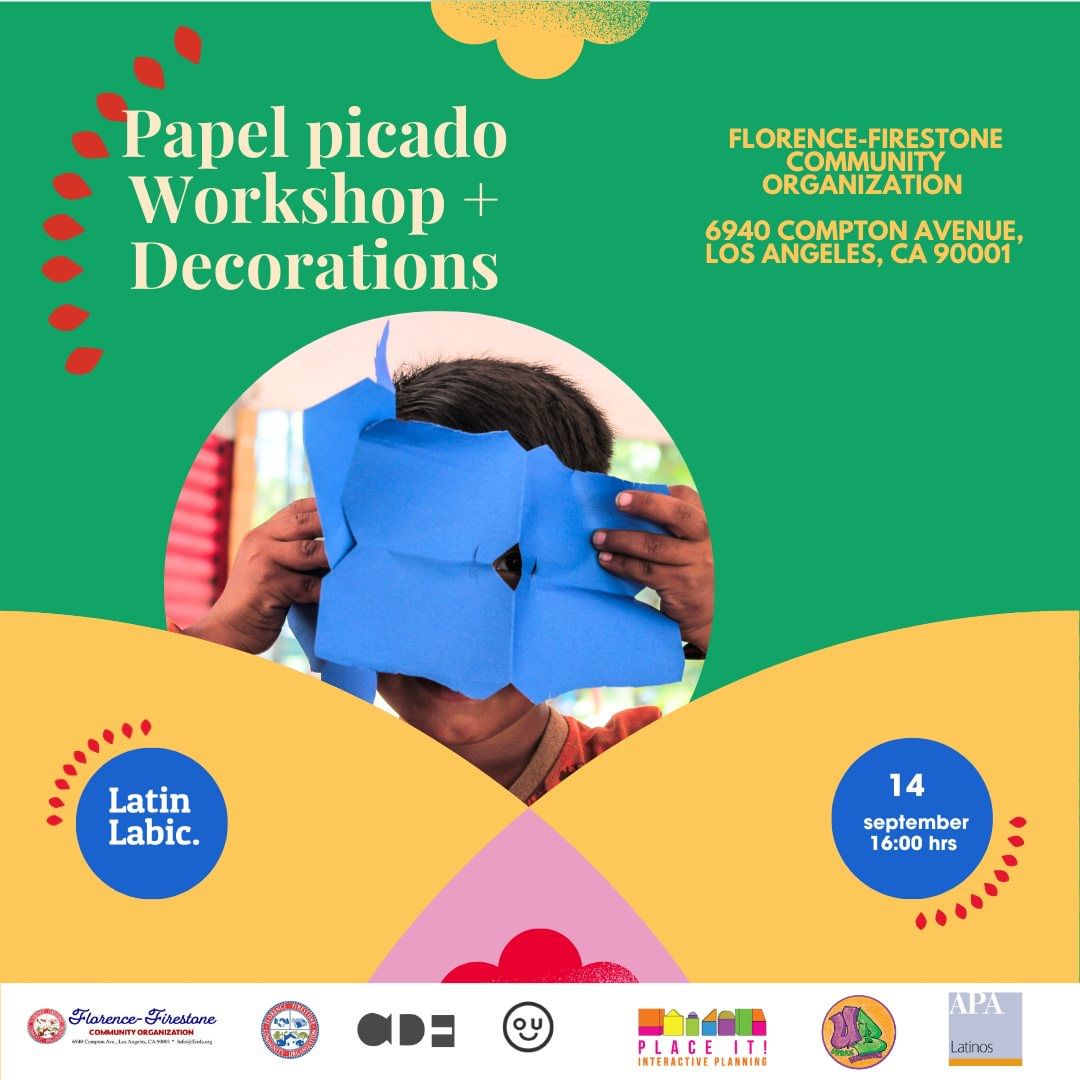
Latin Labic placemaking event and expo kermesse Saturday, September 14, 2024 at the Florence-Firestone Community Organization. With Ortopedia Urbana, Urban Beginnings podcast, APA Latinos and Planning, and Place It! Interactive Planning. Everyone is invited! Come through.
I’m facilitating this Place It! visioning session on Friday 9/6 at Pasadena City College. High school, college & graduate students, and young people come through! Shout out to James Rojas and John Kamp #DreamPlayBuild
I’m doing an IG Live Sept 5th at 6pm Pacific with Elizabeth Gómez Ibarra and Ortopedia Urbana. We’ll discuss the social history, planning innovations, and future of the Florence-Firestone community in South Central LA. The conversation is a precursor to our inaugural Latin Labic placemaking event at the Florence-Firestone Community Organization on 9/14! Join the conversation.
Florence-Firestone Community Organization. Photo by Aditi Peyush
In Fall 2024, the Florence-Firestone Community Organization (FFCO) — where I proudly serve as VP — is partnering with Cal Poly Pomona and UCLA to integrate the neighborhood into these Urban Planning and Chicano Studies courses:
URP 5050: Planning and Place
URP 5120: Planning Ideas and Action
URP 5010: How Planning Works
CCAS M122: Planning Issues in Latino Communities (UCLA)
Building on our past efforts, FFCO will host neighborhood walking tours and discussions, conduct in-class guest lectures, and provide readings and resources (see below) to learn about the Florence-Firestone community in South Central LA.
Local news coverage of Florence-Firestone lamentably focuses on social ills. While the community endures challenges and struggle, there is more to it than the clickbait headlines. Our decades-long community-driven work proves it. The creation of Embedded Planning in Florence-Firestone (now a worldwide movement!) proves it. The birth of FFCO as a community advocacy voice during COVID proves it. Florence-Firestone is a vibrant and historic community. Students will experience it.
Below is a variety of key resources on Florence-Firestone. I am proud to have worked on most of these projects. These help reframe the narrative about our community. They tell a fuller story of partnerships, solidarity, and hope.
Note: This is a living document updated as needed throughout the semester/quarter. Any revision history will be indicated at the bottom of this page.
Florence-Firestone Community Organization and SELA Collaborative interview, including Embedded Planning origins in Florence-Firestone (starts at 5:25 min mark):
How a Tire Shop in South L.A. Became a Community Hub for Locals:
I’m returning to teach this MURP course, URP 5120: Planning Ideas and Action, aka Planning Theories and Practices.
Course Description: There are competing views about what planning is and what processes planners should use to carry out their work, including arguments for technocratic, communicative, advocacy, and radical approaches. These views stem from differing understandings in philosophy, political economy, and justice. The course asks you to learn about and critically evaluate alternative planning approaches in the context of planning practice. You will be challenged to explore how to put complex ideas into action as part of planning praxis – putting theories into practice to better the world. By the end of the course, you should be able to recommend planning processes that are appropriate to a given planning problem. You should also be able to articulate the relationship of your recommendations to your own values and those of the profession. Fundamentally, the course is about how to plan. We emphasize processes by which planners can add reason and judgment to planning “messes,” recognizing the rarity of well-defined, purely technical problems in communities.
Fall 2024, Tuesdays 7:30-9:15pm, with alternating instruction in person & virtual weeks.
I was interviewed by Abigail Bassett in the Observer for this article on fake jobs. I told the story of receiving a cold call offering me a job at an architecture firm that does not exist.
On June 25, I received the Planning Advocate Award 2024 and delivered the invited keynote on Embedded Planning at the APA Los Angeles annual awards gala. I thank my colleagues for the recognition and support! It means a lot coming from my home section.
As I wrote after the APA Inland Empire awards, and as I shared in the LA keynote, our #EmbeddedPlanning movement won. What began in Florence-Firestone is now a planning praxis in other states, regions, countries, and hemispheres.
For real, our #EmbeddedPlanning movement won. What began in Florence-Firestone is now a praxis in San Bernardino and Riverside counties and far beyond — in other states, territories, countries, and hemispheres.
This ain’t “me,” it’s “we.” We have built the future of planning.
You must be logged in to post a comment.