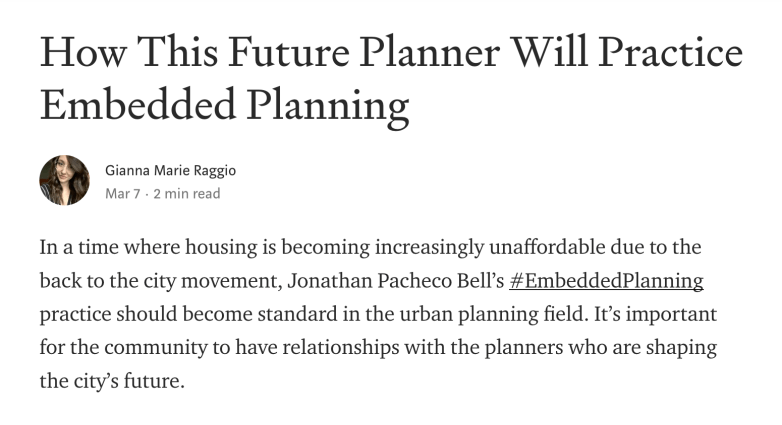
In a recent op-ed, Virginia urban planning student Gianna Raggio declared that she will lead Embedded Planning praxis in her community when she’s a practitioner.
As Gianna observed:
“Once I become a planner, I don’t want to be glued to a desk. Nor should I be. In order to make a positive impact on my community, I need to be present. To be an embedded planner, I need to be constantly interacting with residents in the community in which I work. Yes, that means attending community meetings. But it also goes above that. Embedded planners should go beyond what the job requires. Be present at community events, and contribute to neighborhood relationship building. Be a familiar face in the community.”
From #LosAngeles to #Norfolk and beyond, #EmbeddedPlanning is the future.
“A Matter of Necessity”: Understanding Informal Housing through Embedded Planning at UCI School of Social Ecology, Department of Urban Planning and Public Policy, 25 October 2018
I’m honored to serve as UCI MURP Planning Visions Guest Speaker delivering my public talk, “A Matter of Necessity:” Understanding Informal Housing through Embedded Planning, at UC Irvine School of Social Ecology, Department of Urban Planning & Public Policy, Thursday, Oct 25th, 11:30a-1:00p. The event is made possible through the initiative of 2nd year MURP candidate Irene Aceituno. She will introduce me as speaker, discuss UCI’s Diversity in Planning Fellows program, & emphasize the value of mentorships in planning. The talk is Free & Open To All. RSVP at Eventbrite.
SUMMARY: This presentation puts a human face on California’s housing crisis. Jonathan Pacheco Bell, a zoning enforcement planner in Los Angeles County, will tell the story of the Medina Family from the South Central L.A. community of Florence-Firestone, who built an informal backyard dwelling for extra income after the sudden passing of their head of household. An anonymous complaint triggered an inspection & eventual demolition of the dwelling for code violations. It was Jonathan himself who ordered its removal. Audience members will understand the emotional roller coaster the family endured while embroiled in this regulatory process, & Jonathan’s inner conflict with the outcome. Key takeaways for planning policy, practice & pedagogy will be offered. This talk demonstrates that the rules we enforce can have unintended consequences, especially in working class communities of color.
BIO: Jonathan Pacheco Bell (@c1typlann3r) is a public sector Urban Planner in Los Angeles County with over 12 years of experience in zoning enforcement. He is a fierce advocate for the unincorporated areas of South Central Los Angeles. On any given day you will find him in the unincorporated community of Florence-Firestone partnering with stakeholders to improve quality of life.
A field-based planner, Bell researches, writes, & speaks about informal housing, unorthodox community outreach, and South Central L.A. history from his unique, on the ground perspective. He calls his praxis Embedded Planning.
A product of the California public school system from kindergarten to graduate school, Bell holds an MAUP from UCLA Luskin & an MLIS from SJSU iSchool.
Consider this page 1 of my #manifesto nailed to the Planning Department’s door.
Read my op-ed, “We Cannot Plan From Our Desks”, in APA’s Planning Magazine #PlanMag October 2018 issue. Just in time for #PlanningMonth.
In this editorial I outline the tenets and benefits of #EmbeddedPlanning. This is my opening salvo to the planning field arguing for Embedded Planning praxis, what I describe as planning in the streets, over orthodox, desk-bound practice.
I ground Embedded Planning in the real life example of the Medina Family ADU Saga in the South Central Los Angeles community of Florence-Firestone. In my current speaking tour, “A Matter of Necessity:” Understanding Informal Housing through Embedded Planning, I’m sharing the family’s difficult first lesson in Planning and Zoning, and my inner conflict with the outcome. I can tell the Medinas’ story because I earned their trust, at their doorstep.
“We Cannot Plan From Our Desks.” My op-ed on Embedded Planning praxis published in APA’s Planning Magazine, October 2018.
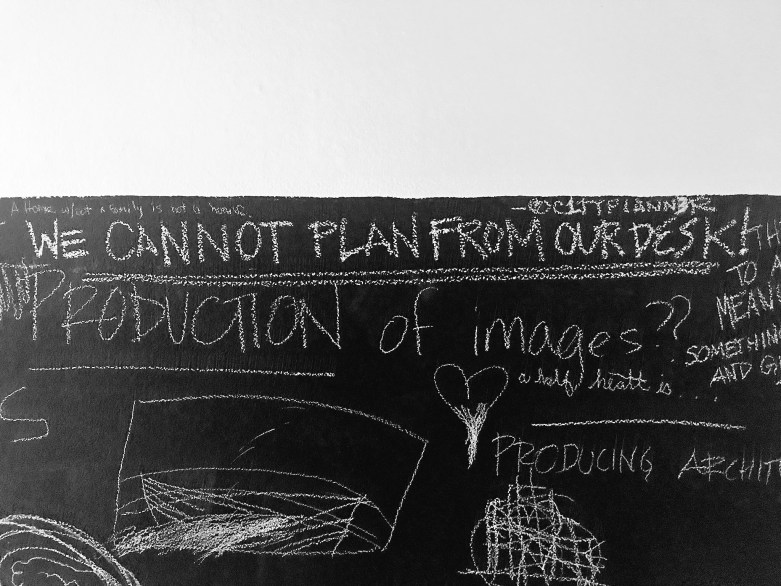
Planning practioners, students, and professors: WE CANNOT PLAN FROM OUR DESKS.
We need to get out there and connect.
#EmbeddedPlanning praxis means planning in streets, not from the comfort of your desk.
My op-ed publishes in APA’s Planning Magazine #PlanMag October 2018, just in time for #PlanningMonth.
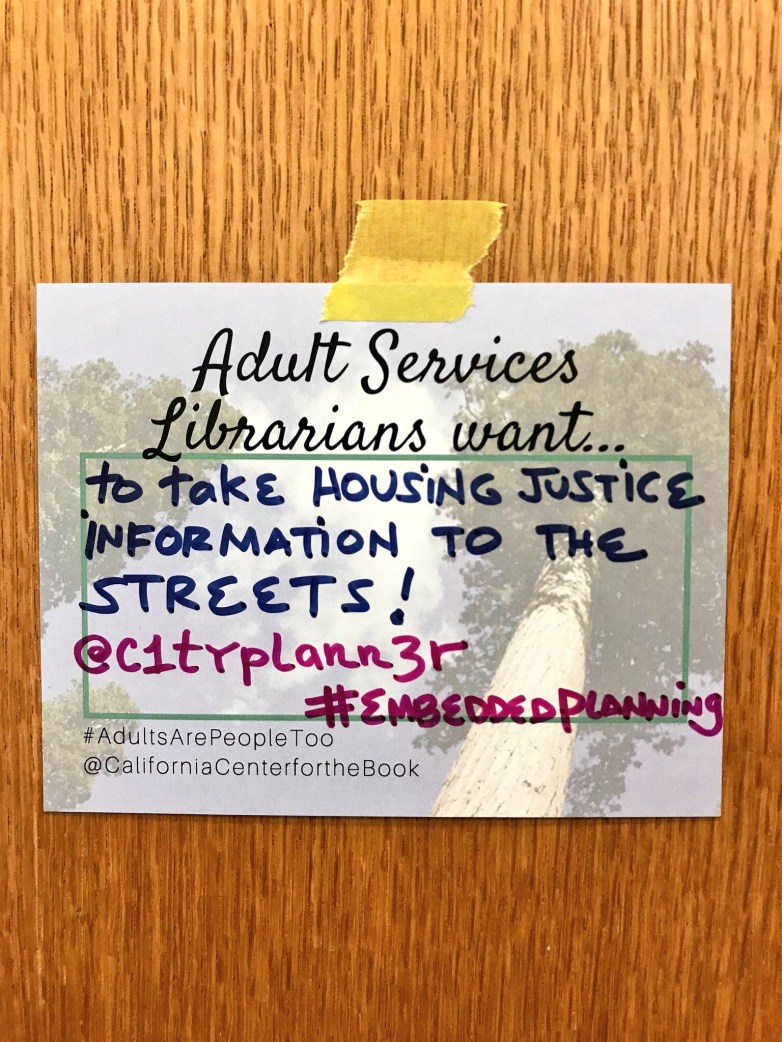
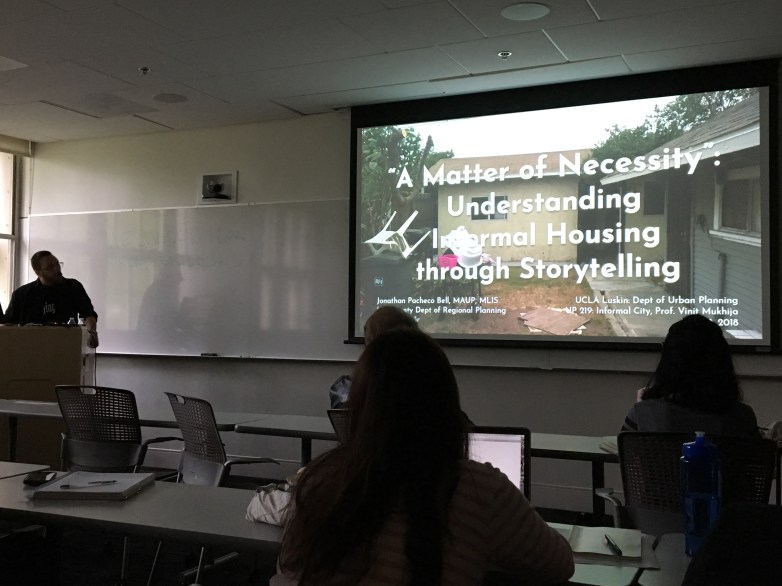
We Cannot Plan From Our Desks! at the 2018 APA National Planning Conference New Orleans #NPC18 via Jonathan Pacheco Bell @c1typlann3rWe Cannot Plan From Our Desks! at the Free School of Architecture closing night 2018 WUHO Gallery in Hollywood, CA via Jonathan Pacheco Bell @c1typlann3rWe Cannot Plan From Our Desks! at UCLA Luskin School of Public Affairs “The Informal City” seminar May 2018 via Jonathan Pacheco Bell @c1typlann3r#EmbeddedPlanning and Embedded Librarianship come together in taking housing justice information to the streets! at the CLA 2018 Adult Services Symposium, Sacramento Public Library via Jonathan Pacheco Bell @c1typlann3r
Delivering the Medina Family ADU talk in the “Informal Cities” seminar at UCLA Luskin School of Public Affairs, May 2018. Photo courtesy of Joshua Baum, MURP ’18
I’m writing an invited op-ed on Embedded Planning. It’s a challenging but rewarding exercise. This has been an amorphous idea swirling in my head for years. I knew what it was intuitively, but I hadn’t defined it. This op-ed is pushing me to define, outline, & explain the benefits of my #EmbeddedPlanning praxis.
The piece draws on my ideas developed over 12 years doing urban planning on-the-ground, from my #MLIS experience in which I regularly wrote about librarians breaking free from the reference desk to do LIS work out in the neighborhood, & from my speaking tour on the Medina Family #ADU saga.
My most fruitful thinking on this op-ed has been away from a desk. On Thursday morning, stuck in #LosAngeles traffic, I had a eureka! moment about the title of my public talk, “A Matter of Necessity”: Understanding Informal Housing through Storytelling. The reason I can tell the Medina Family story is because I earned their trust, at their doorstep, through my Embedded Planning praxis.
Thus far I’ve delivered the Medina Family ADU talk at CSUN, Woodbury University, Cal Poly Pomona, UCLA Luskin, & the American Planning Association #NPC18 Conference in New Orleans under the “Storytelling” title. It’s high time for an update. It’s time to revise my title to underscore that the lessons learned result from Embedded Planning.
Henceforth the title of my talk on the Medina Family ADU story is:
“A Matter of Necessity”: Understanding Informal Housing through Embedded Planning
Only through Embedded Planning do we arrive at my thesis: “Behind every informal unit there’s a story to tell, a human dimension that needs light.”





Consider this page 1 of my #manifesto nailed to the Planning Department’s door.
Read my op-ed, “We Cannot Plan From Our Desks”, in APA’s Planning Magazine #PlanMag October 2018 issue. Just in time for #PlanningMonth.
In this editorial I outline the tenets and benefits of #EmbeddedPlanning. This is my opening salvo to the planning field arguing for Embedded Planning praxis, what I describe as planning in the streets, over orthodox, desk-bound practice.
I ground Embedded Planning in the real life example of the Medina Family ADU Saga in the South Central Los Angeles community of Florence-Firestone. In my current speaking tour, “A Matter of Necessity:” Understanding Informal Housing through Embedded Planning, I’m sharing the family’s difficult first lesson in Planning and Zoning, and my inner conflict with the outcome. I can tell the Medinas’ story because I earned their trust, at their doorstep.