
What is C1TYPLANN3R Company?
I trace Embedded Planning back to my high school days as a 90s graffiti writer in LA, and tell the story of Embedded Planning’s origins and evolution, all while situating it within an 11th grade classroom of future planners in East LA, in “Embedded Planning Returns to ELARA.”
Published on December 18, 2020 at c1typlann3r.medium.com.

Yesterday I was interviewed by an author writing a novel set in the time of the 1992 LA Uprising. I shared memories of interpreting the unrest through my eyes at the time, a high school graffiti tagger in Montebello navigating the larger LA hip hop scene. I’ll share the book when it’s published.
Photo: California African American Museum exhibit, “No Justice, No Peace: LA 1992.” https://caamuseum.org/exhibitions/2017/no-justice-no-peace-la-1992
All of my writings and co-authored works are now available on this blog and will be updated as new pieces publish here:


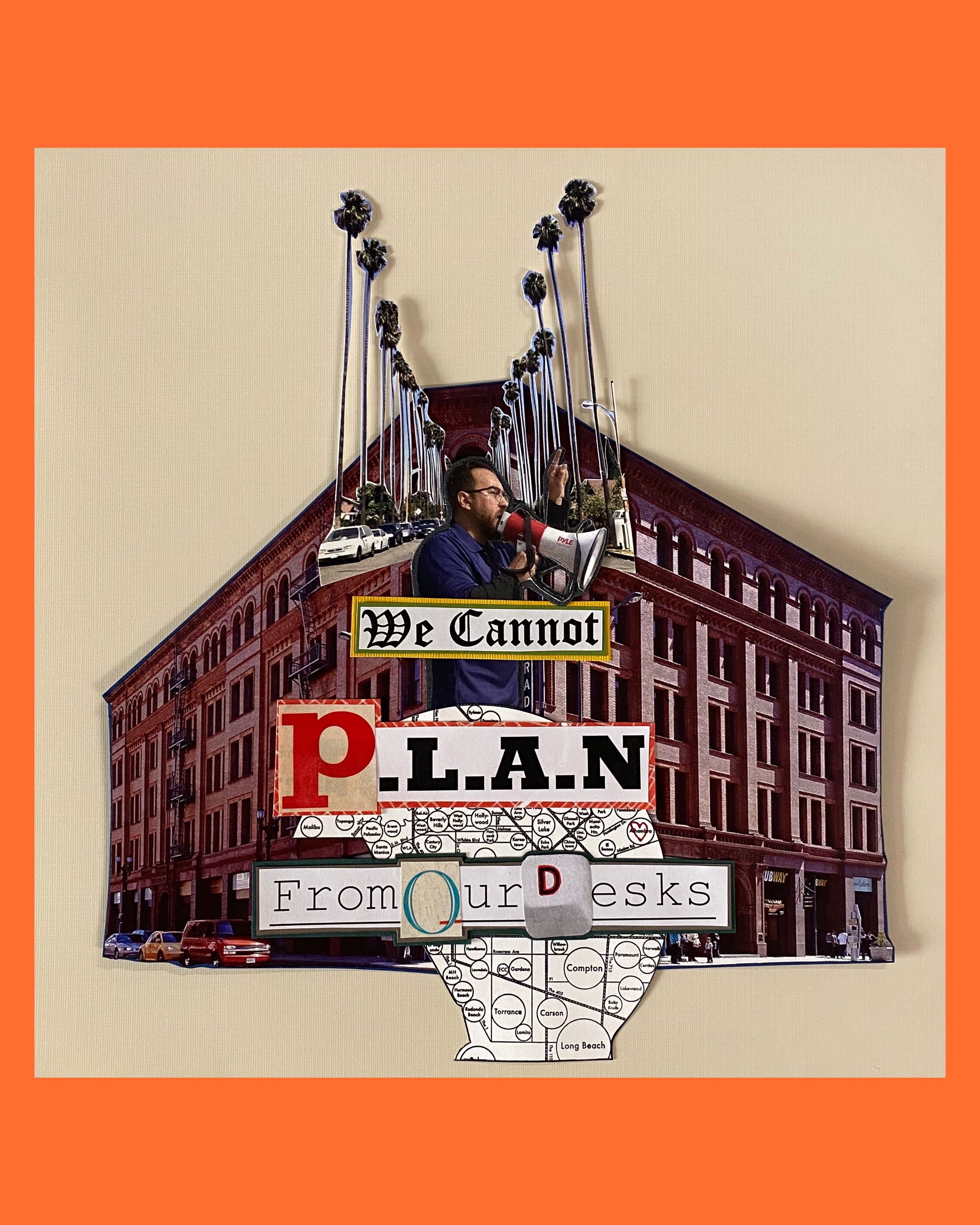
Big up to my Secret Santa for creating this Embedded Planning portrait for me!
2021 will be a game changer for Embedded Planning.
Stay close.

I started a Ko-fi page. Ko-fi (☕️ but it rhymes with “No Fee”) is a micro-donations platform for creators. Ko-fi enables folks to support my writing passion projects. And, Ko-fi sends 100% of the donations to the creator, me!
I launched this because in 2021, I’m ramping up writing about Embedded Planning, my praxis that situates the work of city planners on the streets, not behind a desk. I’m also writing about Public Space, Los Angeles, and more.
Wanna be a part of these efforts?! Your donations will help fund my process, including research, printing, web and database access, copyediting fees, and of course, the iterative and emotional part of writing. Anything helps!
Please consider supporting my writing and praxis that advances equity in urban planning. Thank you so much.
In solidarity,
JPB @c1typlann3r
Embedded Planning creator
Ko-fi.com/c1typlann3r
Here’s a good critique of the emerging medium of writing + publishing through Substack. Also reads as a Big Up to old school blogging, with rich links to blogs past and present.
The author of Applied Divinity Studies published this as a guest post on Nintil blog.
“How Substack Became Milquetoast.”
https://nintil.com/substack-milquetoast
Excerpt:


I was a contributing writer for UrbDeZine from 2014 to 2019. UrbDeZine is/was an online magazine covering urban planning, historic preservation, and architecture in seven US cities. Why the slash/verbs? Because the fate of the magazine is unknown. From its aggregator page at Planetizen, we see the last original article published in October 2019. UrbDeZine has been offline since late that year undergoing a “redesign and reorganization” as described on its currently-static holding page. I write this entry in the waning days of November 2020 noting the relaunch period listed is Summer 2020. I hold out hope it’ll go-live again, but I’ve come to grips with the possibility that UrbDeZine may not come back.
This is dispiriting for a few reasons. First, because UrbDeZine was a passion project of its editor, who always supported the contributing writers, including unpublished and unknown authors, myself included. Second, because the writers added so many original essays, critical reflections, and news stories that advanced conversations on the built environment. Third, and most personally, because I started to find my voice on its pages. My earliest public commentaries on urban planning appeared in UrbDeZine.
My personal attachment wants to see these back online, and there’s interest from some readers, too. The articles pop up in searches but the links don’t work. Now and then, a reader will contact me asking where they’re at. There was enough interest to create a workaround.
Below are my writings from UrbDeZine, in PDF. This list entails works wherein I manually saved the article before it went offline. Most of my articles are accounted for. Some, but not all, of the PDFs retain working hyperlinks in the text. Also, a disclaimer: some of my views have evolved since the original publication of these commentaries (most notably, I’m no longer so stringent about informal housing).
By providing access to these works, I hope to contribute to the public discourse that helped me develop and mature my thinking about today’s vexing urban planning problems.
“We Are a Movement”: Students Advance Embedded Planning at the 2019 National Planning Conference, UrbDeZine. May 14, 2019.
https://c1typlann3r.blog/wp-content/uploads/2020/11/we-are-a-movement-urbdezine.pdf
An Urban Planner on the Ground in South Central Los Angeles, UrbDeZine. January 30, 2018.
An Open Letter to the Pasadena City Council Urging a Comprehensive Overhaul of the Second Dwelling Unit Ordinance, UrbDeZine. January 29, 2017.
An Open Letter to the Pasadena Planning Commission Urging a Comprehensive Overhaul of the Second Dwelling Unit Ordinance, UrbDeZine. December 12, 2016.
Epitaph for Edward W. Soja, UrbDeZine. December 17, 2015.
Reyner Banham, Mike Davis, and the Discourse on Los Angeles Ecology, UrbDeZine. July 14, 2015.
Response to Comments: The Informal Housing Debate Remains Open, UrbDeZine. November 12, 2014.
Converting Garages into a Dissertation: A Conversation with Jacob Wegmann, UrbDeZine. June 17, 2014.

I’ve been doing more talks about Embedded Planning in high school and college classes, as well as meeting students for one-on-one conversations about my praxis, all through Zoom during this Coronavirus pandemic. I realized that I was sending lots of follow up emails providing links to my writings. After copy-pasting the same content several times, it became apparent that there was a more efficient way. This is it.
This post serves as the first compilation of my public works (writings, interviews, and more) on Embedded Planning. As my work on this street-level planning praxis evolves, I’ll share updated compilations as new posts on this infrequently updated blog.
Questions about Embedded Planning? Hit me up here.
We Cannot Plan From Our Desks, Planning. October 2018.
“We Are a Movement”: Students Advance Embedded Planning at the 2019 National Planning Conference, UrbDeZine. May 2019.
The Unforgettable Role of Cal Poly Pomona in the Development of Embedded Planning, Medium. June 2020.
An Urban Planner on the Ground in South Central Los Angeles, UrbDeZine. January 2018.
Mutual Aid at Lunchtime, Cultural Weekly. December 2017.
The Invisibility of Code Enforcement in Planning Praxis: The Case of Informal Housing in Southern California, Focus. 2016.
You Are Planning podcast interview. May 2020.

I was interviewed for this news story on Hostile Architecture targeting unhoused neighbors in LA and the Direct Action response by @streetwatchla, @ktownforall and @lacanetwork to remove it.

I published my essay “The Unforgettable Role of Cal Poly Pomona in the Development of Embedded Planning” on June 13th at Medium.

Danielle Dirksen created, “The Planner’s Beginner Guide to the #BlackLivesMatter Movement.”
Dani is one of our Embedded Planning emissaries at USC Sol Price School of Public Policy.
I am proud of Dani for stepping up to educate us.

Mike Davis has been commenting extensively about the current global Coronavirus / COVID-19 pandemic. I’m sharing his analysis on my social media spaces, as I often do with City of Quartz for urban planning students. For better or worse, Davis avoids social media and has no personal website with links to his work. Fortunately for readers, several outlets are making available without a paywall his works on COVID-19. It just takes some searching.
As I usually do with Davis, I found myself scouring Twitter and Google to find these commentaries. I know others are doing the same. We need his analysis to show us a pathway forward — and we need to get it beyond his faithful readers. So, to help boost readership, I’m aggregating links in this post to Mike Davis’s COVID-19 writings, comments, podcast interviews, etcetera.
There will be cross-posted duplicates from the various publications involved. I’m okay with doubling up. This increases reader access and helps overcome potential link rot. Also there will shorter and longer versions of his articles depending on the publication’s version. All is worth reading.
I’ll update this blog post as often as possible. Readers can recommend relevant works at this Contact page. Thank you. ~JPB
Update: New citations will end on May 31, 2020. This post will stay up as a resource on Mike Davis and COVID-19.
Mike Davis on COVID-19: The Monster Is at the Door
Date: March 12, 2020. Source: Haymarket Books
https://www.haymarketbooks.org/blogs/110-mike-davis-on-covid-19-the-monster-is-at-the-door
Mike Davis on COVID-19: The Monster Is at the Door
Date: March 12, 2020. Source: International Journal of Socialist Renewal
http://links.org.au/mike-davis-covid-19-monster-finally-at-the-door
Mike Davis sobre COVID-19: El Monstruo Finalmente Está en la Puerta
Date: March 12, 2020. Source: Izquierda Diario
http://www.izquierdadiario.es/Mike-Davis-sobre-COVID-19-el-monstruo-finalmente-esta-en-la-puerta
Who Gets Forgotten in a Pandemic
Date: March 13, 2020. Source: The Nation
https://www.thenation.com/article/politics/mike-davis-covid-19-essay/
Mike Davis on Coronavirus: “In a Plague Year”
Date: March 14, 2020. Source: Jacobin Magazine
Socialism as Counter-Pandemic — Mike Davis
Date: March 14, 2020. Source: Legal Form: A Forum for Marxist Analysis of Law
https://legalform.blog/2020/03/14/socialism-as-counter-pandemic-mike-davis/
Mike Davis: Social Distancing, Not Home Arrest
Date: March 16, 2020. Source: Haymarket Books
https://www.haymarketbooks.org/blogs/113-mike-davis-social-distancing-not-home-arrest
Mike Davis on COVID-19: The Monster Is at the Door
Date: March 19, 2020. Source: Monthly Review Online
https://mronline.org/2020/03/19/mike-davis-on-covid-19-the-monster-is-finally-at-the-door/
Mike Davis: The Coronavirus Crisis Is a Monster Fueled by Capitalism
Date: March 20, 2020. Source: In These Times
http://inthesetimes.com/article/22394/coronavirus-crisis-capitalism-covid-19-monster-mike-davis
Solidarity Is an Essential Vaccine
Date: March 20, 2020. Source: The Nation
https://www.thenation.com/article/society/outdoor-coronavirus-exercise-california/
Mike Davis on Coronavirus Politics (podcast interview)
Date: March 20, 2020. Source: The Dig Podcast
https://www.thedigradio.com/podcast/mike-davis-on-coronavirus-politics/
Mike Davis on Coronavirus Plague (podcast interview)
Date: March 22, 2020. Source: Beneath the Surface with Suzi Weissman
https://archive.kpfk.org/index_one.php?shokey=bts_friday
Lessons From Wuhan
Date: March 25, 2020. Source: The Nation
https://www.thenation.com/article/society/lessons-wuhan-coronavirus-recovery/
Mike Davis: Why Global Capitalism Is so Impotent in the Face of Coronavirus (video interview)
Date: March 26, 2020. Source: Jacobin Magazine
Mike Davis on Pandemics, Super-capitalism and the Struggles of Tomorrow
Date: March 30, 2020. Source: Mada Masr
Capitalism Is the Disease: Mike Davis on the Coronavirus Crisis (online teach-in FREE)
Date: March 31, 2020. Source: Haymarket Books and Verso Books
https://www.youtube.com/watch?v=xOp9G5hoQnM
Mike Davis: The Coronavirus — Politics vs. Science; plus Rebecca Solnit on Becoming a Feminist (podcast interview)
Date: April 1, 2020. Source: Start Making Sense
In Memoriam: Michael Sorkin, 1948–2020
Date: April 2, 2020. Source: The Nation
https://www.thenation.com/article/society/michael-sorkin-obit/
How to Save the Postal Service
Date: April 6, 2020. Source: The Nation
https://www.thenation.com/article/politics/usps-profiteering-nationalize-amazon/
COVID-19: A Man-Made Crisis — A conversation with Mike Davis, Marianela D’Aprile and Nafis Hasan
Date: April 7, 2020. Source: Democratic Socialists of America
https://www.dsausa.org/calendar/covid-19-a-man-made-crisis/
Mike Davis: Is Coronavirus Ushering in a New World Order? plus Barbara Ehrenreich on low-wage work (podcast interview)
Date: April 15, 2020. Source: Start Making Sense
The Geopolitics of COVID-19: Mike Davis in Conversation with Joshua Clover
Date: April 16, 2020. Time: 5:30pm to 7:00pm. Source: UC Davis Humanities Institute
https://dhi.ucdavis.edu/events/geopolitics-covid-19-mike-davis-interviewed-joshua-clover
The Monster Enters
Date: March/April 2020, No. 122. Source: New Left Review
https://newleftreview.org/issues/II122/articles/mike-davis-in-a-plague-year
Mike Davis in the Age of Catastrophe
Date: April 24, 2020. Source: The New Yorker
https://www.newyorker.com/news/california-chronicles/mike-davis-in-the-age-of-catastrophe
Mike Davis: Back to Work in the Covid-19 Economy? Plus John Powers on Virus Time TV (podcast interview)
Date: April 29, 2020. Source: Start Making Sense
Mike Davis: C’est La Lutte Finale
Date: April 30, 2020. Source: Progressive International
https://progressive.international/blueprint/34da398a-af05-43bb-9778-c27023932630-la-lutte-finale/en
Mike Davis on the Coronavirus (podcast interview)
Date: May 1, 2020. Source: Coronavirus in California
https://podcasts.apple.com/us/podcast/mike-davis-on-the-coronavirus/id1506426526?i=1000473233887
(Last Updated: May 27, 2020)

This blog is back. It’s more of a “soft re-opening” than a grand re-opening. Stay tuned.

This blog is on hiatus until further notice.

You must be logged in to post a comment.